
TL;DR:
- Secure biometric smart contract triggers rely on hardware-backed biometric verification, zero-knowledge proof verification, and domain-separated nullifiers to ensure privacy and security. The architecture separates on-chain verification from off-chain biometric capture, emphasizing active liveness checks and hardware attestations to defend against spoofing and deepfakes. Cost-effective, hardware-supported verification methods and multi-signature schemes are essential for scalable, resilient biometric authentication in blockchain applications.
Smart contract biometric trigger design is the practice of binding on-chain contract execution to cryptographically verifiable biometric proofs, replacing static keys with living authentication signals. The architecture combines hardware-backed biometric capture, zero-knowledge proof circuits such as Groth16, and blockchain precompiles on networks including Solana, Arbitrum, and Base Sepolia to produce authentication that is both privacy-preserving and Sybil-resistant. This guide covers the prerequisite stack, step-by-step trigger architecture, performance trade-offs, and security patterns that blockchain developers and cybersecurity researchers need to deploy production-grade biometric-triggered contracts in 2026.
What components are essential for smart contract biometric trigger design?
Every biometric-triggered contract system rests on three distinct layers: hardware capture, cryptographic transformation, and on-chain verification. Conflating these layers is the most common architectural mistake developers make at the outset.

Hardware biometric verification forms the trust root. Devices that expose a Secure Enclave, such as Apple’s T2/M-series chips or Android StrongBox implementations, generate P-256 signatures over biometric attestations without ever exposing the raw biometric to application memory. On-chain, those signatures are verified through the RIP-7212/EIP-7951 precompile, activated in ArbOS 51+ on Arbitrum Stylus, which handles native P-256 verification at a fraction of the gas cost of software ECDSA. Developers targeting Solana use the "secp256r1` syscall for equivalent functionality.
Zero-knowledge proof frameworks handle the transformation layer. The most production-ready options in 2026 are:
-
Circom + snarkjs: Groth16 circuit compilation with JavaScript-compatible proof generation, well-suited for browser and Node.js environments
-
Noir: Rust-inspired ZK language with a cleaner developer experience and growing Aztec ecosystem support
-
Halo2: Plonk-based, no trusted setup, preferred when ceremony overhead is unacceptable
Smart contract platforms differ meaningfully in their biometric verification support. The table below maps each platform to its relevant capability:
| Platform | Biometric Verification Support | Key Feature |
|---|---|---|
| Arbitrum Stylus | RIP-7212 P-256 precompile | ~80% gas reduction vs. software ECDSA |
| Solana | secp256r1 syscall + BPF programs | ~215k compute units per Groth16 verify |
| Base Sepolia | EIP-7951 precompile (testnet) | EVM-compatible P-256 verification |
Development environment prerequisites include ethers.js or wagmi for contract interaction, snarkjs for proof generation, and the Poseidon hash library for commitment construction. Raw biometric data must never enter this stack as plaintext. Biometric data management is an off-chain challenge, and on-chain interaction must use non-reversible cryptographic commitments like Poseidon hashes or zero-knowledge proofs to comply with privacy and security requirements.
Pro Tip: Set up a local Hardhat or Foundry fork of Arbitrum before writing a single circuit. Verifying that your P-256 precompile calls resolve correctly in a local environment saves hours of debugging on testnet.
How to architect the biometric trigger mechanism within smart contracts?
The architectural principle that security researchers at Hackster.io have consistently emphasized is clean separation of concerns: smart contracts act as digital identity anchors while biometric presence serves as the signing authority, with biometric logic kept off-chain. Violating this separation by embedding biometric processing logic inside the contract itself creates an unmaintainable, gas-expensive, and privacy-leaking system.
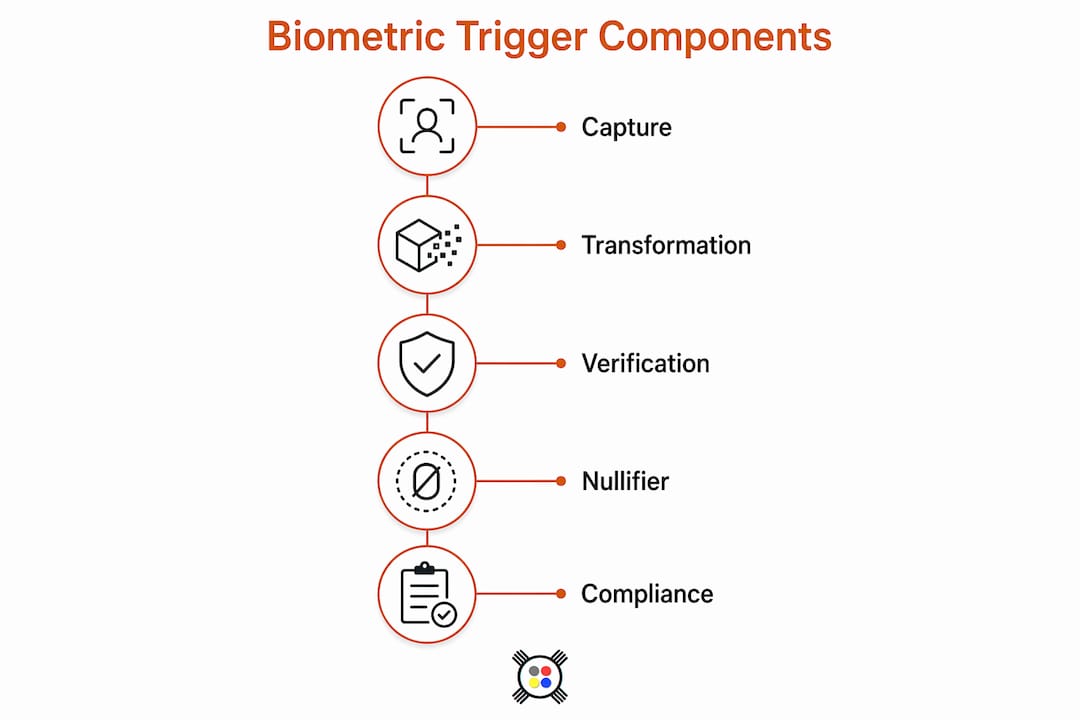
A well-structured biometric trigger follows this sequence:
-
Biometric capture and liveness verification: The client captures the biometric signal (fingerprint, face geometry, or gaze pattern) and passes it through an active liveness check before any proof is generated. This step occurs entirely off-chain.
-
Commitment generation: The client hashes the biometric embedding against a user-specific salt using Poseidon to produce a cryptographic commitment. This commitment, not the biometric, is what the contract ever sees.
-
ZK circuit execution: The Groth16 circuit (compiled via Circom or Noir) takes the raw biometric embedding and the commitment as private inputs, then outputs a proof that the embedding matches the committed value without revealing either.
-
Nullifier derivation: A deterministic nullifier is derived from the biometric embedding combined with an application-specific domain secret. This nullifier is submitted on-chain to prevent double-use of the same proof across sessions or applications.
-
On-chain proof verification: The Groth16 verifier contract checks the proof, validates the nullifier has not been used, and emits the authorization event that triggers downstream contract logic.
-
Multi-signature finalization: For high-value operations, a multi-signature paradigm combining an AI agent signature and the human biometric signature prevents single points of failure even if one signing authority is compromised.
The comparison below illustrates the trade-off between a single-signature and multi-signature biometric trigger design:
| Design Pattern | Failure Mode | Recommended Use Case |
|---|---|---|
| Single biometric signature | Server compromise invalidates all sessions | Low-value, high-frequency interactions |
| Biometric + AI agent multi-sig | Requires compromise of both factors simultaneously | High-value transactions, identity-gated access |
| Biometric + hardware attestation | Tied to specific device; cross-device auth is complex | Device-bound access control, hardware wallets |
The nullifier design deserves particular attention. Deterministic nullifiers derived from biometric embeddings combined with domain secrets prevent cross-application tracking while maintaining Sybil resistance. Without domain separation in the nullifier derivation, a nullifier from one application could be replayed or correlated against another, breaking the unlinkability guarantee that makes ZK-based biometric auth privacy-preserving.
Pro Tip: Store nullifiers in a Merkle tree rather than a flat mapping. Tree-based nullifier storage enables batch verification and dramatically reduces the gas cost of Sybil checks when your user base scales past tens of thousands.
What performance and cost considerations should developers expect?
On-chain biometric verification carries real computational costs that vary significantly by platform and cryptographic method. Developers who ignore these numbers during architecture design routinely discover that their contracts are economically undeployable at scale.
On Solana, Groth16 biometric verification costs approximately 215,000 compute units per verification, as demonstrated in the Dermagraph biometric identity layer deployed in early 2026. Solana’s default compute budget per transaction is 200,000 units, which means a Groth16 verify requires a compute budget extension instruction. This is not a blocker, but it is a deployment detail that catches developers off guard.
On EVM chains, the cost picture changes substantially when hardware precompiles are available. Hardware-grade P-256 verification via the RIP-7212/EIP-7951 precompile lowers costs by approximately 80% compared to traditional ECDSA verification in software. That reduction makes frequent biometric-triggered interactions economically viable for consumer-facing applications.
The table below summarizes the performance profile across verification methods:
| Verification Method | Approximate Cost | Spoofing Resistance |
|---|---|---|
| Software ECDSA (P-256) | Baseline (high gas) | Moderate |
| RIP-7212 precompile (P-256) | ~80% reduction vs. software | High (hardware-backed) |
| Groth16 ZK proof on Solana | ~215k compute units | Very high (ZK + hardware) |
| Groth16 ZK proof on EVM | Variable; depends on verifier contract | Very high (ZK + hardware) |
Key optimization strategies for production deployments include:
-
Minimize on-chain payload: Submit only the proof, nullifier, and public signals. Keep the commitment and domain secret off-chain.
-
Batch verifications: Where the protocol allows multiple users to authenticate in a single block, aggregate proofs using PLONK or recursive SNARKs to amortize fixed verification costs.
-
Cache hardware attestations: For hardware biometrics vs. software implementations, a time-bounded hardware attestation can reduce the frequency of full Groth16 verifications without meaningfully degrading security.
-
Use precompiles on supported chains: Deploying on Arbitrum Stylus or Base Sepolia specifically for the P-256 precompile is a legitimate architectural decision when cost is the primary constraint.
How to ensure security, privacy, and compliance in biometric triggers?
The security surface of a biometric-triggered smart contract spans the client, the network, and the chain. A breach at any layer can compromise the entire authentication guarantee, which is why the design must treat each layer as independently adversarial.
Core security and privacy principles for production systems:
-
Never store raw biometrics on-chain or in contract state. The Groth16 verifier contract verifies the proof without ever accessing raw biometric data, guaranteeing data privacy and preventing leakage. This is the non-negotiable baseline.
-
Use hardware-backed verification methods. Secure Enclaves and FIDO2/WebAuthn offer stronger protection against spoofing and memory scraping compared to software-only methods, particularly against advanced deepfake injection attacks that became prevalent in 2025 and 2026.
-
Implement active liveness detection at the client level. Active liveness detection requiring users to blink, turn their heads, or respond to dynamic prompts is a baseline defense against AI-driven spoofing. This check must occur before the ZK proof is generated, not after.
-
Design nullifiers with domain separation. Application-specific secrets in the nullifier derivation prevent cross-app correlation while preserving Sybil resistance.
-
Use Merkle tree membership proofs for identity sets. Zero-knowledge circuits remove the need to store identity hashes on-chain by proving membership in a Merkle tree of authorized identities, preserving unlinkability across sessions.
-
Adopt multi-signer authentication for critical operations. Multi-signer schemes combining AI analytics and physical biometric confirmation reduce risk even if one factor is compromised.
“The single most dangerous assumption in biometric smart contract design is that the ZK proof layer alone provides sufficient security. Hardware attestation, liveness detection, and nullifier architecture must all be present for the system to resist a well-resourced adversary.”
GDPR and equivalent data protection frameworks treat biometric data as a special category requiring explicit consent and purpose limitation. Because raw biometrics never touch the chain in a correctly designed system, the primary compliance obligation falls on the client-side capture and commitment generation pipeline. Developers should document the data flow from capture to commitment destruction and obtain legal review of that pipeline before production deployment. Biometric encryption patents and related IP considerations also affect which cryptographic commitment schemes are available without licensing exposure.
Pro Tip: Run a threat model specifically against the commitment generation step. If an attacker can substitute a pre-computed commitment at the client before the ZK circuit runs, the entire biometric guarantee collapses. Client-side AI running in a sandboxed environment, as discussed in client-side AI processing, can enforce integrity of this step without a trusted server.
Key takeaways
Secure biometric smart contract triggers require hardware-backed capture, Groth16 ZK proof verification, domain-separated nullifiers, and multi-signature finalization to resist both on-chain and client-side adversaries.
| Point | Details |
|---|---|
| Hardware verification is non-negotiable | Secure Enclaves and FIDO2/WebAuthn prevent memory scraping and deepfake injection that software-only methods cannot stop. |
| ZK proofs keep biometrics off-chain | Groth16 verifier contracts confirm identity without ever accessing raw biometric data, satisfying both security and GDPR requirements. |
| Nullifier design determines privacy | Domain-separated deterministic nullifiers prevent cross-application tracking while maintaining Sybil resistance across sessions. |
| Precompiles cut costs by ~80% | RIP-7212/EIP-7951 on Arbitrum Stylus and Base Sepolia reduce P-256 verification costs enough to make frequent biometric triggers economically viable. |
| Multi-signature eliminates single points of failure | Combining AI agent signatures with biometric proofs means no single compromised factor can authorize a fraudulent transaction. |
Why hardware-first is the only defensible biometric trigger architecture
The field has spent two years debating whether software-based biometric verification is “good enough” for smart contract triggers. My position is that it is not, and the threat model makes this clear. A software-only biometric pipeline running in a standard application process is vulnerable to memory scraping, process injection, and increasingly sophisticated deepfake video feeds that fool optical liveness checks. Hardware enclaves change the attack surface fundamentally because the signing key never leaves protected memory, regardless of what the surrounding OS does.
What I find underappreciated in most developer discussions is the modularity requirement. Developers tend to build monolithic authentication contracts that bundle identity anchoring, proof verification, nullifier storage, and access control into a single contract. When the ZK circuit needs upgrading (and it will, as proof systems evolve), that monolithic design forces a full contract migration. Separating these concerns into distinct, upgradeable modules is not over-engineering. It is the only architecture that survives the pace of change in this space.
The frontier challenge I am watching most closely is cross-device biometric authentication. Today, hardware-backed biometric triggers are inherently device-bound because the P-256 signing key lives in a specific Secure Enclave. Decentralized biometric registries that allow a user to register multiple hardware attestations against a single on-chain identity anchor, similar to what decentralized identity startups are building in 2026, will be the mechanism that makes this architecture practical for everyday users rather than just high-security environments.
— Joshua
Explore Jett Optics for biometric authentication and spatial encryption
Jett Optics builds authentication systems where human biometric signals, including gaze patterns encoded as AGT gaze tensors, function as cryptographic keys for on-chain and encrypted communication protocols. The platform’s spatial encryption and gaze verification layer integrates directly with Web3 and DePIN networks, providing a post-quantum-resistant biometric authentication path that complements the Groth16 and P-256 verification architectures described in this guide. For developers building biometric-triggered contracts who need a production-grade optical authentication layer, Jett Optics’ post-quantum spatial encryption solutions offer both developer documentation and integration references for decentralized identity systems.
FAQ
What is a biometric trigger in a smart contract?
A biometric trigger is an on-chain authorization condition that executes only when a valid cryptographic proof of biometric presence is submitted. The contract verifies a Groth16 ZK proof or P-256 hardware attestation rather than a traditional private key signature.
How do zero-knowledge proofs protect biometric data in smart contracts?
The Groth16 verifier contract confirms that a user’s biometric embedding matches a previously committed value without ever receiving the raw biometric data. This means the chain learns only that authentication succeeded, not what the biometric looks like.
What is a nullifier in biometric smart contract design?
A nullifier is a deterministic token derived from the biometric embedding and an application-specific secret. It is submitted on-chain with each proof to prevent the same biometric proof from being reused across sessions or applications while preserving user unlinkability.
Which blockchain platforms best support biometric trigger contracts?
Arbitrum Stylus with the RIP-7212 precompile and Base Sepolia with EIP-7951 offer the most cost-effective P-256 verification for EVM developers. Solana supports Groth16 verification via BPF programs at approximately 215,000 compute units per proof.
How does active liveness detection fit into the biometric trigger pipeline?
Liveness detection runs at the client level before ZK proof generation, requiring the user to respond to dynamic prompts that AI-generated video feeds cannot replicate in real time. It is a prerequisite step, not a replacement for cryptographic proof verification.