
TL;DR:
- Biometric tools for insider threats enable continuous identity verification by analyzing behavioral and physiological patterns. They enhance detection accuracy when integrated with existing risk management systems, but require careful policy, legal compliance, and baseline calibration. Combining multimodal biometrics with AI-driven analysis improves identification of malicious insiders while minimizing false positives.
Insider threats are among the hardest security problems to solve precisely because the attacker already has authorized access. Perimeter defenses, firewalls, and endpoint controls were built to stop outsiders, and they do that reasonably well. They were never designed to catch a privileged employee exfiltrating data at 11 PM or a contractor slowly escalating permissions over weeks. Insider threat prevention biometric tools change that calculus by binding authentication and behavioral monitoring directly to the human body and its patterns, making identity continuous rather than a one-time login event. This guide covers what security professionals and IT managers need to deploy and optimize these tools effectively.
Table of Contents
-
Insider threat prevention biometric tools: the prerequisites
-
Biometric authentication methods for insider threat contexts
-
Integrating biometrics into insider risk management workflows
Key Takeaways
| Point | Details |
|---|---|
| Traditional controls are insufficient | Background checks and perimeter security cannot address continuous behavioral risk from authorized insiders. |
| Multimodal biometrics outperform single-factor | Combining behavioral, physiological, and gaze-based biometrics reduces false positives and spoofing risk substantially. |
| Integration with UEBA and IRM is critical | Biometric anomalies must be correlated with policy-violation alerts to produce high-confidence insider threat signals. |
| Compliance and privacy must precede deployment | Legal frameworks, employee consent, and data minimization policies must be defined before any biometric tool goes live. |
| Continuous tuning drives long-term accuracy | Behavior baselines drift over time; scheduled recalibration and AI-assisted risk scoring keep detection rates high. |
Insider threat prevention biometric tools: the prerequisites
Before you configure a single sensor or enroll a single fingerprint template, your organization needs foundational work completed at the policy, infrastructure, and legal levels. Skipping this phase is the single most common reason biometric deployments underdeliver.
On the policy and culture side, leadership must define exactly which insider threat scenarios the biometric program is meant to address. Are you prioritizing credential misuse by privileged administrators? Sensitive data exfiltration by departing employees? Lateral movement by compromised accounts? Each scenario maps to a different biometric control, and trying to solve all of them simultaneously with a single undifferentiated deployment creates noise rather than signal. Continuous behavioral monitoring must be an explicit part of your insider threat policy, not an afterthought appended to a hiring-stage background check.
The technical infrastructure requirements are just as specific:
-
Directory and identity integration: Your biometric tools must feed into or pull from a unified identity store. Active Directory, LDAP, or a cloud-based IdP like Entra ID are common anchors.
-
Network visibility: Behavioral biometric systems need access to telemetry from endpoints, authentication logs, and network activity. Without that correlation layer, biometric anomalies exist in a vacuum.
-
Compute and storage capacity: Continuous biometric analysis, especially behavioral biometrics running on endpoint agents, generates significant telemetry volume. Plan your storage and processing headroom before enrollment begins.
-
Existing UEBA and IRM tooling: Identify what insider risk management tools you already operate and confirm that your chosen biometric solution has documented integration paths with them.
Compliance and legal considerations deserve their own workstream. Biometric data is explicitly regulated under BIPA in Illinois, GDPR in EU-scoped deployments, and sector-specific frameworks like HIPAA and NISPOM. Regulated sectors now require CI-based risk scoring rather than generic keyword flagging for compliance. Define data retention limits, consent workflows, and a breach notification process specific to biometric template data before you enroll anyone.
Pro Tip: Run a legal and HR review of your biometric data handling policy in parallel with vendor evaluation, not after contract signature. Retrofitting consent frameworks around an already-deployed system is far more disruptive than building them in from the start.
Biometric authentication methods for insider threat contexts
Not all biometric authentication methods carry equal weight when the adversary is an authorized insider with legitimate credentials. Understanding the tradeoffs is what separates a functional deployment from one that generates a backlog of uninvestigated alerts.
Physiological biometrics
Fingerprint scanning remains the highest-adoption biometric in enterprise environments because the hardware is mature, enrollment is fast, and matching accuracy at low false-accept rates is well-established. For insider threat contexts, fingerprint scanning is most useful at privileged workstation access points and physical security checkpoints. Its limitation is that it only verifies identity at a single authentication moment, not continuously.
Facial recognition adds a dimension that fingerprint alone cannot provide: the ability to confirm that the enrolled user is still the person at the keyboard throughout a session, not just at login. Modern systems use 3D depth mapping and infrared to resist photograph-based spoofing. Combined with liveness detection, they become significantly harder to bypass.

Voice recognition applies well to call center environments, remote access scenarios, and any context where visual biometrics are impractical. Voiceprint analysis captures not just the recorded phrase but acoustic micro-patterns tied to physical vocal anatomy, which are difficult to replicate even with audio deepfakes when liveness detection is active.
Behavioral biometrics
This is where insider threat prevention gains its most powerful continuous monitoring capability. Behavioral biometrics analyze keystroke dynamics, mouse movement patterns, typing cadence, application navigation sequences, and even scroll velocity. These patterns form a personal signature that remains consistent for a given individual under normal conditions. Significant deviation from that baseline, especially correlated with access to sensitive resources, produces a risk signal without requiring any active authentication prompt.
Modern biometric authentication using FIDO2/WebAuthn combined with liveness detection significantly reduces both spoofing risk and credential-based attack vectors. The practical comparison looks like this:
| Method | Continuous monitoring | Spoofing resistance | Privacy footprint | Insider threat relevance |
|---|---|---|---|---|
| Fingerprint | No | Medium | Low | Medium |
| Facial recognition | Yes (with session monitoring) | High (with liveness) | Medium | High |
| Voice recognition | No | Medium | Low | Medium |
| Behavioral biometrics | Yes (continuous) | High | Medium | Very high |
| Gaze-based biometrics | Yes (ambient) | Very high | Low | Very high |
Pro Tip: Deploy behavioral biometrics first on your highest-privilege accounts and service accounts before rolling out to general users. Privileged access misuse produces the highest-severity insider incidents, and that population gives you the fastest signal-to-noise improvement.
The biometric security industry in 2026 increasingly favors multimodal approaches, where two or more biometric signals are fused before a risk decision is made. A single modality can be spoofed or produce false positives under stress or environmental variation. A fused signal from behavioral keystroke analysis plus facial liveness verification is substantially harder to defeat.
Integrating biometrics into insider risk management workflows
Deploying a biometric sensor or agent is the easy part. Integrating it into a functioning insider risk management workflow that produces actionable, investigated alerts is where the real engineering work lives.
-
Conduct a risk-tiered asset inventory. Map your most sensitive data repositories, privileged accounts, and critical systems. These become the enforcement perimeters where biometric controls are applied first. Sequence your deployment roadmap by risk tier, not by organizational unit.
-
Define behavioral baselines per user population. Behavioral biometric systems require a baseline collection period, typically 14 to 30 days, during which normal patterns are established. Segment this by role, shift, and access pattern. A SOC analyst’s keystroke dynamics and application usage will look very different from a finance team member’s, and applying a single organizational baseline produces high false-positive rates.
-
Select tools with documented UEBA and IRM integration. Your biometric platform should have native connectors or published APIs for your existing SIEM, UEBA, or IRM system. Correlating biometric anomalies with policy-violation alerts from tools like Microsoft Purview IRM significantly raises confidence in alert triage.
-
Run a contained pilot with a high-risk population. Select a group of 25 to 50 users from privileged or high-sensitivity roles. Run the biometric system in monitor-only mode for 30 days before enabling any automated response or escalation. Document false-positive rates and tune thresholds before broader rollout.
-
Build an escalation and investigation workflow. A biometric alert is an input to a human investigation process, not a replacement for it. Define who receives alerts, what enrichment steps are taken before escalation, and what the response playbook looks like for a confirmed insider threat versus a false positive.
-
Conduct role-specific training for both users and security administrators. Users need to understand what is being monitored, why, and what their rights are. Administrators need hands-on training with the biometric console, alert triage workflows, and baseline recalibration procedures.
Pro Tip: Build your biometric alert thresholds conservatively at first. A high false-positive rate in the first 60 days kills analyst trust in the system faster than almost anything else. It is better to catch 70% of true positives with high confidence than to generate 200 daily alerts that analysts stop reading.
Understanding employee intent through AI-driven tone and sentiment analysis, layered on top of biometric signals, provides early risk indicators that pure activity monitoring misses entirely. When biometric anomalies coincide with communication sentiment shifts, the combined signal is far more actionable.
Best practices and common deployment challenges
Even well-planned biometric insider threat programs encounter predictable friction points. Knowing them in advance lets you address them structurally rather than reactively.
-
Alert fatigue management: Mapping behavioral anomalies to specific policy violations before surfacing them to analysts reduces noise dramatically. Configure your biometric system to suppress alerts below a composite risk score threshold and only escalate when multiple independent signals converge.
-
Privacy and compliance maintenance: Biometric templates are regulated as sensitive personal data in most jurisdictions. Store templates as encrypted, irreversible hashes, not raw biometric captures. Conduct quarterly access audits on who can query or export biometric data within your system.
-
Spoofing and bypass resistance: Review your vendor’s anti-spoofing architecture explicitly. Optical biometric spoofing defenses are advancing rapidly, but older fingerprint and 2D facial systems remain vulnerable to presentation attacks. Require liveness detection as a non-negotiable capability in vendor selection.
-
Baseline drift and recalibration: Employee behavior changes legitimately over time due to role changes, new tools, or workflow adjustments. Schedule baseline recalibration every 60 to 90 days for active users and immediately following significant role or access changes.
-
Human and AI coordination: Combining human expertise with AI-driven monitoring and external threat intelligence produces detection accuracy that neither achieves alone. Assign a named analyst to own each escalated biometric alert through to resolution.
Pro Tip: Create a “legitimate anomaly” tagging workflow. When an analyst determines that a biometric alert was caused by a real but non-malicious behavioral change, such as an employee recovering from an injury affecting typing dynamics, tag it and feed that context back into the baseline model. This closes the feedback loop that keeps your false-positive rate declining over time.
Measuring effectiveness of your biometric program
A biometric insider threat program without defined metrics is a cost center that security leadership will eventually defund. Structure your measurement framework around outcomes, not activity.
| KPI | Target benchmark | Measurement method |
|---|---|---|
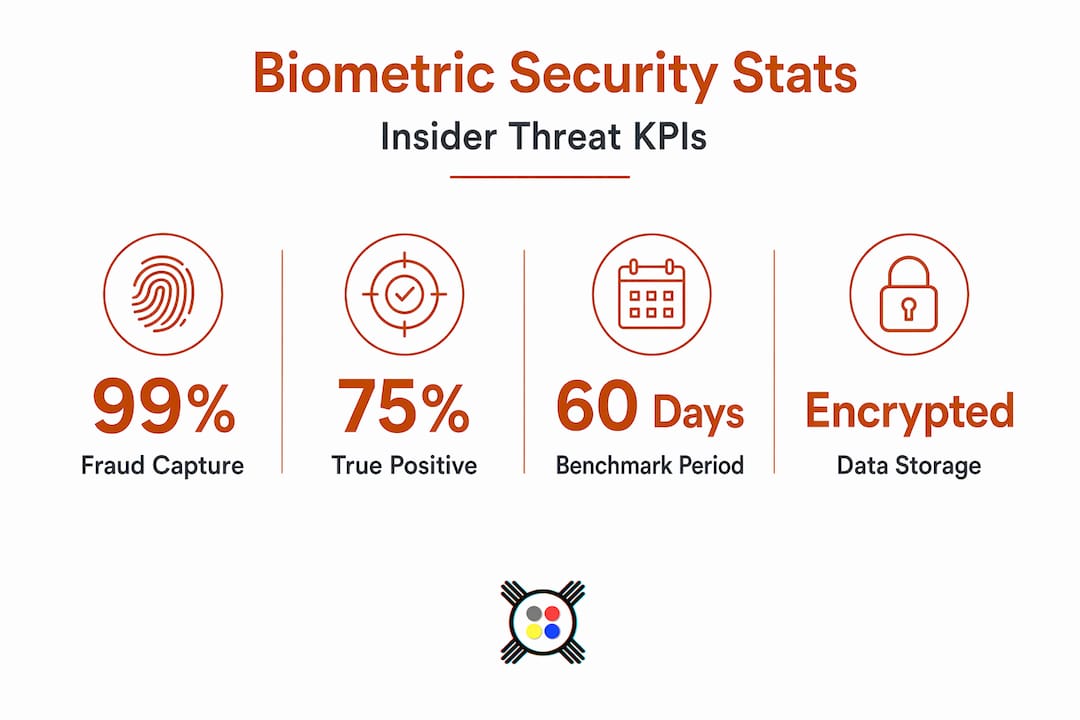
| True positive rate | Greater than 75% of escalated alerts confirmed | Analyst case closure review |
| False positive rate | Less than 15% of total alerts | Weekly alert audit |
| Mean time to detect (MTTD) | Under 4 hours for high-severity anomalies | SIEM timestamp correlation |
| Biometric enrollment coverage | Greater than 95% of privileged accounts | Identity governance report |
| Baseline recalibration adherence | 100% of active users recalibrated within 90 days | System audit log |
AI-enabled identity platforms have demonstrated up to 99% fraud capture rates through real-time risk assessment, which sets a credible long-term benchmark for mature biometric insider threat programs. You will not achieve that figure in year one. The realistic trajectory is progressive: lower false-positive rates, higher detection confidence, and faster mean time to investigate as your behavioral baselines mature and your correlation rules become more precise.
Reviewing biometric encryption patents alongside your vendor roadmap helps you anticipate which cryptographic protections your biometric templates will require as post-quantum threats materialize.
My take on biometrics and insider threats
I’ve spent considerable time working at the intersection of behavioral analytics and identity security, and the pattern I keep seeing is organizations that deploy biometric tools for compliance optics rather than actual threat detection. They enroll fingerprints at the door, check a compliance box, and consider the problem addressed. That approach misses the entire point.
What I’ve found is that the most consequential insider threats unfold over weeks or months through behavioral drift that no single-point authentication captures. The value of continuous behavioral biometrics is not catching someone the moment they go rogue. It’s building a statistical picture of normal that makes the deviation unmistakable when it starts. That requires patience in the baseline collection phase and discipline in the alert tuning phase, two things that are genuinely difficult to sustain under operational pressure.
The other thing I think most organizations underestimate is how much the human investigation layer matters. An insider threat defense program built purely on automated alerts, without trained analysts who understand behavioral context and can conduct investigative interviews, will always have a ceiling on its effectiveness. Biometrics and AI give you speed and scale. Human judgment gives you accuracy. Neither replaces the other.
Where I see this heading is toward ambient, continuous biometric authentication where the authentication event disappears entirely and identity is simply maintained through constant low-friction signal verification. Gaze-based cryptographic authentication, the kind Jett Optics is developing, represents the logical next stage of that progression.
— Joshua
How Jett Optics approaches insider threat biometrics

Jett Optics builds biometric authentication at a layer that most enterprise security platforms have not reached yet. The platform’s core architecture uses Agentive Gaze Tensors (AGT) to transform human gaze and attention patterns into cryptographic keys, creating an authentication signal that is continuous, ambient, and deeply personal. For insider threat prevention, this means identity verification is not a gate at login but a persistent condition of access. Jett Optics’ spatial encryption technology integrates quantum-resistant cryptography with optical biometrics, making template theft or replay attacks computationally infeasible. Security teams looking to move beyond legacy biometric modalities can explore Jett Optics’ gaze verification platform to understand how optical authentication addresses the gaps that fingerprint and facial recognition leave open.
FAQ
What are insider threat prevention biometric tools?
Insider threat prevention biometric tools are authentication and behavioral monitoring systems that use physiological or behavioral biometric signals to continuously verify user identity, detect anomalous access patterns, and flag potential insider threats before data loss or damage occurs.
Which biometric method works best for preventing insider threats?
Behavioral biometrics provide the strongest continuous monitoring capability for insider threat contexts because they analyze ongoing activity patterns rather than a single authentication event. Combining behavioral biometrics with physiological modalities like facial liveness detection produces the most reliable detection accuracy.
How do you reduce false positives in biometric insider threat programs?
Correlating biometric anomalies with policy-violation alerts from IRM and UEBA systems, applying composite risk scoring thresholds, and scheduling regular baseline recalibration collectively reduce false-positive rates to manageable levels.
What compliance requirements affect biometric insider threat tools?
Biometric data is regulated under BIPA, GDPR, HIPAA, and NISPOM depending on jurisdiction and sector. Regulated environments increasingly require CI-based risk scoring and must treat biometric templates as sensitive personal data with defined retention and access controls.
How does AI improve biometric insider threat detection?
AI advances insider threat detection from activity monitoring to intent analysis by processing tone, sentiment, and behavioral telemetry together. Platforms using AI-based risk assessment and social engineering defense workflows alongside biometrics produce earlier, higher-confidence risk signals than rule-based systems alone.