
The promise of optical encryption anchored in human gaze as a cryptographic key is genuinely compelling. When Jett Optics introduced concepts like Agentive Gaze Tensors (AGT), Joule Encryption, and quantum-resistant biometric signatures, the cybersecurity community took notice. Yet a persistent assumption has emerged in technical circles: that optical encryption inherently defeats adversarial spoofing in biometrics. Before building infrastructure decisions or investment theses around that assumption, the field deserves a clear-eyed examination of what the technology actually claims, what public evidence exists, and where the gaps remain.
Table of Contents
Key Takeaways
| Point | Details |
|---|---|
| No verified Jett defeat | There is no public evidence proving Jett Optical Encryption defeats biometric spoofing. |
| Evidence over hype | Always seek quantitative benchmarks and threat model disclosures before adopting biometric security solutions. |
| Optical encryption’s true focus | Modern optical encryption mainly enhances data confidentiality, not direct anti-spoofing defense. |
| Key evaluation criteria | Look for peer review, public attack demos, and published metrics when assessing anti-spoofing claims. |
| Industry’s real trajectory | The future of biometric defense lies in layered, evidence-driven strategies, not unvetted technologies. |
Understanding biometric spoofing risks
To evaluate claims about defeating spoofing, you must first understand what biometric spoofing actually involves at a technical level. Biometric spoofing is the act of presenting a fabricated or manipulated biometric artifact to an authentication system in order to impersonate a legitimate user or bypass verification. The threat is not theoretical.
Common attack vectors include:
-
Print attacks: Static photographs of a face, fingerprint, or iris, printed and held in front of a sensor
-
Replay attacks: Pre-recorded video streams fed back into the camera pipeline, bypassing real-time capture requirements
-
3D artifact attacks: Resin masks or silicone reconstructions designed to fool depth-sensing cameras
-
Deepfake injection: Synthetically generated video or image streams injected directly into the signal pipeline, bypassing the physical sensor entirely
-
Synthetic identity attacks: AI-generated biometric identities that statistically mimic real biometric distributions without corresponding to any real person
Standard defenses in the field focus on liveness detection, which attempts to verify that the biometric sample comes from a physically present, living individual. More advanced defenses incorporate AI-driven forensic analysis, challenge-response protocols, and cryptographic proof-of-liveness schemes. As biometric access controls document, anti-spoofing is typically addressed via liveness detection, though sophisticated attacks including deepfakes and synthetic identities can still bypass even well-designed models.
“The adversarial threat in biometrics is not static. As defenses improve, attacks evolve in parallel, with generative AI dramatically lowering the cost and expertise threshold for producing convincing spoofs.”
The limits of conventional anti-spoofing are real. Liveness detection accuracy degrades under novel attack conditions not represented in training data. Replay defenses can be circumvented by signal injection. This is why any claim of spoofing defeat must be accompanied by specific attack models and quantified results, not general architectural descriptions.
What is Jett Optical Encryption?

Jett Optics has constructed an ecosystem centered on the principle that human gaze patterns can function as a dynamic, continuously generated cryptographic key. The architecture involves several components. OPTX serves as the core optical sensor and processing layer. JETT Auth is the authentication protocol that converts gaze behavior into a verifiable biometric signature. Joule Encryption, more formally the Joule Encryption Temporal Template Auth system, applies time-domain encoding to the biometric signal to generate session-specific cryptographic material.
The workflow is architecturally interesting. A user’s gaze trajectory is captured across a temporal window, quantized into an Agentive Gaze Tensor, and then processed through the Joule Encryption pipeline to produce a biometric signature bound to that session. The resulting signature is designed to be non-replayable because the gaze pattern shifts continuously with attention and intent. This property is theoretically compelling as a foundation for optical spatial encryption approaches that embed identity into the physics of attention itself.
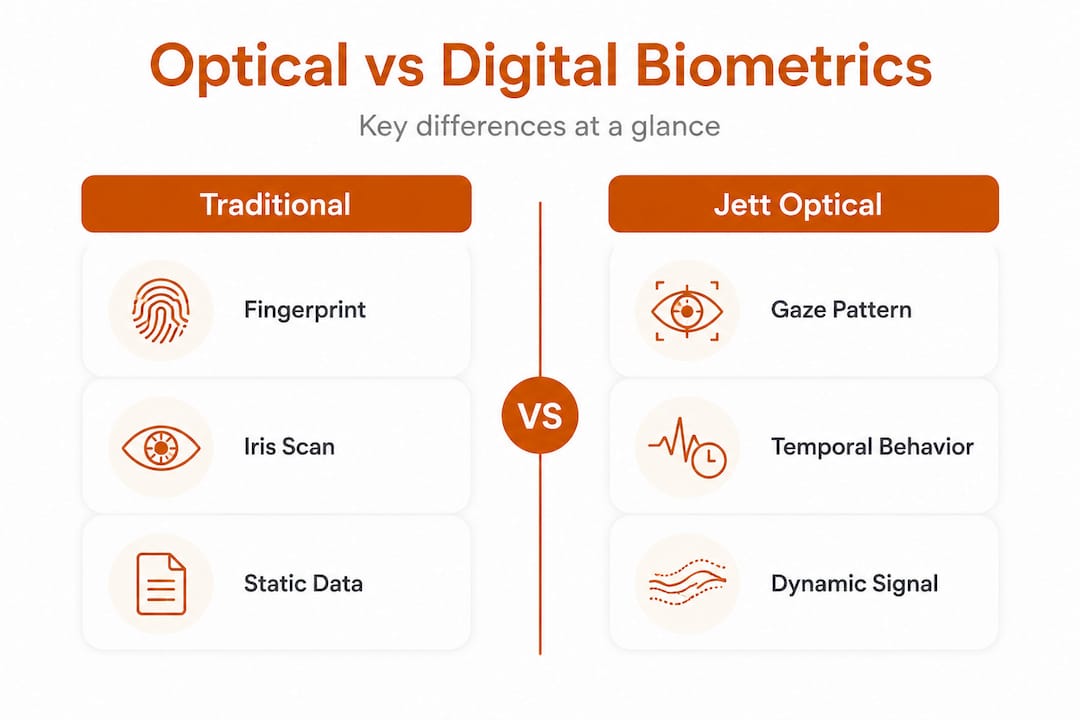
Comparison: Jett Optical Encryption vs. traditional digital biometric encryption
| Attribute | Traditional Digital Biometrics | Jett Optical Encryption (OPTX/JETT Auth) |
|---|---|---|
| Primary signal | Static trait (fingerprint, iris scan) | Dynamic gaze trajectory (temporal pattern) |
| Encryption layer | Software AES/RSA on stored template | Joule Encryption on session gaze tensor |
| Replay resistance | Limited without liveness layer | Architecturally intended by temporal variance |
| Public benchmarks | Mature datasets (LFW, iBeta Level 1/2) | Not publicly disclosed |
| Spoofing attack model | Print, replay, deepfake documented | Not publicly specified |
| Peer-reviewed validation | Available for multiple modalities | Not located in public literature |
However, as the JETT Auth GitHub repository documents, the public-facing README describes the biometric signature workflow and mentions Joule Encryption Temporal Template Auth, but does not provide biometric attack benchmark results or make claims about defeating adversarial spoofing specifically. The architecture is described; the adversarial validation is not.
Pro Tip: When evaluating any next-gen authentication stack, request the specific attack model document separately from the architecture white paper. Architectural novelty and adversarial robustness are different properties, and conflating them is one of the most common and costly mistakes in security procurement.
The distinction matters because JETT authentication protocols may serve entirely legitimate and valuable purposes such as quantum-resistant key generation, decentralized identity binding, and Web3-compatible authentication without those purposes requiring proven spoofing defeat. Overstating the claims does not serve the technology.
Separating claims from evidence
The cybersecurity research community uses specific, quantified metrics to evaluate anti-spoofing systems. APCER (Attack Presentation Classification Error Rate) measures how often spoofing attacks succeed. BPCER (Bona Fide Presentation Classification Error Rate) measures how often legitimate users are falsely rejected. FAR (False Acceptance Rate) and FRR (False Rejection Rate) round out the standard reporting framework. Any system claiming meaningful spoofing resistance should report these figures under clearly specified attack conditions.
Standard anti-spoofing evidence requirements
| Evidence Type | What It Tells You | Status for Jett Optical Encryption |
|---|---|---|
| Published APCER/BPCER | Attack success and false rejection rates | Not located publicly |
| Attack model document | Which attacks were tested | Not publicly specified |
| Peer-reviewed paper | Independent validation of results | Not found |
| Public red-team report | Adversarial testing by third party | Not disclosed |
| Dataset provenance | Training/test data for liveness model | Not documented publicly |
A critical finding, confirmed through review of the Jett Optics GitHub organization, is that no reputable source exists stating that a system called “Jett Optical Encryption” specifically defeats adversarial spoofing in biometrics. That is not a condemnation. It is an accurate characterization of the current public evidence base.
The deeper architectural distinction also matters here. Optical encryption, as a technical discipline, primarily addresses confidentiality at the transmission or storage layer. It protects data from being intercepted or read by unauthorized parties during communication. This is distinct from the liveness and spoof-detection problem, which requires the system to verify that the biometric input itself is genuine and not a fabricated artifact.
Research on secure optical transmission including spatiotemporal noise chaffing and high-dimensional mode encoding demonstrates this clearly: these methods enhance confidentiality and physical-layer security against eavesdropping, but they do not document or address biometric adversarial spoofing defeat. The two problem domains are architecturally adjacent but not equivalent.
Key distinctions to internalize:
-
Encryption protects data in transit and at rest from unauthorized access
-
Anti-spoofing protects the authentication input from fabrication or manipulation
-
A system can be cryptographically strong while remaining vulnerable to presentation attacks at the biometric capture stage
-
Temporal variance in gaze patterns may reduce replay risk, but it does not automatically defeat generative AI synthesis or direct signal injection
Optical encryption in the wider context
Situating Jett Optics within the broader landscape of optical and biometric security research clarifies what the technology represents and what it does not yet demonstrate. Modern optical encryption research spans a wide range of confidentiality-focused techniques. High-dimensional mode encoding, physical unclonable functions (PUFs), and spatiotemporal noise chaffing all represent real advances in securing the physical layer of optical communication. None of them, as recent optical security research confirms, directly document biometric adversarial spoofing defeat.
Current validated anti-spoofing research in biometrics follows a distinct trajectory. The field is advancing through:
-
Multi-modal liveness fusion: Combining depth sensing, infrared imaging, and behavioral micro-pattern analysis to increase the cost of successful spoofing
-
Challenge-response biometrics: Issuing unpredictable challenges (gaze direction commands, micro-expression prompts) to defeat pre-recorded or synthetic inputs
-
Cryptographic liveness binding: Generating cryptographic proofs that encode the liveness evidence itself, so that the authentication token cannot be separated from proof of genuine presence
-
Adversarial training pipelines: Training detection models on continuously updated adversarial samples generated by state-of-the-art synthesis models
A recent scalable privacy-preserving biometric authentication preprint from IACR addresses provable security against biometric data breaches at the protocol level, which is a meaningful contribution to the field, though it is not specific to Jett Optical Encryption and does not constitute an adversarial spoofing liveness bypass benchmark.
“Provable security against data breaches and provable security against adversarial presentation attacks are separate formal guarantees. Conflating them is technically imprecise and practically dangerous in high-stakes authentication environments.”
Pro Tip: When reviewing biometric security research, specifically distinguish between papers that address template security (protecting stored biometric data from theft) and papers that address presentation attack detection (defeating spoofing at the sensor). Many papers address the former; far fewer rigorously address the latter under adaptive adversary assumptions.
For investors, engineering leads, and security architects evaluating optical biometric systems, three requirements should be non-negotiable: a detailed threat model specifying which attack categories were considered, quantitative benchmark results under those conditions, and disclosure of public demos or independent red-team validation.
What to demand from next-gen biometric security
The emergence of optical biometric systems like the OPTX/JETT Auth ecosystem signals a genuinely important direction in authentication research. Dynamic, attention-based biometric signals with quantum-resistant encryption characteristics are architecturally novel. But novelty is not security proof. Any evaluator or decision-maker in this space must hold the technology to the same evidentiary standards applied to mature biometric modalities.
As biometric cybersecurity frameworks make clear, for cybersecurity professionals, AI developers, and investors, any headline claiming spoofing defeat should be treated as unverified until you can obtain the specific threat model, the spoofing capabilities evaluated (print attacks, replay, deepfakes, presentation attacks, AI synthesis), and quantitative results including APCER/BPCER, FAR/FRR, and attack success rate under adaptive adversaries. None of these quantitative anti-spoofing elements were surfaced in publicly available Jett Optics documentation at the time of this analysis.
A practical evaluation checklist for any biometric anti-spoofing claim:
-
Threat model disclosure: Which specific attack types were tested? Under what conditions?
-
Quantitative benchmarks: APCER, BPCER, FAR, FRR under specified attack scenarios
-
Adaptive adversary assumption: Were the spoofing models aware of the defense mechanism?
-
Independent validation: Third-party or peer-reviewed confirmation of results
-
Dataset transparency: What training and test data was used for any liveness detection layer?
-
Signal injection testing: Was resistance to direct pipeline injection (bypassing the physical sensor) evaluated?
-
Generative AI attack coverage: Were synthetic gaze trajectories produced by generative models used as test stimuli?
Pro Tip: The most critical question to ask any biometric vendor is whether their anti-spoofing was validated under white-box conditions where the attacker knows the defense. Systems that only publish black-box results may be significantly weaker than their benchmark numbers suggest when faced with informed adversaries.
For critical infrastructure, financial authentication, or decentralized identity applications, this evidentiary rigor is not optional. The cost of a false acceptance under adversarial conditions in these contexts is not a user experience issue. It is a systemic security failure.
Why evidence, not headlines, should guide your trust in biometric security
From a position of deep engagement with both cryptographic theory and applied biometric system design, the recurring pattern in the field is instructive. Technologies that emerge with strong architectural novelty consistently face a multi-year gap between initial publication and the accumulation of adversarial validation sufficient to support high-stakes deployment decisions.
Gaze-based authentication is architecturally interesting precisely because it incorporates behavioral continuity, temporal variance, and attentional dynamics that static biometric modalities lack. These properties may offer genuine advantages against certain replay and synthesis attacks. That is a legitimate research hypothesis worth rigorous testing.
But the gap between “architecturally plausible advantage” and “demonstrated spoofing defeat under adversarial conditions” is where many technologies stall, and where organizations that move too quickly pay the highest price. The history of biometric security is littered with systems that were bypassed at scale after deployment because attack models were assumed rather than specified and tested.
The most valuable posture for cybersecurity professionals and technical investors evaluating Jett Optics or any analogous optical biometric system is calibrated optimism: acknowledge the architectural innovation, identify the specific hypotheses about spoofing resistance, and insist on the experimental evidence before trusting the headline. This is not skepticism for its own sake. It is the professional standard that separates security engineering from security theater.
Discover cutting-edge optical encryption with Jett Optics
Jett Optics is actively building at the frontier of optical biometric authentication, combining gaze-derived cryptographic keys with quantum-resistant encryption and blockchain-compatible identity protocols. If you’re evaluating post-quantum secure authentication architectures or researching spatial cryptography for decentralized environments, the resources and platform documentation available directly from the team are worth your time.
Visit the Jett Optics platform to access the latest technical documentation, protocol architecture overviews, and information on their DePIN-compatible identity systems. For a deeper technical dive into the core encryption methodology, their dedicated resource on optical spatial encryption provides context on how the OPTX ecosystem approaches physical-layer and cryptographic-layer security simultaneously. As the field matures and adversarial benchmarks become available, Jett Optics represents a technology trajectory worth tracking closely.
Frequently asked questions
What is adversarial spoofing in biometrics?
Adversarial spoofing in biometrics involves attackers using fake physical or digital traits to deceive authentication systems, including photos, deepfakes, or synthetically generated biometric signals. Liveness detection and related defenses represent the standard technical response, though sophisticated attacks continue to challenge even advanced models.
Does Jett Optical Encryption prevent all biometric spoofing attacks?
No public evidence or published benchmark confirms that Jett Optical Encryption defeats all forms of biometric spoofing. A review of the Jett Optics GitHub organization confirms no reputable source was found making that specific claim with supporting adversarial test results.
How is optical encryption different from traditional biometrics security?
Optical encryption primarily addresses physical-layer security by protecting data confidentiality during transmission, rather than providing direct defense against liveness or presentation attacks, which require dedicated anti-spoofing protocols.
What proof should I ask for before trusting a biometric anti-spoofing claim?
Demand published threat models, quantitative APCER/BPCER and FAR/FRR results under specified attack conditions, evidence of adaptive adversary testing, and independent peer-reviewed or third-party validation before trusting any anti-spoofing claim.
Are there alternative approaches to improving biometric security?
Yes, active research tracks include liveness detection fusion, cryptographic proof-of-liveness protocols, and scalable privacy-preserving authentication with provable security guarantees against biometric data breaches, each addressing different layers of the threat model.