

Implementing decentralized identity systems that allow secure, standards-based credentialing without vendor lock-in is still a complex challenge for most organizations. Many platforms either require heavy engineering resources to deploy, lack proven integration with critical enterprise infrastructure, or restrict credential portability through proprietary formats. This comparison reviews open protocol support, integration options, and real-world use cases among top decentralized identity vendors so you can select a platform that genuinely supports your privacy, compliance, and customization needs.
Table of Contents
walt.id
At a Glance
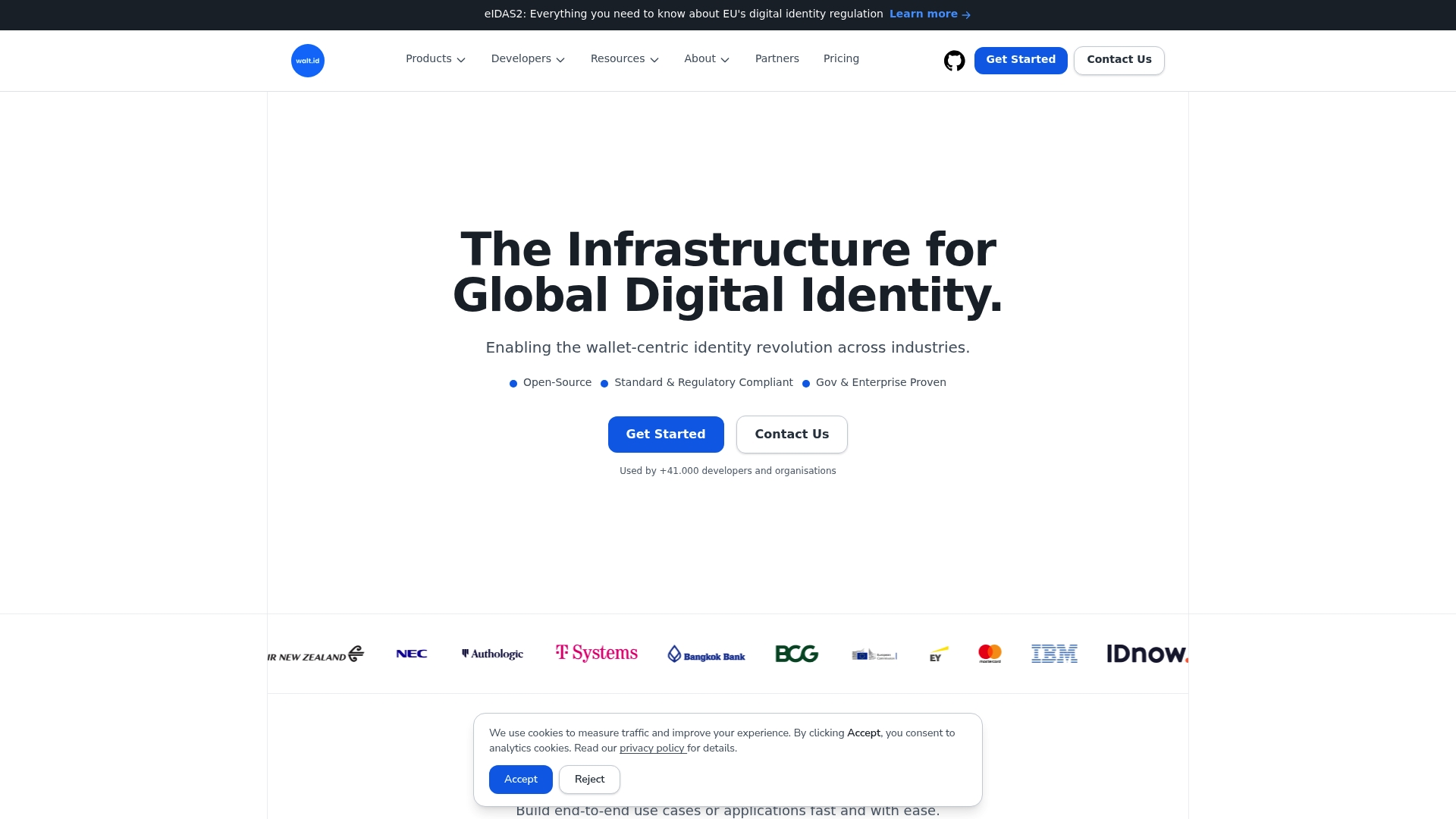
The vendor advertises more than 41,000 developers and organizations using its open source identity stack, a signal that the project has momentum beyond niche experiments. That figure comes from the company and is self reported.
Core Features
-
Open-source infrastructure offering building blocks for issuing, storing, and verifying digital credentials across wallets and ecosystems.
-
Standards support including W3C VC, SD-JWT, and ISO mDL for regulatory alignment and cross-border interoperability.
-
Support for multiple crypto algorithms such as ed25519, rsa, and secp256k1 plus deployment options for on premises, cloud, or SaaS.
-
Compatibility layers and tooling to integrate with IAM and KMS systems so you can plug into existing identity stacks.
Key Differentiator
walt.id focuses on a standards-driven, regulatory aligned, open source stack aimed at governments and enterprises that need wallet centric identity infrastructure. That emphasis makes it a different choice than Jett Optics, which targets optical and biometric cryptography rather than broad credential issuance and wallet interoperability.
Pros
-
Build or scale identity infrastructure with both community and enterprise stacks, so teams can prototype with no license cost then move to paid support if needed.
-
Standards alignment reduces friction with eIDAS2 and other regulatory regimes, which helps when governments or banks are stakeholders.
-
Flexible deployment models let you choose self managed on premises, cloud hosted, or a SaaS path depending on operational constraints.
-
Strong integration ecosystem with major IAM and KMS vendors eases adoption inside existing security architectures.
-
The emphasis on interoperability makes cross border verification and multi wallet support practical rather than experimental.
Cons
-
Public, independent reviews are limited, so outside validation of operational maturity and performance is sparse.
-
The platform’s technical surface is broad; deploying and customizing the stack typically requires experienced developers and identity engineers.
-
That engineering requirement raises the total cost of ownership for teams without in house infrastructure skills.
When It May Not Fit
If you need a turnkey hosted identity product with minimal customization and hands off operations, walt.id’s open source and self managed model will feel heavy. Small teams without engineering capacity will struggle to keep up with upgrades, key management, and protocol choices.
Notable Integrations
-
AWS KMS
-
Azure Key Vault
-
HashiCorp Vault
-
IDnow
-
Microsoft Entra
-
Oracle Cloud KMS
Who It’s For
Developers, enterprises, and government agencies building wallet centric identity platforms that must follow formal standards and integrate with existing IAM and key management stacks. Best for teams that plan to operate or heavily customize the infrastructure.
Real World Use Case
According to the vendor, a government in Thailand used walt.id to build a national ID platform for more than 20 million citizens, digitizing credential issuance and verification. That example shows the stack can support large scale, standards aligned rollouts when backed by implementation teams.
Pricing
Not applicable — informational only. The project offers community open source stacks for self management and enterprise options for supported deployments, with commercial terms agreed directly with vendors.
Website: https://walt.id
Indicio
At a Glance
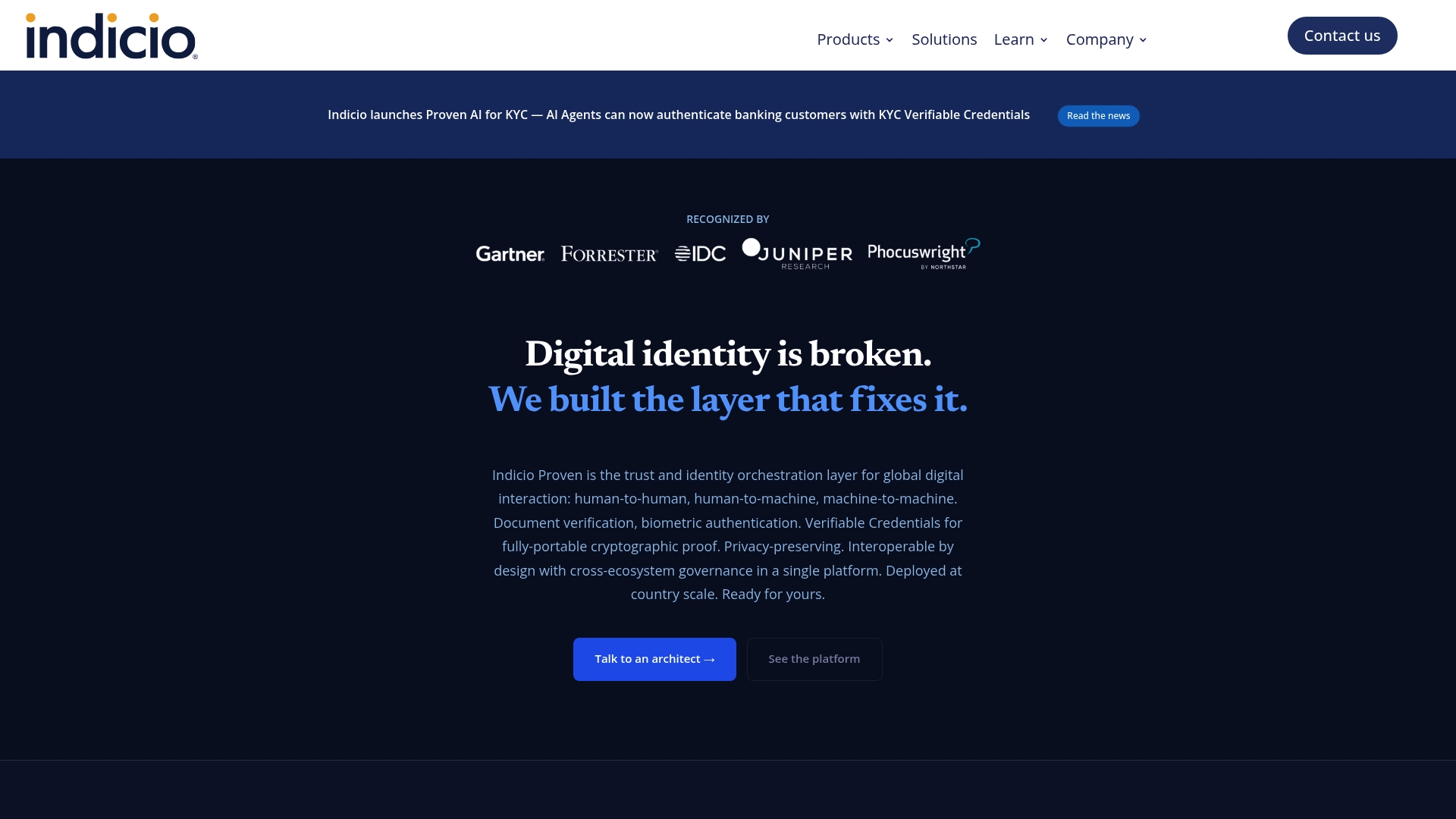
Standards-native stack supporting W3C Verifiable Credentials, AnonCreds, ISO, and ICAO Digital Travel Credentials from a single implementation. The platform is built to run at country scale for borders and enterprise identity, with privacy-preserving biometric bindings and reusable credentials.
Core Features
Cross-ecosystem trust orchestration that combines document validation, biometric authentication, credential issuance, and verification into one workflow. The architecture supports EUDI Wallet, eIDAS 2.0 flows, and DIDComm protocols for message exchange.
High-volume, scalable components handle large transaction loads and are designed for national border systems and enterprise deployments. The biometric layer cryptographically binds biometric checks to devices and credentials to reduce replay and deepfake risk.
Key Differentiator
Indicio brings multiple standards and formats into a single interoperable implementation so you can issue and verify credentials across systems without building separate adapters. That approach targets borderless trust and privacy while reducing integration work for governments and large institutions.
Pros
-
Wide protocol support from one platform lowers integration work. You can issue W3C, AnonCreds, and ICAO formats without separate stacks.
-
Designed for scale. The platform targets country-scale use cases and large enterprise throughput which matters for border and national ID projects.
-
Vendor-agnostic document and biometric layers let you reuse existing scanners and biometric providers rather than rip and replace hardware.
-
The biometric design minimizes central biometric storage and uses cryptographic binding to reduce exposure of raw biometric templates.
-
According to the company, Indicio has been recognized by industry leaders and analysts like Gartner for its approach to digital identity and AI integrity.
Cons
-
The standards-first architecture adds complexity. Organizations without protocol experience will need dedicated technical resources for deployment and governance.
-
Some buyer scenarios that want simple, point-in-time verification rather than reusable credentials may find the platform more elaborate than necessary.
-
Support for very new or niche credential formats depends on emerging standards and may lag until formats stabilize.
Who It’s For
Government agencies, border control authorities, banks, and large enterprises that need interoperable, privacy-focused credentialing at scale. Best fit if you operate across jurisdictions or need multi-format issuance and long lived credentials.
Real World Use Case
A country deploys nationwide digital travel credentials that cryptographically verify a traveler across checkpoints. The result reduces manual checks and speeds throughput while keeping biometric templates off central servers through device binding.
Pricing
Not applicable. The product data is informational only and does not include public pricing. Expect enterprise procurement models for national or large scale deployments and custom pricing tied to scope and support.
Website: https://indicio.tech
Dentity
At a Glance
Dentity’s marketing materials state it integrates with authoritative data sources, including Facebook Marketplace and the National Notary Association — a signal-oriented claim that suggests enterprise adoption beyond hobbyist pilots.
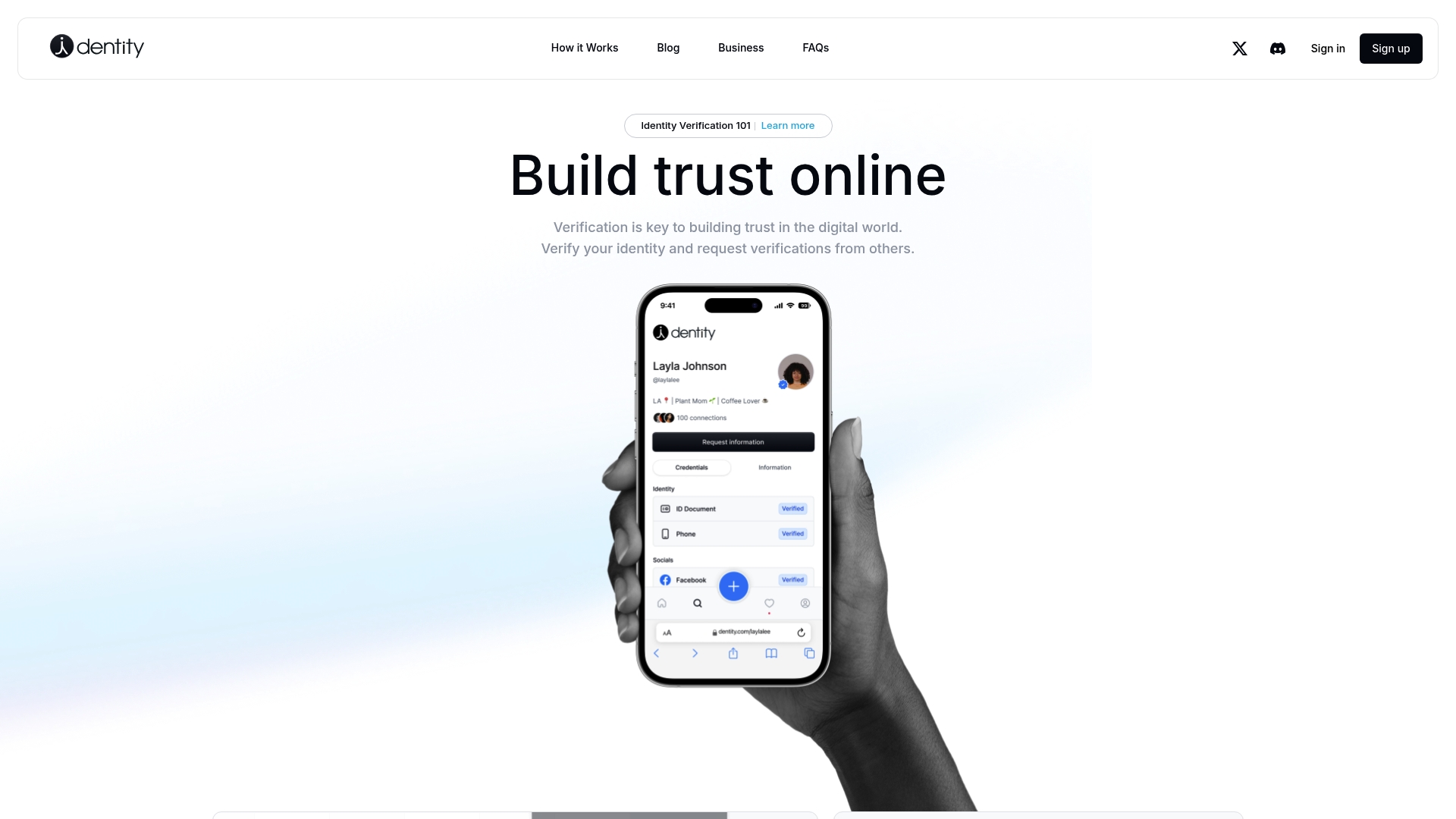
The product centers on reusable Verifiable Credentials and desktop access for identity verification, with an emphasis on privacy and user control.
Core Features
-
ID verification via government documents and selfies that ties a biometric check to a claimed identity.
-
Setup and display of verified profiles so users can present a stable identity across services.
-
Request and share verified information with granular user consent for each disclosure.
-
Add and manage digital credentials with cryptographic safeguards for private key control.
-
Standards-based Verifiable Credentials for cross-platform reuse and interoperability.
Key Differentiator
Dentity positions itself around open identity standards and cryptographic credentialing rather than proprietary silos. The platform’s focus on reusable verifiable credentials helps organizations avoid vendor lock-in and supports credential portability across services that implement the same standards.
That design makes it easier for developers and IT teams to map Dentity credentials into existing onboarding flows without custom serializer logic.
Pros
-
Easy onboarding and a clean interface reduce support load for help desks; several third-party reviews mention a low learning curve for end users.
-
Focus on user privacy and data control gives individuals explicit consent flows when they share credentials, which lowers privacy friction during transactions.
-
Broad source support is advertised, which helps identity proofing across regions and data types rather than relying on a single national registry.
-
Standards-first architecture simplifies integration for engineering teams that prefer open protocols over closed APIs.
-
The vendor advertises enterprise references such as Facebook Marketplace and the National Notary Association, which can reassure procurement teams evaluating trust claims.
Cons
-
Third-party reviews note a limited user base for broad consensus; that smaller footprint can slow network effects you get with larger identity networks.
-
Public documentation and marketing materials leave long-term scalability and advanced enterprise features unclear, so you may need a technical proof of concept before committing.
-
The company does not list many public third-party integrations, which means custom integration work can be required for uncommon data sources.
Who It’s For
Dentity fits privacy-conscious individuals who want portable identity proofs and businesses that need standards-based onboarding and KYC tooling. Engineering teams that favor open protocols and want credentials that travel across services will find the platform familiar.
Real World Use Case
A freelancer verifies a government ID, publishes a verified profile, and sends a credential bundle to a client during onboarding. The client accepts the credential without manual document review, shortening contract setup and reducing identity-related friction.
Website: https://dentity.com
Comparative Analysis
Evaluating identity solutions uncovers distinct strengths across options, guided by the specific dynamics and requirements of implementation scenarios. Each platform demonstrates a tailored approach to identity verification and credential management, offering tangible tradeoffs advantageous in particular situations.
Biometric Integration vs. Credential Standards Alignment
Jettoptics.ai excels in its biometric-centric cryptographic methods, providing granular data protection bound to hardware-level implementations. This makes it beneficial for environments where physical access security and device-dependent identity checks are. Walt.id, by contrast, prioritizes adherence to cross-border standards such as W3C and ISO, which suits organizations looking to deploy interoperable identity frameworks within regulatory ecosystems. Choosing between these fundamentally depends on whether hardware-level data security or cross-standard compatibility takes precedence.
Flexibility in Deployment vs. Uniform Protocol Integration
Indicio shines with its multi-standard support, including ICAO and EUDI Wallet formats, simplifying projects needing diverse credential issuances across multiple schemes. It supports large-scale rollouts with high throughput needs, positioning itself as highly adaptive for national-level implementations. In contrast, Jettoptics.ai offers focused biometrics and cryptography neatly tied to device-level validations, reducing complexity but limiting multi-standard interoperability. Aspects such as deployment scope and the breadth of credential integration dictate suitability and sustainability.
Best Fit Analysis
-
Jettoptics.ai: Recommended for critical-use cases leveraging biometric security implemented at hardware and sensor levels, such as high-security installations.
-
Walt.id: Suitable for entities prioritizing standards-aligned identity solutions for international cooperation and wallet interoperability.
-
Indicio: Best for agencies managing extensive credential issuance across varied formats, especially ones requiring high-volume scalability across jurisdictions.
-
Dentity: Works well for projects emphasizing user-controlled data sharing and portable credentials, an excellent fit for consumer-facing online ecosystems.
Our Pick
Jettoptics.ai stands out due to its precision-focused biometric cryptographic methods, optimizing secure and reliable device-specific identity verifications. However, those requiring large-scale interoperability or protocol simultaneous handling might look towards Indicio for its excellent multi-standard capabilities. As highlighted, users interested in privacy portability and verified consumer profiles may prefer Dentity.
Digital Credential Platforms Comparison
Which platform provides the most comprehensive and interoperable digital credential solutions?
| Product | Primary Use Case | Key Differentiator | Best For | Notable Limitation |
|---|---|---|---|---|
| Jett Optics | Optical and biometric cryptography | Advanced engineered integration for optical recognition | Identity management requiring biometric precision | Not disclosed |
| walt.id | Issuing, storing, and verifying digital credentials | Regulatory-aligned open-source infrastructure | Governments needing wallet-centric identity | Requires experienced developers for customization |
| Indicio | Credential issuance and border control | Privacy-preserving credentials with biometric integration at scale | Governments handling country-scale identity | Complexity due to standards-first architecture |
| Dentity | ID verification and profile management | User-centric credential portability with privacy emphasis | Individuals and businesses preferring open protocols | Limited user base affecting network effects |
Unlock Next-Level Security with Optical and Biometric Cryptography
Decentralized identity startups like walt.id, Indicio, and Dentity tackle the challenge of building standards-aligned, privacy-focused digital credentials for governments and enterprises. Yet many face hurdles such as complex integration, the need for advanced engineering skills, and limitations around biometric security that can impact trust and user experience. Jett Optics offers a powerful alternative that harnesses human gaze and attention as cryptographic keys combined with quantum-resistant encryption. This unique approach enhances secure access beyond common digital credentials by delivering spatial authentication and optical encryption rooted in cutting-edge computer vision.
Explore how Jett Optics can elevate your decentralized identity solution with biometric methods designed for ambient, hands-free authentication. Visit Jett Optics to discover technology built to secure digital interactions using optical and spatial cryptography. Take action today by integrating optical biometric security that supports blockchain-based identities and protects against emerging threats.
Frequently Asked Questions
What unique features does Jett Optics offer for decentralized identity management?
Jett Optics provides an open-source infrastructure that allows for issuing, storing, and verifying digital credentials across various wallets and ecosystems. This feature is emphasized in their capability to support multiple crypto algorithms, thus meeting diverse implementation needs. Organizations looking to enhance their identity management should consider adopting Jett Optics for its flexibility and integration options.
How does Jett Optics compare to walt.id for integrating with existing identity systems?
Walt.id has established a strong emphasis on standards-driven solutions aimed at government and enterprise needs. Its compatibility with major IAM and KMS vendors makes it a solid choice for organizations focused on compliance. Jett Optics is more suitable for teams that prefer an open-source model allowing greater customization without upfront licensing costs, making it ideal for a tech-savvy user base.
Can Jett Optics support organizations requiring regulatory alignment?
Yes, Jett Optics supports regulatory alignment through its adherence to standards including W3C Verifiable Credentials and ISO regulations. This highlights its potential for usage in contexts where compliance is critical, such as government or financial institutions. Teams seeking a compliant identity solution should explore Jett Optics, especially if they anticipate flexible deployment options to meet regulatory demands.
Does Jett Optics provide a turnkey solution for organizations with minimal engineering resources?
No, Jett Optics may not be ideal for organizations that require a simply managed, turnkey identity product. The platform’s broad technical surface typically necessitates skilled developers for effective deployment and maintenance. Small teams lacking engineering capacity might consider leveraging Jett Optics for prototyping while preparing for the complexities of a more invested implementation.
What advantages does Jett Optics provide for teams looking to scale their identity infrastructure?
Jett Optics allows organizations to build or scale their identity infrastructure using both community and enterprise stacks. Its design enables teams to start prototyping with no license cost, making it a cost-effective choice for initial development phases. Organizations aiming for gradual integration and scalability should definitely explore this option.