
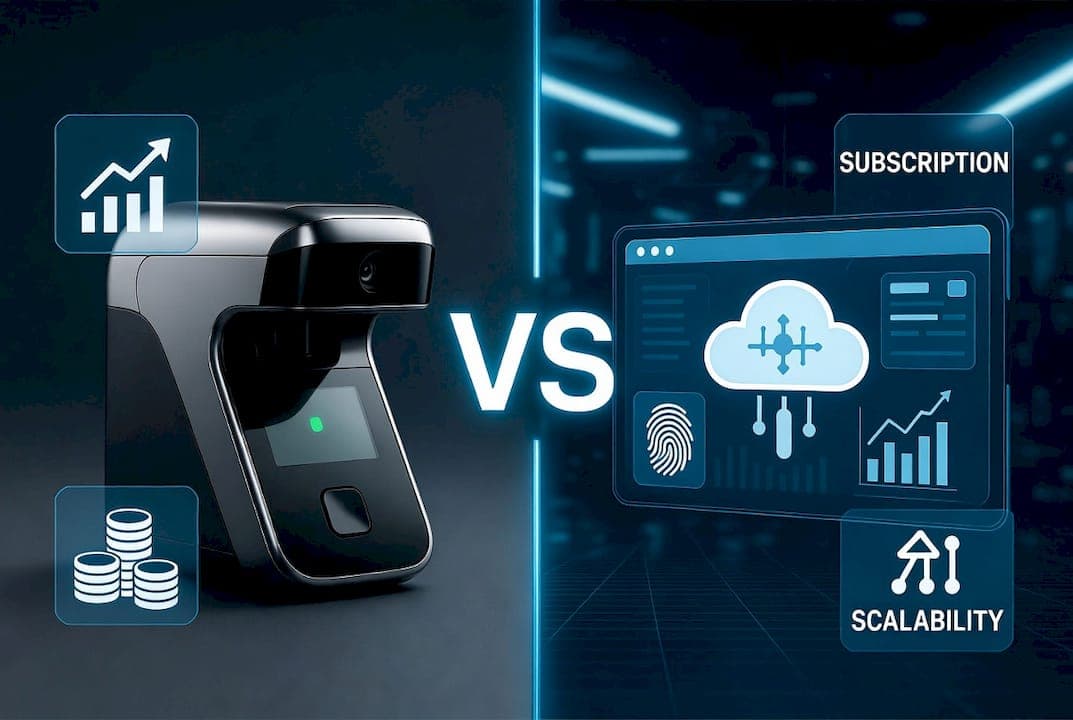
TL;DR:
Choosing between hardware and software biometrics investments significantly impacts enterprise security, risk, and compliance profiles.
Hybrid solutions leveraging both hardware trust anchors and flexible software layers offer the most resilient and scalable approach for long-term ROI.
Choosing between hardware biometrics vs software biometrics investments is one of the more consequential capital allocation decisions in enterprise security today. The stakes extend well beyond technology preference. Where biometric keys are stored, how authentication is certified, and which platform ecosystems your solution depends on all determine your risk profile, compliance posture, and long-term return. The biometric identity verification market is projected to reach $17.81 billion by 2030, with software biometrics leading at a 16.5% CAGR. That growth trajectory makes a rigorous biometric investment comparison more necessary than ever.
Table of Contents
-
1. Key evaluation criteria for hardware biometrics vs software biometrics investments
-
2. Hardware biometric solutions: characteristics and investment implications
-
3. Software biometric solutions: characteristics and investment implications
-
4. Side-by-side comparison of hardware vs software biometric investments
-
5. Strategic recommendations for biometric technology investment decisions
Key Takeaways
| Point | Details |
|---|---|
| Hardware offers isolation-level security | Secure enclaves prevent key exposure to OS-level attacks, which is critical for high-assurance deployments. |
| Software costs vary dramatically | Development ranges from $40K for SDK integrations to over $1M for custom multimodal proprietary systems. |
| Ecosystem dependencies are a hidden risk | Hardware biometrics require certified drivers and firmware, adding procurement and compatibility complexity. |
| ROI appears in operations, not just security | Biometric deployments typically return value through efficiency gains and risk reduction over 3 or more years. |
| Hybrid strategies outperform pure approaches | Combining hardware trust anchors with software flexibility often produces the strongest risk-adjusted investment profile. |
1. Key evaluation criteria for hardware biometrics vs software biometrics investments
Before committing capital to either category, investors need a structured lens for evaluation. The term “biometric authentication” covers a remarkably wide technology surface, and the financial implications differ sharply between modalities, deployment environments, and certification requirements.
The core evaluation dimensions for any biometric security investment include:
-
Cost structure: Both upfront development and ongoing operational costs. Hardware carries higher unit economics; software carries higher engineering and compliance overhead.
-
Security assurance level: Defined by where credentials and biometric templates are stored and how keys are managed. Hardware-backed trust and software-only implementations represent different threat models entirely.
-
Ecosystem dependencies: Hardware solutions require specialized device drivers, firmware certification, and platform compatibility. Software solutions depend on AI/ML infrastructure, cloud APIs, and regulatory certification bodies such as NIST FRVT.
-
Scalability and time-to-market: Software biometrics deploy faster across existing device fleets. Hardware biometrics require physical procurement and integration cycles that extend timelines significantly.
-
Regulatory alignment: Sectors including BFSI, government, and telecom carry specific authentication mandates that favor hardware-backed identity in high-value transaction contexts.
Pro Tip: When conducting a biometric investment comparison, always map regulatory requirements first. A software solution that fails FIDO2 certification or NIST compliance in your target vertical can invalidate an otherwise sound technology investment.
ROI for biometric deployments manifests primarily through operational efficiency and risk reduction, not just security upgrades. Investors who frame the decision purely as a technology acquisition miss the full financial picture.
2. Hardware biometric solutions: characteristics and investment implications
Hardware biometrics refer to authentication systems where the biometric sensor, key storage, and cryptographic operations are physically separated from the host operating system. Common modalities include fingerprint sensors with embedded secure elements, iris scanners, and palm vein readers. The defining characteristic is that private keys and biometric templates never leave the hardware boundary.
The core benefits of hardware biometrics for high-assurance deployments are well-established:
-
Secure enclave key storage: Hardware-backed trust using TPM chips and secure enclaves prevents template leakage from breached servers or compromised endpoints. Private keys reside in isolated hardware, not in OS memory where software attacks can reach them.
-
Resistance to remote exploits: Because authentication logic executes in physically isolated firmware, entire classes of software-level attacks become structurally irrelevant.
-
Regulatory acceptance: Hardware-backed authentication meets the bar for high-assurance identity frameworks including FIPS 140-2, Common Criteria, and FIDO2 hardware authenticator profiles.
The cost structure for choosing hardware biometric technology carries meaningful complexity. Sensor manufacturing, embedded certificate provisioning, driver and firmware development, and platform certification all add to the upfront investment. Windows Enhanced Sign-in Security (ESS), for example, requires fingerprint sensors with embedded Microsoft-issued certificates and fully compatible driver stacks. That certification pipeline is not trivial to navigate or budget.
Ecosystem risk is also a real consideration. Hardware biometric deployments are tightly coupled to specific platform requirements, device generations, and supply chains. A firmware update from a platform vendor can break compatibility. A component shortage can stall deployment at scale. Investors in hardware biometric vendors must model these operational variables, not just the technology quality, into their due diligence. A thorough review of common due diligence mistakes in deep tech investments is worth completing before committing capital to hardware-dependent biometric portfolios.

3. Software biometric solutions: characteristics and investment implications
Software biometric solutions authenticate users through algorithms running on commodity hardware, typically leveraging facial recognition, voice recognition, or behavioral biometrics. The authentication logic, AI/ML models, and in many cases the biometric templates themselves reside in application memory or cloud infrastructure.
Key attributes of software biometric solutions from an investment perspective include:
-
Lower upfront hardware cost: No specialized sensor procurement or embedded certificate provisioning required. Deployment runs on existing smartphones, laptops, and web cameras.
-
Rapid iteration: Model updates, liveness detection improvements, and modality expansions ship as software releases, not hardware revisions.
-
Broad addressable market: A single software SDK can deploy across millions of existing devices simultaneously, which is the primary reason software biometrics lead market growth at 16.5% CAGR.
-
Compliance complexity: NIST FRVT certification, ISO 30107-3 liveness standards, and GDPR-compliant template handling require significant engineering investment that grows with each additional modality.
The cost of biometrics systems built on software architectures varies dramatically with scope. SDK integration into an existing application runs from $40,000 to $90,000. Enterprise-grade multimodal systems with custom enrollment workflows and liveness detection range from $180,000 to $400,000. Fully proprietary builds with custom AI models can exceed $1 million. These ranges reflect engineering effort alone and exclude regulatory certification, ongoing model maintenance, and infrastructure costs.
The hidden complexity is what sits beneath the matching algorithm. Software biometric deployments require quality control for enrollment, device detection and camera normalization, presentation attack detection (liveness), error handling, and certification by recognized bodies. Investors who size these projects based on the matching algorithm alone consistently underestimate total development cost by a factor of two or more.
Pro Tip: When evaluating software biometric vendors, ask specifically about their liveness detection certification status under ISO 30107-3. Uncertified liveness detection is a regulatory liability that can delay market entry by 12 to 18 months in regulated verticals.
4. Side-by-side comparison of hardware vs software biometric investments
Understanding the trade-offs between these two categories requires looking at multiple investment dimensions simultaneously, not just security or cost in isolation.
| Dimension | Hardware biometrics | Software biometrics |
|---|---|---|
| Upfront investment | High (sensors, certs, firmware) | Moderate to high (engineering, AI/ML) |
| Ongoing costs | Low per unit at scale | Ongoing model maintenance and cloud infra |
| Security assurance | Highest (isolated key storage) | Moderate (OS-dependent) |
| Time-to-market | Longer (hardware supply chain) | Faster (software releases) |
| Scalability | Limited by device procurement | High (deploys to existing hardware) |
| Spoofing resistance | Strong (hardware attestation) | Dependent on liveness detection quality |
| Regulatory fit | High for government, finance | Growing but certification-dependent |
| Ecosystem risk | Platform and firmware lock-in | AI model drift and vendor API dependency |
The reframe that changes how sophisticated investors approach this comparison: the decision is not hardware versus software. It is a question of where trust and keys are stored. Private keys in hardware reduce the attack surface to physical access. Private keys in OS memory are exposed to the full software threat model. That distinction drives compliance posture, insurance risk, and liability exposure in enterprise deployments.
Long-term ROI for biometric security investments typically manifests through reduced investigation time, operational efficiencies, and fraud loss reduction rather than direct technology revenue. A deployment generating 133% ROI over three years does so by changing operational workflows, not by selling biometric data. Investors who build their return models around this dynamic allocate capital more accurately than those focused on technology licensing revenue alone.
The market consolidation trend reinforces the investment logic here. Major biometrics firms are merging to offer combined sensor and algorithm portfolios, targeting a $95 billion market by 2030. The direction of industry capital tells you something important: scale and synergy across hardware and software capabilities are becoming competitive necessities.
5. Strategic recommendations for biometric technology investment decisions
The most durable biometric investments are not pure hardware plays or pure software plays. They are architecturally hybrid, using hardware trust anchors to protect keys while software layers handle modality flexibility and user experience. The strategic question is which layer to own versus source, and that depends on your specific deployment context.
Guidance for investors and decision-makers:
-
Assess your regulatory environment first. Government, defense, and financial services deployments face authentication mandates that hardware-backed solutions satisfy more cleanly. Software-first strategies in these verticals carry certification risk.
-
Match investment scale to modality complexity. A single-modality facial recognition SDK is a very different capital commitment than a multimodal behavioral biometrics platform. Scope the engineering requirement before sizing the investment.
-
Evaluate ecosystem lock-in explicitly. Hardware ecosystem dependencies including driver certification and firmware compatibility should be modeled as technical debt, not just implementation details.
-
Monitor AI/ML infrastructure trends. Software biometric performance is increasingly a function of model quality, training data provenance, and hardware acceleration availability. These variables shift faster than traditional software quality indicators.
-
Consider platform convergence. The trend toward combined sensor and algorithm portfolios means that pure-play investments in either category carry consolidation risk if market leaders absorb the capability.
Pro Tip: For investors evaluating early-stage biometric security startups, check whether the company’s IP is tied to the sensor hardware, the algorithm, or the protocol layer. Protocol-layer IP tends to be more platform-agnostic and generates more durable licensing value across changing hardware generations.
A portfolio approach, holding positions across hardware-anchored and software-scaled biometric solutions, distributes technical risk while capturing growth across both segments of the authentication market.
My take on what investors consistently get wrong here
I’ve tracked a lot of biometric investment decisions over the years, and the most persistent mistake is treating the hardware versus software distinction as a binary choice rather than a layered architecture question. Decision-makers allocate to one category, encounter limitations, and then reverse course at significant cost.
What I’ve found actually matters is the ecosystem due diligence, not the modality selection. Investors who get burned on hardware biometrics usually missed the platform certification dependencies. Investors who get burned on software biometrics usually underestimated the regulatory certification timeline, specifically the gap between a working liveness detection algorithm and a commercially certifiable one.
The contrarian view I hold is that the most defensible biometric investment right now is neither pure hardware nor pure software. It is in solutions that abstract the trust layer, where the cryptographic key binding is done in hardware or a secure protocol, but the modality surface area remains flexible. Jett Optics’ approach of using gaze-derived cryptographic keys, where optical spatial encryption serves as the trust anchor rather than a commodity sensor, points toward where this architecture goes next. The investors who understand that distinction early will not be chasing consolidation plays later.
— Joshua
Where Jett Optics positions in this investment landscape

Jett Optics operates at an architectural layer that sidesteps the traditional hardware biometrics vs software biometrics investments dilemma entirely. Rather than competing on sensor hardware or matching algorithms, Jett Optics uses Agentive Gaze Tensors (AGT) and optical gaze patterns as cryptographic keys, secured through quantum-resistant protocols and DePIN-compatible infrastructure. This architecture delivers hardware-grade trust assurance without proprietary sensor lock-in. For investors and decision-makers evaluating the next generation of biometric authentication, the GazeVerify platform illustrates how spatial authentication can meet the security bar of hardware-backed systems while retaining the scalability and rapid deployment characteristics of software solutions. Explore the full Jett Optics architecture at jettoptics.ai.
FAQ
What is the main cost difference between hardware and software biometrics?
Hardware biometrics carry higher upfront costs due to sensor manufacturing, embedded certification, and firmware development. Software biometric solutions range from $40,000 for basic SDK integrations to over $1 million for custom multimodal proprietary systems, making engineering scope the primary cost driver.
When should investors favor hardware biometrics over software?
Hardware biometrics are the stronger investment in high-assurance regulatory environments such as government, defense, and financial services, where hardware-backed key storage and FIDO2 hardware authenticator profiles are required for compliance.
How does biometric ROI typically materialize?
Biometric security investments return value primarily through operational efficiency gains and fraud risk reduction rather than direct technology revenue, with documented examples showing 133% ROI over three years from investigation time savings alone.
What is the biggest hidden risk in software biometric investments?
The most underestimated risk is the engineering and timeline cost of regulatory certification. Liveness detection, NIST FRVT compliance, and ISO 30107-3 certification require extensive engineering beyond the matching algorithm itself and can delay market entry by 12 to 18 months.
Is a hybrid hardware-software biometric strategy viable at scale?
Yes. The industry consolidation trend toward combined sensor and algorithm portfolios confirms that hybrid architectures are becoming the competitive standard in a market projected at $95 billion by 2030, and they distribute technical and regulatory risk more effectively than pure-play approaches.