
TL;DR:
Biometric SaaS transforms verification into a cloud-based, recurring revenue model driven by APIs and compliance integration.
Performance metrics like FAR and FRR directly impact business risk, user experience, and regulatory adherence.
Effective evaluation requires understanding vendor architecture, scalable pricing, and building compliance into core product workflows.
Most business leaders treat biometric authentication as a security feature sitting atop an existing product. The biometric SaaS business model explained properly looks nothing like that assumption. It is a distinct commercial architecture, one where cloud-delivered biometric verification drives recurring revenue, shapes pricing strategy, and introduces regulatory obligations that touch product design at every layer. Understanding biometric SaaS, or more precisely Biometrics-as-a-Service (BaaS), is no longer optional for leaders in healthcare, finance, logistics, or any sector where identity verification underpins operations. This article covers the core architecture, revenue mechanics, performance metrics, implementation challenges, and practical evaluation frameworks you need.
Key Takeaways
| Point | Details |
|---|---|
| BaaS is a business model, not just a feature | Biometric SaaS defines revenue, pricing, compliance, and product architecture simultaneously. |
| Revenue runs on subscriptions and transactions | Most vendors combine flat-rate licensing with per-verification fees to balance predictability and scale. |
| Performance metrics carry real business risk | FAR and FRR thresholds determine fraud exposure and user drop-off rates, not just technical accuracy. |
| Compliance must be built into the product | BIPA, GDPR, and HIPAA requirements for consent and retention must be embedded in the SaaS platform itself. |
| Vendor evaluation requires a structured framework | Assess performance benchmarks, compliance automation, and scalability before any integration commitment. |
What the biometric SaaS business model actually covers
The term Biometrics-as-a-Service (BaaS) describes a cloud-based verification system that uses biological and behavioral characteristics to authenticate or identify individuals, replacing paper forms, PINs, and legacy credential flows with scalable, API-delivered verification. The phrase “biometric SaaS business model explained” is useful for search, but the recognized industry term is BaaS. Both refer to the same commercial and technical reality.

What separates BaaS from a traditional biometric deployment is delivery and ownership. In conventional on-premises biometric systems, your organization purchases hardware, licenses software, manages servers, and handles updates. In the BaaS model, the vendor hosts the entire verification infrastructure. You integrate via API or SDK, pay for access on a recurring or per-transaction basis, and the vendor absorbs hosting, maintenance, and scaling overhead.
The technical pipeline inside a BaaS platform follows four stages:
-
Enrollment — The system captures raw biometric data (a face scan, fingerprint, iris image, or voice sample) from the user’s device or a dedicated sensor.
-
Template creation and encrypted storage — Raw biometric images are processed into mathematical templates, then encrypted before storage. Raw images are discarded; only the encrypted template persists.
-
Matching and scoring — When a user attempts verification, the system captures a new biometric sample, generates a fresh template, and compares it against the stored encrypted template using a similarity score.
-
Decision and response — The platform applies calibrated threshold logic, combining the match score with liveness detection signals, to return an accept or reject decision to the calling application.
Common biometric modalities deployed across enterprise BaaS platforms include facial recognition, fingerprint scanning, iris recognition, voice recognition, and behavioral biometrics such as keystroke dynamics or gait analysis. Enterprise deployment scenarios range from physical access control and time recording to mobile customer onboarding and remote identity verification for regulated industries. For a detailed view of biometric delivery mechanisms shaping 2026 enterprise architecture, the current market landscape offers important context.
Pro Tip: When evaluating a BaaS vendor’s technical architecture, ask specifically whether raw biometric images are retained at any stage of the pipeline. Vendors that store raw images rather than encrypted templates introduce significantly higher regulatory and data breach risk.
Revenue and pricing in a biometric SaaS business
Understanding how biometric SaaS companies generate revenue matters because it directly determines your total cost of ownership as a buyer. Most BaaS vendors combine two revenue streams: recurring subscription fees and per-transaction verification charges.
The subscription layer typically covers platform access, API calls up to a monthly threshold, support, and compliance tooling. The transaction layer charges per successful or attempted verification above that threshold. This hybrid structure benefits vendors by ensuring baseline revenue while capturing upside from high-volume customers.
Pricing strategy varies meaningfully across vendor types:
-
Pay-as-you-go — No minimum commitment; charges apply per verification. Best for pilots, irregular volumes, or early-stage products.
-
Prepaid packages — Bulk verification credits purchased at a discount. Suitable for organizations with predictable but moderate volumes.
-
Flat-rate user-based licensing — A fixed monthly fee per enrolled user or per seat. Common in workforce access control and employee identity management.
-
Enterprise contracts — Custom pricing with volume commitments, SLA guarantees, and dedicated infrastructure. Standard for high-volume financial or government deployments.
CLEAR is the clearest real-world illustration of BaaS commercial dynamics. The company’s $199 annual membership drove approximately 88% of 2025 revenue, with subscriber retention sitting near 90%. CLEAR’s adjusted EBITDA margin reached roughly 28% in late 2025, demonstrating that a well-calibrated subscription model can generate strong unit economics even in a hardware-dependent biometric service.
| Pricing model | Best use case | Key trade-off |
|---|---|---|
| Pay-as-you-go | Pilots, variable volumes | Higher per-unit cost at scale |
| Prepaid packages | Moderate, predictable volumes | Requires accurate volume forecasting |
| Flat-rate user licensing | Workforce and access control | Fixed cost regardless of actual usage |
| Enterprise contract | High-volume regulated industries | Requires commitment and negotiation |
SaaS verification pricing generally offers lower upfront costs and faster deployment than on-premises systems, but costs can escalate significantly as verification volume grows. On-premises deployments carry higher initial investment but often deliver better unit economics at enterprise scale.
Pro Tip: Before signing a BaaS contract, model your verification volume at 12 months, 24 months, and 36 months under optimistic and conservative growth assumptions. Per-transaction pricing that looks affordable at launch can become your largest technology cost by year two.
Biometric performance metrics and business impact
Most business leaders focus on feature checklists when evaluating BaaS vendors. That approach misses the variable that actually determines whether the product works in production: biometric accuracy, measured through two opposing metrics.
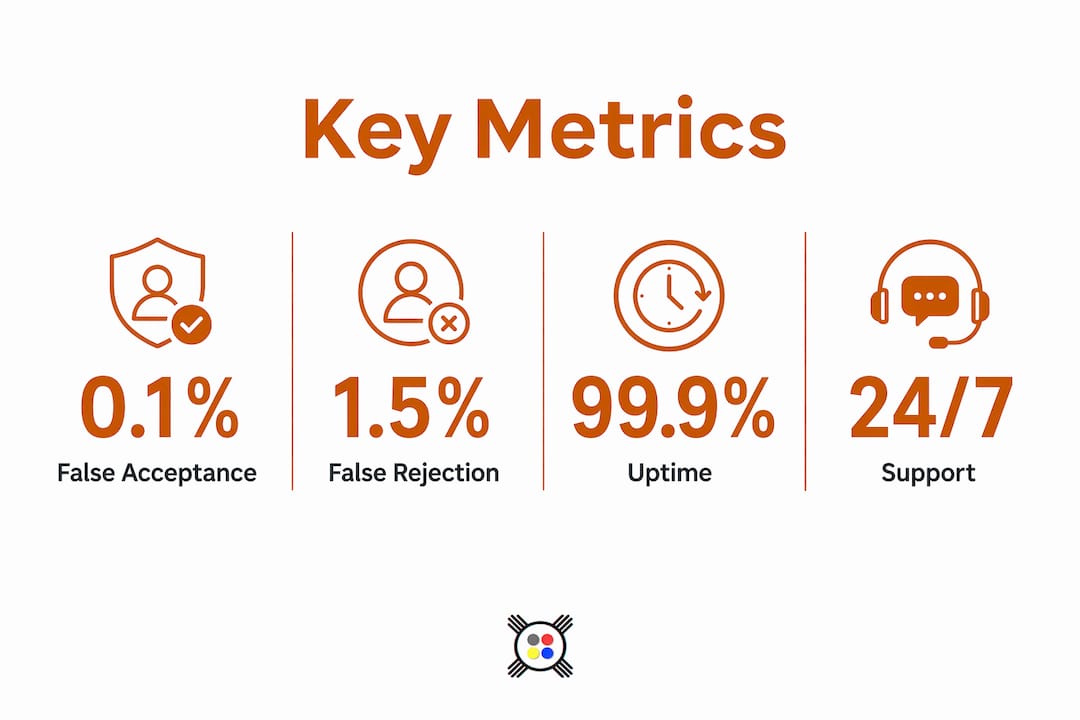
False Acceptance Rate (FAR) measures how often the system incorrectly grants access to an unauthorized user. A high FAR means fraudsters get through. False Rejection Rate (FRR) measures how often the system incorrectly denies access to a legitimate user. A high FRR means real customers get turned away. These two metrics move in opposite directions: tightening the threshold to reduce FAR inevitably increases FRR, and vice versa.
The variation across biometric algorithms is far wider than most buyers expect. DHS RIVR 2025 data shows DFAR ranging from below 0.88% to below 76.68% depending on algorithm and deployment conditions. NIST FRTE face algorithm benchmarks show FMR spanning 0% to 1.66% and FNMR ranging from 0.08% to 99.66%. These are not marginal differences. They represent the gap between a system that works and one that fails operationally.
The business consequences of miscalibrated thresholds are direct and measurable:
-
A high FAR in a financial services onboarding flow exposes the business to identity fraud and regulatory penalties.
-
A high FRR in a consumer app raises user drop-off at the verification step, directly reducing conversion and retention.
-
In regulated environments, either failure mode can trigger compliance investigations and audits.
Biometric identity is evolving beyond simple authentication toward full recognition workflows that support regulatory governance. That evolution makes threshold calibration, not just raw accuracy, the central engineering and product decision in any BaaS deployment.
Challenges in adopting or building biometric SaaS
The BaaS model introduces a class of operational and regulatory challenges that do not appear in conventional SaaS products. Business leaders who treat biometric compliance as a legal department problem rather than a product architecture problem consistently underestimate implementation cost and timeline.
Regulatory exposure is the most immediate challenge. The Illinois Biometric Information Privacy Act (BIPA), GDPR in Europe, and HIPAA for healthcare-adjacent applications each impose specific requirements on how biometric templates are captured, stored, and deleted. Compliance with BIPA and GDPR requires integrated consent capture, data retention schedules, and audit logs built into the product itself. Successful vendors embed these functions into core platform workflows rather than bolting them on after development.
Beyond regulation, several technical challenges compound complexity:
-
Multimodal support — Deploying multiple biometric modalities (face plus voice, or fingerprint plus behavioral) requires coordinated hardware support, synchronized liveness detection, and modality-specific regulatory scoping.
-
On-device versus server-side matching — On-device matching keeps biometric templates on the user’s device, reducing data transmission risk but limiting centralized audit capability. Server-side matching enables richer logging but increases network-side attack surface.
-
Spoofing resistance and liveness detection — Presentation attacks using photographs, masks, or synthesized audio require active countermeasures. Vendors lacking certified liveness detection introduce unacceptable fraud risk for regulated deployments.
Implementation complexity grows substantially when multimodal support, certification requirements, and accuracy targets combine. SDK integration accounts for only a fraction of total engineering effort. Consent flow design, audit infrastructure, retention policy enforcement, and regional legal variation each add weeks or months to deployment timelines.
Pro Tip: Request a vendor’s compliance automation documentation before any technical evaluation. If a BaaS provider cannot demonstrate how consent capture and data retention schedules are enforced programmatically within the platform, not through manual process, the compliance burden shifts entirely to your engineering team.
Evaluating and applying biometric SaaS to your operations
For business leaders moving from exploration to decision, a structured evaluation framework prevents the most common and costly mistakes. Assessing biometric technology for competitive advantage requires examining vendors across three dimensions before technical integration begins.
-
Performance and benchmark validation — Require independent benchmark results, specifically NIST FRTE or DHS RIVR data, rather than vendor-published accuracy claims. Validate performance against your specific user population and device environment, since demographic and hardware variation significantly affects real-world accuracy.
-
Compliance automation depth — Evaluate whether the platform enforces BIPA consent flows, GDPR right-to-deletion requests, and retention schedules programmatically. Biometric policy requirements treated as core product features drive trust and contracting success with enterprise buyers. Vendors who have operationalized this earn procurement preference.
-
Scalability and pricing structure — Model your verification volume at multiple growth scenarios and calculate total cost at each tier. Confirm the vendor’s infrastructure can scale without renegotiation or service degradation.
After vendor selection, run a structured pilot before full deployment. Define your FAR and FRR targets for your specific use case before the pilot begins, since threshold tuning for production environments must reflect your actual fraud risk tolerance and user experience requirements. Consumer onboarding tolerates different thresholds than employee physical access control.
User experience optimization requires deliberate friction management. Biometric verification that fails frequently erodes user trust faster than almost any other product failure. Design enrollment flows that maximize template quality at capture, reducing matching errors in production. Monitor FRR in production dashboards and treat rising rejection rates as a leading indicator of user churn, not a system performance footnote.
Finally, build regulatory change into your vendor evaluation criteria. BIPA-style legislation is expanding geographically, and decentralized identity frameworks are advancing toward enterprise adoption. Vendors with modular compliance architectures adapt faster to regulatory shifts than those with rigid, jurisdiction-specific implementations.
My perspective on what most leaders get wrong
In my experience working through the layers of biometric SaaS adoption, the most consistent mistake I see business leaders make is treating compliance as a procurement checkbox rather than a product architecture decision. By the time legal has reviewed the BIPA exposure and the vendor’s data processing agreement, engineering has already built an integration that requires complete rework to support lawful consent flows and deletion requests. That sequence is not just inefficient. It is expensive.
What I have found actually determines project success is not the vendor’s accuracy claims or the elegance of their API documentation. It is whether the vendor’s platform makes compliance behavior the default path rather than an optional configuration. When consent capture is not baked into the enrollment SDK, your team will build it themselves, imperfectly, under time pressure.
The FAR and FRR trade-off is another area where I think conventional wisdom underserves leaders. Most conversations treat it as a technical tuning problem. But the choice of where to set your threshold is fundamentally a business decision about which error you can afford more. In fraud-exposed financial services, the answer is obvious. In consumer identity for a mobile app, getting it wrong means losing real customers to false rejections that feel indistinguishable from a broken product. I have seen organizations set thresholds during development, never revisit them, and then wonder why their biometric-gated feature has a 20% abandonment rate.
The business opportunity in biometric SaaS is real and significant. But the leaders who will capture it are the ones who understand that performance metrics, compliance architecture, and pricing structure are not vendor problems. They are strategic decisions that belong in the boardroom.
— Joshua
How Jett Optics approaches biometric SaaS

Jett Optics operates at an intersection most BaaS vendors have not reached: optical encryption, spatial authentication, and quantum-resistant cryptographic systems that treat human gaze as a verifiable biometric input. Rather than deploying conventional face or fingerprint matching over generic cloud infrastructure, Jett Optics builds gaze-based verification systems that encode authentication directly into user attention patterns using AGT (Agentive Gaze Tensor) technology.
For enterprise leaders who need biometric authentication that is ambient, hands-free, and resistant to presentation attacks, Jett Optics’ optical spatial encryption platform addresses both the security architecture and the regulatory design questions that conventional BaaS vendors leave to the customer. The platform is designed with blockchain-compatible, DePIN-compatible infrastructure, making it relevant for organizations building toward decentralized identity frameworks as regulatory requirements evolve.
Explore Jett Optics’ approach to biometric authentication at jettoptics.ai and engage with a team that builds authentication from the optical layer up.
FAQ
What is Biometrics-as-a-Service (BaaS)?
Biometrics-as-a-Service is a cloud-delivered authentication model that uses biological or behavioral characteristics to verify identity, replacing PINs and passwords with scalable API-based verification delivered by a third-party vendor.
How does a biometric SaaS vendor generate revenue?
Most BaaS vendors combine recurring subscription fees for platform access with per-transaction charges for each verification event, a model illustrated by CLEAR’s subscription-driven revenue structure that generated roughly 88% of 2025 revenue from $199 annual memberships.
What are FAR and FRR in biometric systems?
False Acceptance Rate (FAR) measures how often an unauthorized user is incorrectly granted access, while False Rejection Rate (FRR) measures how often a legitimate user is incorrectly denied. NIST FRTE benchmarks show FNMR ranging from 0.08% to 99.66% across algorithms, underscoring how dramatically vendor selection affects real-world performance.
What regulations apply to biometric SaaS deployments?
BIPA (Illinois), GDPR (European Union), and HIPAA (for healthcare contexts) are the primary frameworks. Each requires embedded consent and retention controls built into the platform itself rather than managed through manual legal processes.
How should a business evaluate a BaaS vendor?
Start with independent performance benchmarks such as NIST FRTE data, then assess whether compliance automation (consent capture, audit logs, deletion enforcement) is native to the platform. Model your verification volume at multiple growth stages and confirm pricing remains viable at scale before committing to integration.