

TL;DR:
- Commercial success in deep tech security depends more on funding strategies, compliance, and deployment planning than on technical maturity. SBIR Phase III contracts provide a unique, sole-source pathway for federal commercialization, with no dollar limits and direct procurement authority. Deploying passkeys typically takes six to twelve weeks, primarily due to recovery design and legacy system integration, highlighting operational challenges over cryptography.
Most business leaders assume that if the technology works, commercialization follows naturally. The deep tech security commercialization path proves otherwise. Across authentication, encryption, and zero-trust architectures, organizations with technically superior solutions routinely lose ground to competitors who master funding mechanics, compliance alignment, and phased deployment. This article unpacks what actually drives success in commercializing deep tech security: SBIR Phase III funding structures, FIDO2 passkey adoption timelines, NIST compliance frameworks, and the pilot strategies that convert interest into recurring contracts.
Table of Contents
-
The deep tech security commercialization path: market context
-
Compliance alignment: NIST SP 800-63 and risk-based authentication
Key takeaways
| Point | Details |
|---|---|
| Technology maturity is not enough | Capital design and pilot strategy determine commercialization success more than technical readiness. |
| SBIR Phase III is a strategic lever | Sole-source authority with no dollar ceiling makes Phase III a uniquely powerful vehicle for deep tech market entry. |
| Passkey deployment takes 6 to 12 weeks | Most time is spent on recovery design and legacy integration, not core FIDO2 implementation. |
| Compliance frameworks accelerate adoption | Aligning with NIST SP 800-63 and FIDO2 standards builds enterprise credibility and shortens sales cycles. |
| Paid pilots outperform broad interest | A 3 to 6 month pilot anchored by measurable KPIs is the fastest path from proof of concept to contract. |
The deep tech security commercialization path: market context
Before any commercialization strategy can function, you need a precise picture of the forces currently shaping enterprise security purchasing decisions.
Deep tech security refers to solutions built on foundational scientific advances rather than incremental software improvements. This category includes quantum-resistant cryptography, hardware-based biometric authentication, spatial encryption, optical identity systems, and AI-driven behavioral analysis. These are not iterative products. They require long development cycles, specialized validation, and buyers who understand both the technical and regulatory stakes.
The market drivers in 2026 are unusually convergent. Three regulatory frameworks are simultaneously reshaping enterprise procurement:
-
NIS2 and DORA (European mandates) require financial and critical infrastructure organizations to demonstrate identity assurance and incident response capabilities with documented controls.
-
PCI DSS 4.0 now mandates phishing-resistant multi-factor authentication for all cardholder data environment access, directly accelerating demand for FIDO2-compatible solutions.
-
Zero-trust executive mandates in U.S. federal agencies are driving procurement toward hardware-anchored credentials and continuous authentication models.
Alongside regulatory pressure, platform maturity has finally caught up. Enterprise FIDO2 adoption reached 87% actively deploying or piloting passkeys in 2026, up from 53% in 2024. That is a 64% increase in two years. For deep tech security innovators, this convergence of mandate and market readiness creates an exceptionally receptive environment. The window for early commercialization advantage is real, but it closes as the category matures.
Capital structure and SBIR Phase III
The most underutilized tool in deep tech security strategy is SBIR Phase III. Most founders and innovation leaders treat it as a research funding mechanism. It is actually a commercialization vehicle with structural advantages that no other procurement path offers.
Here is how the phases work in practice, with specific emphasis on where commercial traction begins:
-
Phase I funds feasibility research, typically $50K to $300K, and establishes the technical concept with a federal agency sponsor.
-
Phase II funds prototype development and technical validation, ranging from $750K to $2M, and produces the IP that anchors a Phase III claim.
-
Phase III is where commercialization occurs. Phase III contracts carry no statutory dollar ceiling and can scale from $500K to over $50M. More critically, they allow any federal agency to award sole-source contracts for SBIR-derived technology, bypassing competitive procurement entirely.
The sole-source authority is the strategic core. It means a program office that wants your technology does not have to run a full and open competition. They can award directly, provided the relationship and budget alignment are in place. This creates a fundamentally different sales motion from commercial enterprise deals.
To execute this path successfully, prioritize these four steps:
-
Identify program office champions early. Contracting officers execute the paperwork, but program managers control budget lines. Map the agency’s program structure before submitting Phase I.
-
Establish budget line presence. Work with your sponsoring agency to ensure SBIR-derived technology appears in the next fiscal year’s budget request. Without a line item, Phase III awards stall regardless of technical merit.
-
Understand the 2026 matching fund requirements. VC-backed or revenue-generating firms hold a distinct advantage for Strategic Breakthrough Awards under 2026 SBIR reauthorization guidelines, which require matching commercial traction.
-
Document Phase II technical outputs meticulously. Phase III authority requires a direct technical lineage from the SBIR work. Gaps in documentation can disqualify a sole-source claim.
Pro Tip: Never approach Phase III as a contracting exercise alone. It is a relationship exercise that happens to produce a contract. The program manager who becomes your internal advocate is the asset, not the award document.
For bootstrap-funded startups without revenue, the path is harder but not closed. Partnering with a prime contractor who holds an existing IDIQ vehicle and can flow down Phase III authority is a viable alternative. It requires earlier business development investment but preserves access to sole-source mechanics.

FIDO2 and passkey deployment: timelines and friction points
The technical architecture of FIDO2 is mature. The organizational challenges of deploying it are not.
Production-ready passkey implementation takes 6 to 12 weeks for most enterprises. That timeline is not driven by cryptographic complexity. It is driven by account recovery design, cross-platform testing, and change management for end users who have never encountered a passkey workflow. Understanding this distinction matters enormously when you are selling or deploying a deep tech authentication product.
Key deployment challenges and their mitigation strategies:
-
Account recovery architecture. A robust recovery flow targets fallback rates below 5%. Anything higher signals that users cannot self-serve recovery, which drives helpdesk cost and erodes adoption. Design recovery paths before writing a single line of passkey registration code.
-
Legacy system integration. Most enterprises run identity infrastructure built between 2008 and 2018. Retrofitting passkeys requires compatibility layers for SAML-based SSO systems that were never designed for public-key cryptography flows.
-
Synced versus device-bound credentials. Synced passkeys (stored in iCloud Keychain or Google Password Manager) offer the fastest adoption curve but introduce shared-device risk. Device-bound credentials provide stronger assurance but require hardware provisioning workflows.
-
High-risk user prioritization. Phase rollouts that start with privileged accounts, administrators, and finance teams first generate the most measurable risk reduction and the fastest ROI data for stakeholders.
Pro Tip: Pair your FIDO2 deployment with AI-powered conditional access policies that evaluate device posture, location, and behavioral signals before issuing authentication challenges. This creates adaptive MFA that satisfies AAL2 requirements while reducing friction for low-risk sessions.
The financial case for modern authentication is quantifiable. Phishing-resistant MFA reduces cyber insurance premiums by 15 to 30% and cuts password reset requests by 25 to 80%. For a mid-sized enterprise spending $2M annually on identity-related helpdesk and insurance, these numbers represent direct operating cost reduction, not just theoretical risk mitigation. That data point belongs in every sales conversation and board presentation you make.
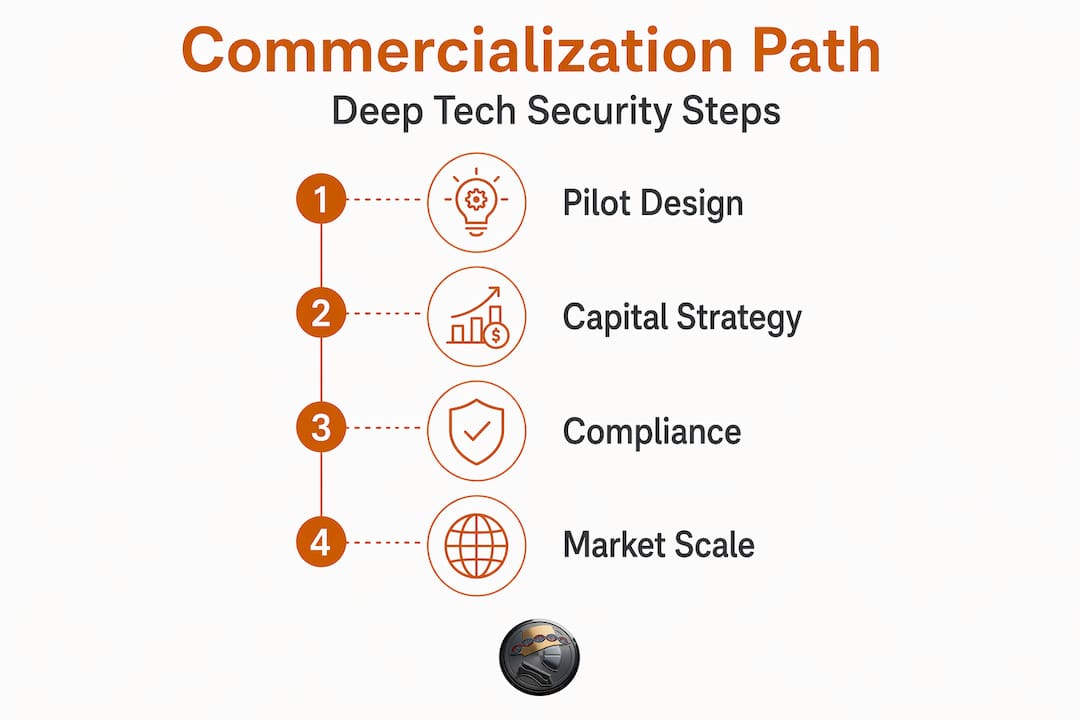
Commercializing deep tech: pitfalls and success factors
Deep tech startup failures trace more reliably to capital structure problems than technology problems. This is a structural observation, not a criticism of founders. Deep tech timelines are long. Sales cycles in enterprise cybersecurity routinely run 12 to 18 months. The capital structure that funds a 24-month development cycle is often wrong for a 36-month path to first material revenue.
“The best path to commercialization moves from exploration to paid pilot decisions with clear KPIs to demonstrate value and build recurring contracts.” — Kista Science City, Thales Trust My Tech Nordic Sprint
The pilot model deserves direct attention. A 3 to 6 month paid pilot anchored by specific KPIs outperforms broad interest surveys and proof-of-concept demonstrations as a commercialization tool. The reasons are practical. A paying pilot customer has made a procurement decision. They have internal budget allocated. They have a sponsor accountable for results. That organizational commitment transforms the relationship from evaluation to partnership.
The critical distinction between startups and large enterprises on the deep tech IP commercialization path is methodology. Startups favor pilot-driven validation with tight iteration loops. Larger organizations gravitate toward acquisition or licensing models that absorb the IP into existing product lines. Neither approach is universally superior. What matters is matching your commercialization motion to your organizational structure and capital runway.
Several patterns reliably predict failure in the deep tech security space:
-
Prioritizing technology demonstrations over integration proof points in sales cycles
-
Delaying compliance alignment until after initial enterprise contracts are signed
-
Building sales processes around technical stakeholders while neglecting procurement and legal
-
Underestimating change management requirements for end-user-facing authentication deployments
-
Allowing pilot programs to run indefinitely without hard decision gates
Success factors follow a different logic. The organizations that scale deep tech security solutions consistently build sales processes that treat compliance readiness as a product feature, not an afterthought. They maintain biometric encryption IP documentation from early development phases. And they treat customer KPI achievement as a contractual milestone, not a reporting exercise.
Compliance alignment: NIST SP 800-63 and risk-based authentication
NIST SP 800-63 provides the most operationally relevant framework for positioning deep tech authentication products in the enterprise market. Its three assurance level dimensions directly map to procurement requirements.
| Assurance Level | Definition | Authenticator Requirements |
|---|---|---|
| IAL1 (Identity Assurance) | Self-asserted identity, no verification | No specific requirements |
| AAL2 (Authenticator Assurance) | Proof of possession of two distinct factors | TOTP, push notification, or FIDO2 passkeys |
| AAL3 (Authenticator Assurance) | Hardware-bound, phishing-resistant | FIDO2/WebAuthn hardware keys, PIV smart cards |
| FAL2 (Federation Assurance) | Signed assertions, single-use tokens | Requires encrypted assertions from IdP |
AAL3 requirements mandate hardware-based phishing-resistant authenticators, and this level is increasingly required for privileged administrators under zero-trust mandates. For deep tech security vendors, AAL3 alignment is no longer a differentiator. It is a baseline qualification for federal and regulated enterprise procurement.
The practical commercialization implication is that AAL3-compliant authentication demands are growing across healthcare, defense contracting, and financial services. Products that can demonstrate out-of-the-box NIST alignment, with documented evidence for auditors, reduce the procurement risk calculus for enterprise buyers. This is where Jett Optics’ optical spatial encryption and gaze-based authentication systems find direct market relevance: they combine biometric assurance with hardware-anchored cryptographic verification in architectures that map cleanly to AAL3 requirements.
For teams preparing for compliance audits, document your authenticator binding process, enumerate your phishing-resistant credential types, and maintain evidence of conditional access policy enforcement. Auditors want artifacts, not assurances.
My perspective on what actually moves the needle
I’ve watched technically exceptional deep tech security teams lose deals they should have won because they optimized for the wrong stage. They perfected the demo. They built elegant architecture. They wrote thoughtful white papers. Then they lost to an incumbent solution with worse security properties but better procurement alignment and a simpler integration story.
What I’ve found is that the commercialization path in deep tech security has a very specific inflection point: the moment you move from explaining what your technology does to proving what it costs the buyer not to deploy it. Most teams spend too long in the explanation phase. Enterprise buyers are not waiting to be educated. They are waiting for someone to absorb their procurement risk.
The SBIR Phase III mechanics are genuinely underappreciated by private-sector security innovators. I’ve seen teams with world-class cryptographic IP struggle for three years in commercial sales cycles while a comparable team used Phase III sole-source authority to build a federal revenue base that funded their commercial motion. The funding path shapes the sales path more than most founders admit.
My honest assessment of passkey and biometric authentication deployment challenges: the recovery workflow is where deployments fail, not the cryptography. Teams that obsess over the authentication ceremony and ignore the recovery ceremony ship products that create helpdesk tsunamis at scale. Plan the recovery path first.
And on compliance: align with NIST SP 800-63 and FIDO2 standards from the beginning of product design, not after a prospect asks for a compliance matrix. The organizations with the shortest sales cycles are the ones who walk into a meeting with a pre-completed AAL3 evidence package. That document eliminates an entire approval stage.
— Joshua
How Jett Optics fits your security commercialization goals
Jett Optics builds authentication architectures where human gaze patterns function as cryptographic keys, combining AGT gaze tensors, quantum-resistant encryption, and DePIN-compatible identity protocols into a system designed from the ground up for AAL3-aligned deployment. If you are commercializing a deep tech security solution or integrating next-generation authentication into your enterprise stack, Jett Optics’ spatial encryption platform and encrypted messaging system provide both reference architecture and production-ready infrastructure. The platform supports zero-trust integration, compliance documentation, and phishing-resistant credential management without requiring legacy identity system replacement. Explore Jett Optics’ full technology suite at jettoptics.ai to assess how optical biometric authentication fits your commercialization roadmap.
FAQ
What is SBIR Phase III and why does it matter for deep tech security?
SBIR Phase III allows any federal agency to award a sole-source contract with no dollar ceiling for technology derived from prior SBIR work, bypassing competitive procurement. For deep tech security innovators, this creates a direct path to substantial federal contracts without open competition.
How long does enterprise passkey deployment actually take?
Most organizations complete production-ready passkey implementation in 6 to 12 weeks, with the majority of that time spent on recovery design and cross-platform testing rather than core FIDO2 integration.
What NIST assurance level applies to privileged administrator accounts?
AAL3 applies to high-risk and privileged accounts, requiring hardware-bound phishing-resistant authenticators such as FIDO2/WebAuthn hardware keys or PIV smart cards under current zero-trust mandates.
Why do deep tech security startups fail despite strong technology?
Capital design failures are the leading cause, as development timelines and enterprise sales cycles extend far beyond what most initial funding structures can sustain. Technology quality is rarely the limiting factor.
What makes a paid pilot more effective than a product demo?
A paid pilot creates an internal budget commitment and an accountable sponsor inside the customer organization, transforming the relationship from evaluation to active deployment with measurable KPIs and a clear path to contract renewal.