
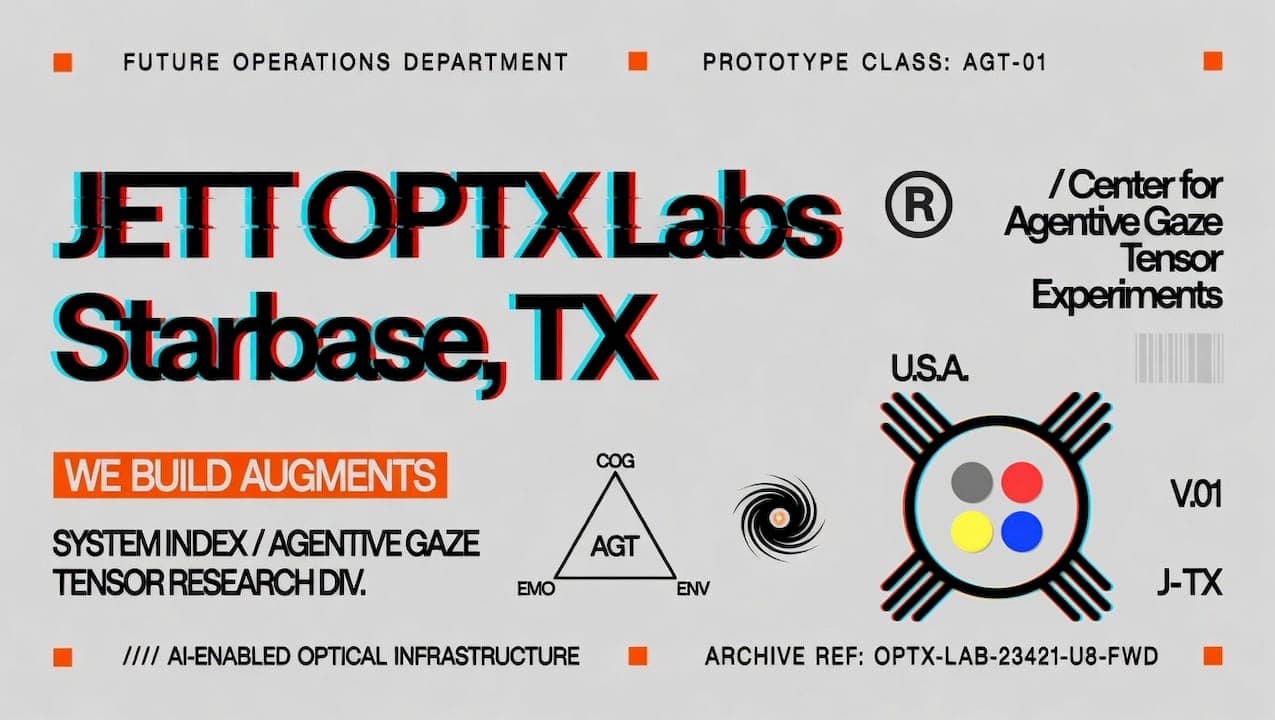
The term “Jett Optical Encryption” stops many investors cold, and for good reason. It does not map cleanly onto a single commercial product, yet it represents something far more consequential: a converging architecture of gaze-based biometric authentication, physical-layer optical cryptography, and blockchain-backed identity that is redefining how AR security technology gets built and funded. If you are allocating capital toward advanced encryption technology, spatial computing, or AI-integrated AR systems, understanding precisely what this ecosystem contains and what it does not is the difference between a thesis-driven investment and a costly assumption.
Table of Contents
-
Understanding optical encryption technologies and Jett’s place in AR security
-
Innovations in physical-layer optical encryption and authentication
-
Balancing security and performance in optical encryption for AR systems
-
Market context and investment outlook for AR optical security technologies
-
What investors often miss about optical encryption and AR security investments
-
Jett Optical Encryption solutions for next-generation AR security investment
Key Takeaways
| Point | Details |
|---|---|
| Clarify ‘Jett Optical Encryption’ | It is a broad ecosystem term rather than a single product; investor diligence is essential to verify specifics. |
| Physical self-destruction adds security | Metastructure collapse after reading prevents data cloning and enhances tamper resistance in encryption. |
| Optical encryption supports high throughput | AES-CTR modulation-layer encryption achieves strong security with negligible impact on AR system performance. |
| Defense spending drives market growth | Military AI-enabled AR systems ramp defense-related investment in secure optical sensing and encryption tech. |
| Due diligence on blockchain claims | Verify cryptographic proofs and audits behind on-chain attestations to validate security promises. |
Understanding optical encryption technologies and Jett’s place in AR security
Optical encryption encodes information within the physical properties of light itself: polarization states, phase relationships, spatial modes, and temporal patterns. In AR security contexts, this is significant because AR systems transmit enormous data volumes across optical links, often in environments where conventional software-layer encryption creates latency or vulnerability at the physical interface. Optical encryption addresses the hardware-level attack surface that purely algorithmic approaches leave exposed.
The term “Jett Optical Encryption” is genuinely ambiguous, and that ambiguity has direct implications for how you conduct due diligence. No reliable public source confirms it as a single commercial product. Instead, references trace to engineering repositories and research outputs under the "jettoptxnamespace, including thejoe-aaron-router` project, which functions as part of a broader authentication and routing ecosystem rather than a turnkey encryption appliance. This distinction matters enormously when evaluating claims.
Jett Optics, operating at jettoptics.ai, has developed a multi-component ecosystem that integrates several distinct technology layers. Investors evaluating this space need to understand each component on its own merits:
-
JETT Auth: A biometric gaze authentication module that converts Agentive Gaze Tensors (AGTs) into cryptographic key material, treating the user’s real-time gaze pattern as a continuously evolving visual signature
-
OPTX Bridge: A protocol layer connecting optical biometric events to Solana’s blockchain via Web3 and DePIN (Decentralized Physical Infrastructure Network) standards, enabling on-chain attestation of authentication events
-
AARON Router: The networking component managing secure signal routing between physical optical hardware and decentralized network infrastructure
What Jett’s approach represents, when viewed as spatial computing trust infrastructure, is a genuinely novel model: human attention itself becomes the cryptographic primitive. The underlying post-quantum gaze security architecture incorporates quantum-resistant primitives designed to remain viable as classical cryptographic assumptions erode. Before investing, verify whether these components have undergone third-party security audits and confirm the maturity level of any deployed code versus research-stage prototypes.
Innovations in physical-layer optical encryption and authentication
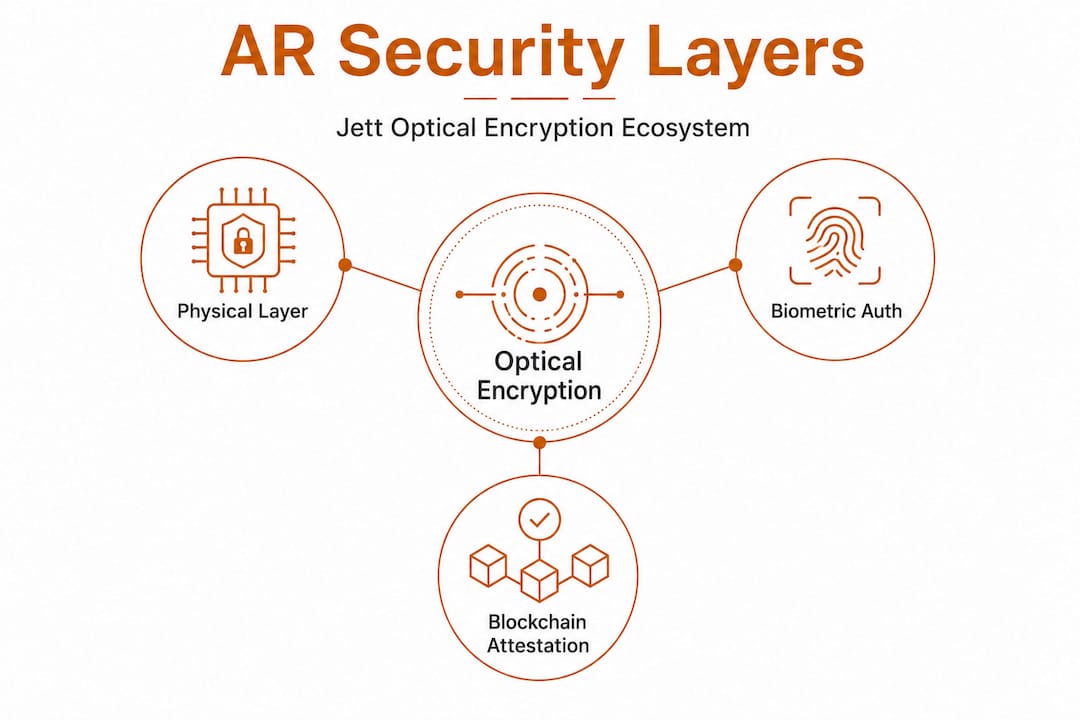
Having clarified the terminology and context, we next explore the physical-layer optical encryption technologies showing the most promise for AR security, and the specific technical properties that determine investment viability.
A 2026 study published in Light: Science & Applications demonstrated time-programmable coloration encryption using 3D metastructures with a built-in physical “burn after reading” mechanism. The carrier material undergoes capillary-force-induced structural collapse after the encrypted optical signal is read, making any subsequent interception of the physical medium cryptographically useless. This is not a software wipe or a key deletion. The physical structure that encoded the information no longer exists.
This mechanism matters for AR deployment because AR hardware operates in environments where device theft or signal interception is a real operational concern. A tamper-evident physical layer that destroys itself on unauthorized access provides a security guarantee that no firmware update can replicate.

Vector hologram metasurfaces represent a parallel breakthrough. These structures encode security keys not in data patterns but in the polarization state and orbital angular momentum (twist) of light itself. Because cloning requires exact reproduction of light’s physical properties at the nanoscale, these keys resist duplication far more reliably than conventional digital tokens. For AR and VR smart glasses, this enables encrypted messaging gaze verification that is tied to hardware-specific optical signatures rather than transferable credentials.
| Encryption approach | Security mechanism | Key advantage | Technical challenge |
|---|---|---|---|
| 3D metastructure time-coding | Structural collapse post-read | Physical tamper destruction | Precise timing calibration required |
| Vector hologram metasurface | Polarization and twist keys | Extremely hard to clone | Receiver must decode vector states |
| AES-CTR modulation-layer | Algorithmic coherent signal | High throughput, low penalty | Interoperability with existing hardware |
| Gaze tensor biometric | AGT-derived key generation | Continuously evolving key | Environmental stability of eye-tracking |
Understanding the tradeoffs in this table is foundational to sound AR investment strategies. Physical self-destruction offers maximum tamper evidence but requires single-use medium logistics. Vector holograms provide strong cloning resistance but demand specialized optical receivers. AES-CTR integration preserves existing infrastructure investment. Gaze-based keys enable continuous re-authentication but introduce dependency on reliable eye-tracking hardware. Review the biometric encryption patents landscape carefully before committing capital to any single approach.
Pro Tip: Physical-layer encryption and cryptographic-layer encryption solve different attack surfaces. The strongest AR security architectures layer both, and you should be skeptical of any vendor claiming one approach renders the other unnecessary.
Balancing security and performance in optical encryption for AR systems
Building on the physical encryption concepts, we now examine how optical encryption meets the practical demands of high-throughput AR systems, which is where many investment theses either solidify or collapse.
AES-CTR modulation-layer encryption operating on coherent optical signals has demonstrated high symbol rates exceeding 100 Gsymbols per second with no measurable penalty on Q-factor squared or optical signal-to-noise ratio (OSNR). For investors, this resolves what was the central technical objection to deploying encryption at the optical transport layer: the assumption that security came at the cost of throughput. It does not, at these tested conditions.
The practical investor questions this raises deserve direct answers:
-
Does optical encryption create latency in AR rendering pipelines? At coherent transport rates above 100 Gsymbols/s with AES-CTR, latency additions are negligible for the display refresh cycles current AR hardware uses
-
What are the interoperability risks with existing optical hardware? Coherent optical receivers must support the modulation format used by the encryption layer, which introduces integration costs that vary significantly by vendor and deployment environment
-
How does key management work at optical transport speeds? At these rates, key exchange protocols must be pre-negotiated and synchronized; dynamic re-keying mid-stream introduces synchronization overhead that deployment teams must account for
-
What happens to security guarantees when OSNR degrades in field conditions? Error correction thresholds tested in lab conditions may not hold under real-world optical path degradation, which is a deployment risk labs do not fully capture
This last point is particularly important for assessing biometric tech and optical systems together. Lab performance and field performance diverge in ways that affect both security guarantees and investment timelines.
Pro Tip: Always request both lab benchmark data and field pilot results when evaluating optical encryption vendors. A system demonstrating no OSNR penalty in a controlled environment may show measurable degradation in real-world fiber spans with temperature variation or connector loss. These are separate risk categories requiring separate validation.
Market context and investment outlook for AR optical security technologies
With security and performance considerations understood, let us place optical encryption into the broader AR security and investment landscape.
Defense procurement is currently the clearest signal of institutional capital flowing into AR optical security. Syntec Optics secured approximately $2 million in foundational purchase orders for AI-powered AR micro cameras with decade-long recurring buy plans, illustrating that defense agencies are making long-term infrastructure commitments to AR optical sensor systems. This is not discretionary procurement. It signals architectural decisions that will govern platform requirements for ten-plus years.
Why does this matter for the broader spatial computing trust infrastructure investment thesis? Because defense platforms that commit to specific AR optical sensor architectures also commit to compatible encryption and authentication standards. The encryption layer that wins defense certification becomes the baseline for commercial derivatives.
Sound AR investment strategies for this market require evaluating several layered factors simultaneously:
-
Sensing layer: Does the optical hardware have certifiable AI-enabled sensing capability, including eye-tracking for biometric authentication?
-
Encryption layer: Is the physical-layer encryption telecom-compatible, quantum-resistant, and independently audited?
-
Authentication layer: Are identity proofs hardware-bound, gaze-derived, or otherwise resistant to credential theft?
-
Attestation layer: Does the blockchain attestation model use cryptographic primitives with documented security proofs?
-
Supply chain layer: Is U.S.-based manufacturing verifiable, given defense contract eligibility requirements?
-
Integration layer: Has the full stack been tested end-to-end, not just component-by-component?
| Factor | Standalone demo | Integrated system deployment |
|---|---|---|
| Encryption coverage | Single-layer, controlled conditions | Multi-layer, field-tested |
| Authentication binding | Software credential | Hardware-bound biometric |
| Regulatory readiness | Pre-certification | Defense or FIPS-certified |
| Supply chain verification | Unverified components | Audited domestic sourcing |
| Recurring revenue model | None or unclear | Long-term procurement contracts |
| Investment risk profile | High (concept stage) | Moderate (production validated) |
U.S. manufacturing provenance is not a secondary consideration for defense-adjacent top security investments. It is frequently a contractual prerequisite, and failure to verify this before investing creates portfolio exposure that neither encryption architecture nor blockchain attestation can mitigate.
What investors often miss about optical encryption and AR security investments
The most consequential errors in this investment category are not technical miscalculations. They are categorical errors: treating a research demonstration as a deployed product, or treating an open-source routing component as evidence of a finished commercial system.
Jett Optics publishes engineering repositories and research outputs, which is exactly what a technically credible organization should do. However, the existence of a public GitHub repository is not evidence of production deployment, third-party security audit, or enterprise-grade support infrastructure. Investors who conflate these categories will systematically misprice both risk and opportunity. The deployment risks vary significantly between physical-layer telecom-compatible encryption and metasurface-based authentication, and treating them as equivalent overstates system maturity.
Several persistent misconceptions distort capital allocation decisions in this niche:
-
Misconception: Blockchain attestation equals security proof. Blockchain records are only as trustworthy as the cryptographic primitives and input data they receive. An on-chain gaze attestation is meaningless if the eye-tracking hardware can be spoofed or the key derivation function is not independently audited.
-
Misconception: High symbol-rate lab results guarantee field performance. As noted earlier, OSNR and Q-factor results tested in optimal conditions do not automatically translate to deployment environments with real-world signal degradation.
-
Misconception: Open-source publication implies production readiness. Engineering repository commits are design artifacts. Production readiness requires documented test coverage, threat modeling, penetration testing, and often regulatory certification.
-
Misconception: A single encryption layer secures an AR system. AR systems require sensing, transmission, processing, display, and authentication security simultaneously. Optical encryption at the transport layer does not protect the AI inference pipeline or the display output.
The benefits of optical encryption are real and substantial. Physical tamper destruction, polarization-encoded keys, and gaze-derived cryptographic primitives represent genuine advances in AR security architecture. But realizing those benefits requires the full integration stack to be verified, not just the most compelling individual component. Reviewing biometric tech advantages in isolation, without contextualizing them within the full AR system threat model, produces investment theses that hold under ideal conditions and fail under operational ones.
Pro Tip: Before committing capital to any optical encryption or AR security platform, require a cross-disciplinary technical review that includes a cryptographer, an optical engineer, and a deployment practitioner who has fielded AR hardware in real environments. No single domain expert will surface all the relevant risks.
Jett Optical Encryption solutions for next-generation AR security investment
Understanding the technical landscape is the first step. Knowing where to engage directly is the second.
Jett Optics has built an integrated platform that brings together the technical layers described throughout this article: biometric gaze authentication via JETT Auth, on-chain attestation via the OPTX Bridge authentication to Solana’s blockchain, and spatial encryption architecture built on post-quantum cryptographic primitives. The platform’s gaze verification messaging system treats your gaze pattern as a continuously rotating cryptographic key, removing static credential exposure from the authentication model entirely. For investors seeking exposure to advanced encryption technology at the intersection of AI, biometrics, and decentralized infrastructure, Jett Optics offers a technically differentiated architecture with documented components and active development. Explore the full spatial encryption post-quantum security documentation, request partnership information, and review the engineering repositories to conduct the thorough due diligence this category demands.
Frequently asked questions
What exactly is ‘Jett Optical Encryption’ in the context of AR security?
“Jett Optical Encryption” refers to a suite of integrated technologies combining optical encryption, biometric gaze authentication, and blockchain attestation developed by Jett Optics, rather than a single commercial product. Investors should verify component-level maturity and audit status before building a position, as public references link to engineering repositories and research rather than a finished product deployment.
How does physical self-destruction enhance security in optical encryption?
Physical self-destruction permanently eliminates the encrypted medium by inducing irreversible structural collapse, meaning intercepted hardware yields no readable data regardless of the attacker’s decryption capability. The burn after reading mechanism using metastructures provides a tamper-evident guarantee that operates at the physical substrate level, not the software layer.
Does optical encryption slow down AR system performance?
Modern AES-CTR modulation-layer optical encryption has demonstrated negligible performance penalties at symbol rates exceeding 100 Gsymbols per second, making it compatible with high-bandwidth AR data transmission requirements without measurable throughput degradation under tested conditions.
Why are defense contracts important for AR optical encryption investment?
Defense procurement establishes long-term platform commitments that define compatible encryption and authentication standards across both military and commercial derivative markets. Syntec Optics’ procurement of AI-powered AR cameras with decade-long recurring buy plans illustrates how defense agencies are locking in architectural decisions that will govern platform requirements for years.
What should investors verify regarding Jett’s blockchain-based attestation claims?
Investors must confirm what biometric or optical data is being attested on-chain, which cryptographic primitives underlie the attestation, and whether an independent security audit has validated both the key derivation process and the blockchain trust model before accepting any security guarantees tied to on-chain proofs.