

TL;DR:
- Remote photoplethysmography (rPPG) uses standard cameras to non-invasively estimate vital signs by analyzing skin blood-volume signals, supporting health and biometric applications. Reliability depends on physiology-informed correction, cross-ROI coherence, and environmental robustness, especially in real-world settings. Incorporating uncertainty management, regulatory compliance, and multi-modal cryptographic systems enhances trustworthiness and broad deployment potential.
Photoplethysmography remote biometrics, formally known as remote photoplethysmography (rPPG), is defined as a camera-based, non-contact method for extracting physiological signals from video by analyzing blood-volume modulations in skin light reflectance. Unlike contact-based PPG sensors embedded in devices like Apple Watch or Fitbit, rPPG requires only a standard camera and signal processing software to estimate heart rate, respiratory rate, and blood flow dynamics from a subject’s face. This positions rPPG as a foundational technology for non-invasive biometrics in healthcare monitoring, identity verification, and liveness detection. For researchers and security engineers, the critical question is no longer whether rPPG works in controlled settings. It is whether it works reliably enough for real-world deployment at scale.
How does remote photoplethysmography work in biometric systems?
rPPG signal extraction follows a defined pipeline: facial video capture, region-of-interest (ROI) selection, color channel decomposition, signal filtering, and physiological parameter estimation. The green color channel carries the strongest blood-volume signal because hemoglobin absorbs green light more strongly than red or infrared at typical ambient illumination levels. Most production-grade rPPG systems isolate facial ROIs such as the forehead, cheeks, and nose, then apply spectral analysis to identify the dominant cardiac frequency within the 0.5 to 4 Hz band.

The four most cited signal decomposition algorithms in rPPG research are POS (Plane-Orthogonal-to-Skin), CHROM (Chrominance-based), LGI (Local Group Invariance), and OMIT (Orthogonal Matrix Iterative Technique). Each addresses the core challenge of separating the weak cardiac signal from motion artifacts and illumination noise using different mathematical projections of the RGB color space. POS and CHROM remain the most widely deployed in real-time systems because they balance computational cost with accuracy under moderate motion.
The most significant technical barrier in rPPG is not algorithm selection. It is signal reliability under unconstrained conditions. Physiology-informed correction algorithms outperform generic machine learning denoisers because they constrain heart rate estimates within physiologically valid bounds, preventing the system from accepting noise-driven frequency spikes as cardiac events. This approach is validated across multiple datasets and is suitable for edge deployment on devices with limited compute.
-
Capture facial video at a minimum of 30 fps under stable illumination.
-
Select ROIs across forehead, cheeks, and perinasal regions for spatial averaging.
-
Decompose RGB channels using POS, CHROM, or equivalent projection methods.
-
Filter the resulting signal with bandpass filters centered on the expected cardiac frequency range.
-
Apply physiology-informed correction to constrain estimates within valid heart rate bounds.
-
Output heart rate, heart rate variability, and optionally respiratory rate.
Pro Tip: Never rely on a single facial ROI for production rPPG systems. Cross-ROI coherence, comparing signal phase and amplitude across multiple face regions, is the most reliable indicator of genuine physiological signal versus motion artifact or synthetic video.
What datasets and benchmarks support robust rPPG research?
Dataset quality determines whether an rPPG algorithm generalizes beyond the lab. The MPU-rPPG dataset is the current gold standard for remote biometrics research, covering heart rate ranges from 50 to 160 bpm across diverse lighting conditions, motion scenarios, body regions, and demographic groups. Its design specifically addresses the three failure modes that collapse most rPPG systems in deployment: motion artifacts, illumination variation, and partial occlusion.
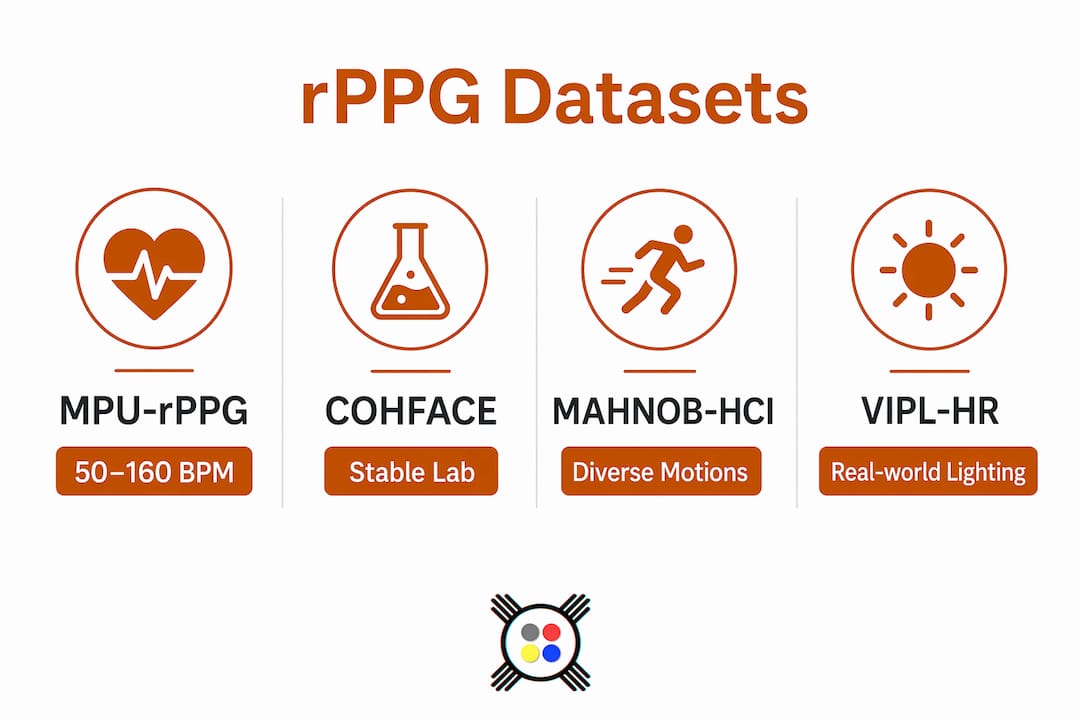
Dataset realism is a major bottleneck for deploying rPPG in unconstrained real-world settings. MPU-rPPG addresses this gap with diverse conditions and heart-rate ranges reflecting actual biometric applications. The practical implication is direct: algorithms trained and validated only on earlier datasets like MAHNOB-HCI or COHFACE will exhibit performance breakdowns when deployed in remote onboarding workflows where users are on mobile devices in variable lighting.
| Dataset | Heart rate range | Key conditions covered | Primary use case |
|---|---|---|---|
| MPU-rPPG | 50–160 bpm | Motion, illumination, occlusion, demographics | Robustness benchmarking |
| MAHNOB-HCI | 45–100 bpm | Controlled lab, emotional stimuli | Affective computing |
| COHFACE | 40–100 bpm | Compressed video, indoor lighting | Compression robustness |
| PURE | 48–90 bpm | Six motion types, stable lighting | Motion artifact studies |
Aligning ground-truth heart rate validation with the intended physiological operating range across diverse demographics prevents performance breakdowns in real biometric onboarding scenarios. This is not a minor calibration detail. It is the difference between a system that passes a controlled benchmark and one that fails on 30% of real users.
Pro Tip: When publishing rPPG algorithm results, always report performance stratified by heart rate range, motion type, and illumination condition separately. Aggregate metrics mask the specific failure modes that matter most for deployment.
How is rPPG applied in biometric security and authentication?
rPPG’s most consequential application in security is passive liveness detection, the ability to confirm that a face presented to a camera belongs to a living person without requiring any active cooperation from the subject. The BioVerify system implements this through physics-grounded rPPG signal analysis, checking for heart-rate presence, temporal coherence across video frames, and spatial coherence across facial regions simultaneously.
The design philosophy of BioVerify reflects a principle that the broader biometric security industry is converging on: explainability is not optional in high-assurance contexts. Every liveness decision must be backed by an auditable evidence pack that includes spectral analysis results, cross-ROI coherence scores, and harmonic analysis outputs. This makes the system’s reasoning transparent to compliance teams and regulators.
Key operational characteristics of the BioVerify approach:
-
Passive detection requires no user action beyond presenting their face to the camera, reducing friction in remote onboarding workflows.
-
Spatial coherence checks compare green-channel rPPG signals across multiple facial ROIs to confirm physiological consistency that synthetic media cannot replicate.
-
Harmonic analysis verifies that the detected cardiac frequency and its harmonics follow expected physiological patterns rather than compression artifacts or replay noise.
-
Fail-safe observability gates return an “Inconclusive” verdict when signal quality falls below confidence thresholds, rather than forcing a binary accept or reject decision.
-
Zero false positive design prioritizes high-assurance KYC compliance over throughput, making it appropriate for regulated identity verification contexts.
“Explainability in remote biometrics is critical. Systems like BioVerify structure their evidence around physiological signal properties to make liveness decisions auditable and trustworthy.” — BioVerify research documentation
The anti-spoofing architecture underlying these systems matters because deepfake video quality has reached a level where pixel-level analysis alone is insufficient. rPPG-based liveness detection is physiologically grounded. A synthetic face cannot generate a coherent cardiac signal across multiple facial regions simultaneously, which is why spatial coherence is the most spoof-resistant signal property available to camera-based biometric systems today.
What are the challenges and regulatory considerations for rPPG in 2026?
rPPG deployment faces three categories of challenge: environmental, algorithmic, and regulatory. Each requires a distinct mitigation strategy, and conflating them leads to systems that address one failure mode while remaining vulnerable to others.
Environmental challenges include:
-
Motion artifacts from head movement, facial expressions, and camera shake that corrupt the cardiac frequency band.
-
Illumination variation from fluorescent flicker, sunlight changes, and mixed lighting sources that introduce non-physiological color channel fluctuations.
-
Partial occlusion from glasses, masks, and hair that reduce the available facial ROI area below reliable signal extraction thresholds.
Algorithmic limitations that researchers must account for:
-
Overfitting to dataset-specific noise profiles, where models learn to exploit artifacts unique to training data rather than genuine physiological signals.
-
Generic denoising failures, where standard signal processing filters remove physiological signal alongside noise when dominant environmental frequencies overlap with the cardiac band.
-
Demographic performance gaps, where algorithms trained on non-diverse datasets underperform on subjects with darker skin tones due to reduced green-channel signal amplitude.
Regulatory requirements are now codified. EU regulation 2026/798 mandates privacy-enhancing cryptographic controls limiting biometric data collection during remote onboarding, specifying data-protection-by-design and data-protection-by-default as non-negotiable requirements. For organizations deploying rPPG in European identity verification workflows, this means biometric signals must be processed locally where possible, with cryptographic binding of identity assertions rather than raw biometric data storage. Data minimization is not a best practice under this framework. It is a legal obligation.
What are practical deployment strategies for rPPG systems?
Deploying rPPG in production requires moving beyond benchmark accuracy and addressing the full operational envelope. The following sequence reflects the order in which deployment decisions compound on each other.
-
Define the physiological operating envelope first. Specify the heart rate range, motion tolerance, and illumination conditions the system must handle before selecting an algorithm. Algorithms optimized for resting heart rates in controlled lighting will fail on users in motion or outdoor environments.
-
Select physiology-informed correction over generic denoising. Adaptive correction modules that apply cardiac dynamics constraints maintain accuracy under motion and low-light conditions where standard bandpass filters fail.
-
Implement cross-ROI coherence validation. Single-ROI systems are vulnerable to localized motion artifacts and partial occlusion. Multi-ROI coherence checking provides both signal reliability and spoof resistance.
-
Integrate observability gates with explicit inconclusive states. Systems that force binary decisions under low signal quality generate false accepts and false rejects. Returning an inconclusive result and requesting a retry is operationally superior to a forced guess.
-
Validate against demographically diverse datasets. MPU-rPPG’s coverage of diverse demographics and conditions is the current benchmark for deployment-grade validation.
Beyond security, rPPG health technology supports clinical biomarker extraction including heart rate variability, respiratory rate, and emerging indicators of hypertension risk and mental stress. A review of 96 studies confirmed the clinical potential of rPPG for remote health assessment, while also identifying outstanding validation gaps that prevent broader clinical adoption. The most promising near-term healthcare applications are continuous vital sign monitoring in telehealth platforms and stress biometrics in occupational health programs, where the non-contact nature of rPPG removes the compliance friction of wearable biometrics.
The convergence of rPPG with optical encryption and spatial computing represents the most significant forward-looking opportunity in this space. Jett Optics has positioned its spatial encryption architecture to complement physiological biometric signals with gaze-based cryptographic keys, creating multi-modal authentication systems where liveness, identity, and intent are verified simultaneously through optical channels.
Key takeaways
rPPG-based remote biometrics is production-viable when physiology-informed signal correction, cross-ROI coherence validation, and fail-safe observability gates are implemented together as a system rather than as independent components.
| Point | Details |
|---|---|
| Physiology-informed correction | Adaptive cardiac constraints outperform generic denoisers under motion and low-light conditions. |
| Cross-ROI coherence | Comparing signals across multiple facial regions is the most spoof-resistant property in camera-based liveness detection. |
| Observability gates | Returning “Inconclusive” under low confidence prevents false decisions and supports KYC compliance. |
| Dataset diversity | MPU-rPPG’s 50–160 bpm range and demographic coverage sets the current standard for deployment-grade validation. |
| Regulatory compliance | EU 2026/798 mandates cryptographic data minimization for biometric remote onboarding workflows. |
Why rPPG’s real bottleneck is uncertainty management, not accuracy
The field has spent considerable energy optimizing rPPG accuracy metrics on controlled benchmarks. That work matters, but it has created a blind spot. The systems that fail in production are not failing because their peak accuracy is insufficient. They are failing because they do not know when they do not know.
What I find most technically compelling about the BioVerify approach is the explicit design decision to return “Inconclusive” rather than force a verdict under poor signal conditions. That is not a limitation. It is the correct engineering choice for any system operating in a high-assurance context. A biometric system that admits uncertainty is more trustworthy than one that projects false confidence.
The same principle applies to dataset selection. Researchers who validate exclusively on COHFACE or MAHNOB-HCI are measuring their algorithm’s performance on a narrow slice of the physiological and environmental space it will encounter in deployment. MPU-rPPG exists precisely because the field needed a dataset that reflects the actual distribution of conditions in remote onboarding workflows, not the convenient distribution of a university lab.
The emerging integration of rPPG with gaze biometrics and optical encryption is where the most defensible authentication architectures are being built. Physiological signals from rPPG provide liveness assurance. Gaze patterns provide intent and identity signals. Cryptographic binding through systems like Jett Optics’ AGT gaze tensors converts those signals into quantum-resistant access credentials. That combination is substantially harder to spoof than any single modality.
The researchers who will define the next generation of remote biometric systems are the ones treating uncertainty quantification, demographic generalization, and cryptographic integration as first-class design requirements rather than afterthoughts.
— Joshua
Build on rPPG with Jett Optics’ optical authentication platform
Jett Optics extends the physiological signal layer of rPPG into a full optical authentication stack. Where rPPG establishes liveness through cardiac signal coherence, Jett Optics’ post-quantum gaze security adds spatial encryption through AGT gaze tensors, converting human attention into cryptographic keys that are quantum-resistant and blockchain-compatible. For teams building remote identity verification systems, this means layering rPPG-based liveness detection with gaze-based identity binding in a single optical pipeline. The JettChat encrypted messaging platform demonstrates this architecture in a production context, where biometric authentication and encrypted communication are unified through optical channels rather than treated as separate systems.
FAQ
What is remote photoplethysmography (rPPG)?
Remote photoplethysmography is a non-contact method for measuring physiological signals such as heart rate by analyzing blood-volume-driven color changes in skin captured through a standard video camera. It requires no physical sensor contact, making it suitable for remote health monitoring and biometric authentication.
How accurate is rPPG for heart rate monitoring?
rPPG accuracy depends heavily on illumination stability, motion level, and algorithm design. Physiology-informed correction significantly improves reliability under motion and low-light conditions compared to standard signal processing approaches.
Can rPPG detect deepfakes and spoofing attempts?
Yes. Systems like BioVerify use spatial coherence of rPPG signals across multiple facial regions to detect synthetic media, since deepfake video cannot generate physiologically consistent cardiac signals across the face simultaneously.
What regulations apply to rPPG in remote onboarding?
EU regulation 2026/798 requires cryptographic data minimization for biometric processing in remote identity onboarding workflows, mandating data-protection-by-design and limiting raw biometric data storage.
What clinical biomarkers can rPPG measure beyond heart rate?
rPPG can extract heart rate variability, respiratory rate, and emerging indicators of hypertension risk and mental stress. A review of 96 studies confirmed this clinical potential while identifying validation gaps that must be addressed before broader clinical deployment.