
TL;DR:
- Healthcare optical biometric compliance involves securing biometric identifiers like iris scans with encryption standards such as AES-256 and TLS 1.3, to meet HIPAA, BIPA, and EU/UK regulations. Continuous oversight, detailed risk management, and vendor agreements are essential to protect patient data and ensure lawful deployment of optical biometric systems. Failure to follow these layered safeguards can lead to severe penalties, data breaches, and regulatory sanctions.
Healthcare optical biometric compliance governs the secure collection, storage, and use of optical biometric identifiers, such as iris scans and retinal patterns, to protect patient data and satisfy overlapping regulatory demands from HIPAA, the Illinois Biometric Information Privacy Act (BIPA), and EU/UK medical device regulations. Biometric data collected in clinical contexts is classified as Protected Health Information (PHI) under HIPAA, which means the full weight of the Security Rule applies. Compliance officers and IT administrators deploying optical systems in healthcare face a layered challenge: encryption standards like AES-256 and TLS 1.3, vendor management through Business Associate Agreements (BAAs), anti-spoofing certification under ISO/IEC 30107-1, and continuous risk governance are all non-negotiable components of a defensible program.
What legal and regulatory frameworks apply to optical biometrics in healthcare?
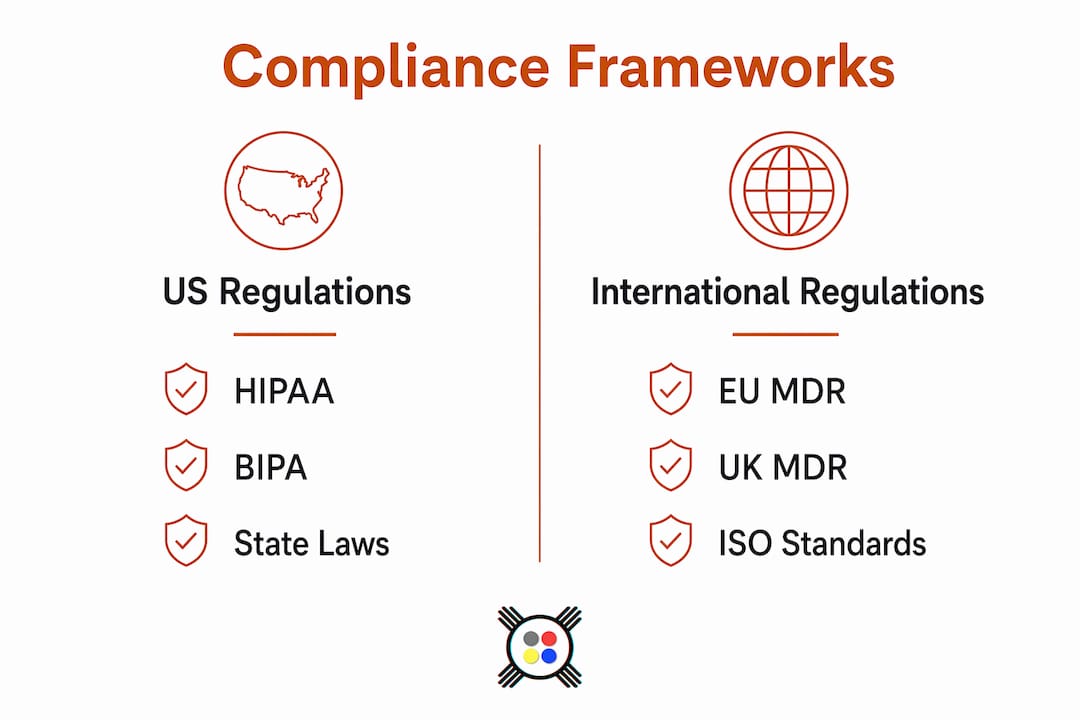
The regulatory environment for optical biometric systems in healthcare spans federal privacy law, state biometric statutes, and international medical device regulations. Each layer carries distinct obligations and penalties, and they do not cancel each other out. A healthcare organization operating in Illinois, for example, must satisfy both HIPAA and BIPA simultaneously.
HIPAA Privacy and Security Rules treat biometric templates as PHI when linked to clinical records. Biometric templates classified as PHI require explicit consent, documented data lifecycle management, and non-invertible storage. Encrypted storage alone does not satisfy the rule. This distinction matters because many organizations deploy iris scanning for patient identification and assume encryption is sufficient, when in fact consent workflows and retention schedules are equally required.
Illinois BIPA is the most aggressively enforced state biometric privacy law in the United States. BIPA penalties reach $5,000 per intentional violation, with attorney fees added to each claim. Active enforcement as of 2026 means a single misconfigured enrollment workflow can generate thousands of individual violations. Healthcare organizations collecting iris scans from Illinois residents must provide written notice, obtain written consent, and publish a publicly available retention and destruction policy before any collection occurs.
EU and UK Medical Device Regulations add a third compliance dimension for organizations operating internationally. Eye examination and ophthalmic biometric equipment are classified as regulated medical devices under both UK MDR and EU MDR, requiring conformity assessments and full technical documentation. This classification applies to hardware used in clinical optical biometric workflows, not just diagnostic instruments.
The table below summarizes the primary frameworks and their core obligations:
| Framework | Core Obligation | Penalty for Non-Compliance |
|---|---|---|
| HIPAA Security Rule | AES-256 encryption, BAAs, audit controls | Civil and criminal penalties |
| Illinois BIPA | Written consent, retention policy, no data sale | Up to $5,000 per intentional violation |
| EU/UK MDR | Conformity assessment, technical documentation | Market withdrawal, regulatory sanctions |
| ISO/IEC 30107-1 | Presentation attack detection testing | Certification failure, regulatory rejection |
How must healthcare organizations technically secure optical biometric data?
Technical safeguards for optical biometric data go beyond standard PHI protections because biometric identifiers are permanent. A compromised password can be reset. A compromised iris template cannot. This irreversibility demands a higher standard of cryptographic rigor at every layer of the data lifecycle.

HIPAA security standards specify AES-256 encryption for data at rest, with encryption keys held in Hardware Security Modules (HSMs) or equivalent secure vaults, and TLS 1.3 for data in transit. TLS 1.2 remains technically acceptable but is no longer the preferred standard. Any optical biometric system transmitting enrollment or authentication data over a network must use TLS 1.3 by default in 2026.
The following technical controls are required for a compliant optical biometric deployment:
-
Encryption at rest and in transit. Deploy AES-256 with HSM-managed keys for stored templates. Use TLS 1.3 for all data transmission between enrollment stations, authentication servers, and identity management systems.
-
Multi-factor authentication and least-privilege access. Biometric system administrators must authenticate with at least two factors. Role-based access controls limit which personnel can query, export, or modify biometric templates.
-
Audit logging and monitoring. Role-based access, automatic logoff, and audit logging are explicit HIPAA technical safeguard requirements. Every access event, enrollment, and authentication attempt must be logged with timestamps and user identifiers.
-
Break-glass procedures and incident response. Define documented procedures for emergency access to biometric systems and a tested incident response plan that covers biometric template compromise specifically.
-
Vendor oversight via Business Associate Agreements. All vendors handling biometric ePHI must sign BAAs that explicitly address biometric data handling, breach notification timelines, and subcontractor obligations.
-
Anti-spoofing and presentation attack detection. ISO/IEC 30107-1 and CEN/TS 18212-3:2026 require biometric systems to be tested against both impostor and concealer presentation attacks. Failure to meet these standards can block certification and regulatory approval.
-
Biometric template lifecycle management. Templates must be non-invertible by design to prevent reconstruction of the underlying biometric image. Documented policies must govern template creation, storage duration, and secure deletion.
Pro Tip: When evaluating optical biometric vendors, request their ISO/IEC 30107-1 test reports and ask specifically which attack categories were evaluated. A vendor who cannot produce third-party presentation attack detection results has not met the standard, regardless of marketing claims.
Spatial encryption and post-quantum security methods are now viable options for organizations seeking to future-proof biometric template storage beyond current AES-256 baselines. These approaches improve resistance to advanced cryptanalytic attacks and can simplify compliance audits by providing a single, auditable encryption layer.
What are the risks and governance best practices for optical biometric systems?
Risk governance for optical biometrics in healthcare requires a dedicated framework that builds on, but extends beyond, the standard HIPAA risk analysis. The permanence of biometric identifiers and the sensitivity of the clinical context create risk scenarios that generic IT risk assessments do not capture.
Effective governance programs share several structural characteristics:
-
Biometric-specific risk assessments. Map every point where optical biometric data is collected, processed, stored, or transmitted. Standard HIPAA risk analyses often miss enrollment kiosks, third-party identity verification APIs, and cloud-based template repositories.
-
Data flow mapping across vendors. Continuous risk management through data flow mapping and threat identification is more effective than point-in-time assessments. Document every vendor that touches biometric data and verify BAA coverage for each.
-
Data minimization and retention limits. Collect only the biometric data required for the stated clinical purpose. Define maximum retention periods aligned with BIPA, HIPAA, and any applicable state law, and automate deletion at the end of the retention window.
-
Transparent biometric privacy policies. Publicly available biometric information policies must specify what data is collected, for what purpose, how long it is retained, and that it will not be sold. Most compliance failures trace back to privacy notices that do not explicitly mention biometric data collection.
-
Staff training and awareness. Clinical and administrative staff who interact with optical biometric systems need role-specific training covering consent workflows, incident reporting, and data handling restrictions.
-
Vulnerability testing targeting presentation attacks. Compliance auditors expect biometric systems to withstand sophisticated spoofing attempts. Schedule periodic penetration testing that specifically targets optical biometric capture hardware and software.
Pro Tip: Treat your biometric data governance layers as a living architecture. Assign a named owner to each data flow, review ownership assignments quarterly, and update your risk register whenever a vendor relationship or system configuration changes.
How do healthcare organizations implement and audit optical biometric compliance programs?
Deploying a compliant optical biometric program requires structured implementation followed by continuous audit activity. A one-time deployment review does not satisfy HIPAA’s requirement for ongoing risk management, and it will not withstand scrutiny from OCR investigators or state attorneys general enforcing BIPA.
The following sequence reflects current best practice for 2026 deployments:
-
Develop and publish compliance policies before deployment. Draft biometric-specific addenda to your existing HIPAA privacy and security policies. These addenda must address consent workflows, data collection scope, retention schedules, and breach response procedures specific to biometric PHI.
-
Design secure enrollment and authentication workflows. Enrollment stations must capture consent electronically, log the consent event with a timestamp, and transmit template data only over TLS 1.3 connections to HSM-protected storage. Authentication workflows must enforce multi-factor verification for privileged access.
-
Implement audit logging from day one. Configure your identity management platform to log every biometric authentication event, enrollment, template update, and deletion. Retain logs for a minimum of six years to satisfy HIPAA’s documentation retention requirement.
-
Conduct a post-deployment risk assessment. After go-live, perform a biometric-specific risk assessment to identify gaps between the designed architecture and the deployed system. Update your risk register and remediate findings within documented timelines.
-
Schedule periodic compliance reviews. Integrate biometric compliance reviews into your annual HIPAA risk analysis cycle. Add a mid-year review specifically targeting vendor BAA status, template lifecycle adherence, and anti-spoofing test currency.
The table below compares a reactive compliance posture against a continuous governance model:
| Dimension | Reactive posture | Continuous governance model |
|---|---|---|
| Risk assessment frequency | Annual or incident-driven | Quarterly, triggered by system or vendor changes |
| Vendor oversight | BAA signed at contract start | BAA reviewed annually, subcontractors verified |
| Anti-spoofing testing | At deployment only | Scheduled penetration tests, updated per new attack vectors |
| Privacy policy updates | Updated after regulatory changes | Reviewed at each system change and annually |
| Staff training | Onboarding only | Role-specific, annual refresher with documented completion |
Organizations integrating biometric security industry trends into their governance programs are better positioned to anticipate regulatory shifts before enforcement actions occur. The biometric encryption patent landscape also informs procurement decisions, particularly when evaluating whether a vendor’s claimed encryption method is proprietary, standards-based, or legally encumbered.
Key takeaways
Healthcare optical biometric compliance requires layered regulatory adherence, non-invertible template encryption, continuous vendor oversight, and documented risk governance to protect PHI and avoid HIPAA and BIPA penalties.
| Point | Details |
|---|---|
| Biometric data is PHI | Optical biometric templates linked to clinical records carry full HIPAA Security Rule obligations. |
| BIPA penalties are severe | Illinois BIPA imposes up to $5,000 per intentional violation, making consent workflow errors costly. |
| Encryption must be complete | AES-256 with HSM-managed keys and TLS 1.3 in transit are the current minimum technical standards. |
| BAAs are non-negotiable | Every vendor handling biometric ePHI must sign a BAA with explicit biometric data handling terms. |
| Compliance is continuous | Point-in-time assessments are insufficient; governance requires scheduled reviews, testing, and vendor audits. |
Why most compliance programs underestimate optical biometric risk
The most common mistake I see compliance teams make is treating optical biometric deployment as a subset of standard PHI management. It is not. The irreversibility of biometric identifiers creates a risk profile that standard HIPAA controls were not designed to address in full. When a social security number is exposed, you can issue a new one. When an iris template is compromised, the patient carries that vulnerability permanently.
The second oversight is vendor risk. Even with vendor-supplied security assurances, healthcare organizations bear ultimate compliance responsibility and must independently validate vendor controls. I have reviewed BAAs that were signed at contract execution and never revisited, while the vendor added three subprocessors and migrated template storage to a new cloud region. That is a live compliance gap, not a theoretical one.
The third issue is spoofing. Most compliance programs focus on data protection and consent, which are correct priorities, but they skip presentation attack testing entirely. Regulators and auditors are catching up to this gap. Presentation attack detection covering both impostor and concealer attacks is now an expected component of any mature optical biometric compliance program, not an optional enhancement.
The organizations that handle this well treat biometric compliance as a continuous program with named owners, scheduled reviews, and a live risk register. They do not wait for a breach or a regulatory inquiry to find out whether their controls actually work.
— Joshua
How Jett Optics supports healthcare optical biometric compliance
Healthcare compliance officers and IT administrators need more than policy templates. They need cryptographic infrastructure that meets current standards and scales with evolving regulatory requirements.

Jett Optics delivers spatial encryption and quantum-resistant authentication architectures designed specifically for optical biometric environments. The platform’s gaze-based authentication uses AGT gaze tensors as cryptographic keys, providing a non-invertible authentication layer that satisfies HIPAA template security requirements while eliminating the static template vulnerabilities that make traditional iris scan systems a liability. Jett Optics integrates with existing healthcare identity management frameworks and supports audit logging, HSM-compatible key management, and anti-spoofing detection aligned with ISO/IEC 30107-1. For compliance teams looking to reduce audit exposure and strengthen health data biometric security, Jett Optics spatial encryption provides a technically defensible foundation.
FAQ
What makes biometric data PHI under HIPAA?
Biometric identifiers, including iris scans and retinal patterns, are classified as PHI when collected or used in connection with healthcare services and linked to an individual’s health records. HIPAA’s Privacy Rule explicitly lists biometric identifiers as one of the 18 categories of PHI.
What encryption standards apply to optical biometric data in healthcare?
HIPAA requires AES-256 encryption for biometric data at rest, with keys managed in Hardware Security Modules, and TLS 1.3 for data in transit. These standards apply to all systems storing or transmitting biometric templates as part of a healthcare workflow.
Does BIPA apply to healthcare organizations?
Yes. Illinois BIPA applies to any private entity collecting biometric data from Illinois residents, including healthcare organizations. BIPA requirements for written notice, written consent, and a published retention policy operate independently of HIPAA and carry penalties up to $5,000 per intentional violation.
How often should optical biometric systems be tested for spoofing?
ISO/IEC 30107-1 and CEN/TS 18212-3:2026 require testing against both impostor and concealer presentation attacks. Best practice in 2026 is to conduct anti-spoofing penetration tests at deployment, after any hardware or software update, and on an annual scheduled basis at minimum.
What must a Business Associate Agreement cover for biometric vendors?
A BAA for a biometric vendor must explicitly address biometric data handling procedures, breach notification timelines specific to biometric PHI, subcontractor obligations, and the vendor’s responsibility for anti-spoofing and encryption controls. Generic BAA templates that do not mention biometric data are insufficient.