

TL;DR:
- Effective optical security vendor evaluation relies on validated cryptographic certifications, comprehensive multi-layer threat assessments, and structured scenario-based demos. Conducting thorough third-party validation, ensuring operational compatibility, and establishing clear scoring rubrics beforehand are essential to making defensible procurement decisions. Ignoring these structured processes often leads to field failures, unverified claims, and integration challenges that compromise long-term security.
Optical security vendor evaluation is defined as the structured process of assessing vendors against technical performance, cryptographic compliance, integration capability, and operational fit before committing to advanced authentication or encryption deployments. Security professionals who skip this process routinely discover that polished demos mask integration gaps, unvalidated quantum-safe claims, or optical PUF metrics that collapse under real environmental conditions. The frameworks covered here apply directly to deployments involving quantum key distribution (QKD), post-quantum cryptography (PQC) standards such as NIST FIPS 140-3 and CAVP, and physical unclonable function (PUF) technologies. Getting this evaluation right determines whether your organization gains a genuinely secure optical layer or inherits a liability dressed in technical marketing.
How to evaluate optical security vendor solutions: core criteria
The most defensible vendor evaluations are built on capability categories, not feature lists. Structured vendor checklists that prioritize system integration, data security, scalability, field adoption, and operational support consistently outperform evaluations driven by marketing collateral. Each category maps to a concrete failure mode: poor integration produces key management gaps, weak scalability creates bottlenecks under load, and thin field adoption signals unproven reliability.
Technical criteria for optical security differ meaningfully from standard IT procurement. The evaluation must cover:
-
Optical effect reliability: Consistency of optical PUF responses, holographic authentication, or spatial encryption outputs across temperature, humidity, and lighting variation
-
Encryption strength and key management: Verified implementation of post-quantum algorithms (ML-KEM, ML-DSA, SLH-DSA) with documented key rotation and revocation procedures
-
Quantum-safe key exchange: Support for QKD or PQC-based key establishment, not just symmetric encryption at rest
-
Physical security features: Optical PUF entropy metrics, uniqueness scores, and bit stability under environmental stress
-
Multi-layer threat coverage: Optical network threats span physical, control plane, and cross-layer dimensions; vendors must demonstrate protections across all three, not just encryption on paper
Operational factors carry equal weight. Total cost of ownership, vendor financial stability, integration compatibility with existing identity and access management (IAM) infrastructure, and SLA commitments all determine whether a technically superior product survives contact with your production environment.
Pro Tip: Build your scoring rubric before the first vendor call. Assign percentage weights to each capability category, and require internal sign-off from security, IT, and procurement stakeholders before any demo begins. This prevents post-demo score manipulation driven by vendor relationships or presentation quality.

How do you verify quantum-safe encryption and optical PUF claims?
Vendor claims of “quantum-safe” or “post-quantum ready” are meaningless without third-party validation. NIST CAVP and CMVP certifications are the authoritative trust anchors for confirming that a vendor’s cryptographic module correctly implements PQC algorithms and meets federal procurement requirements. A vendor without CAVP or CMVP certification for their PQC implementation has not proven correctness at the algorithm level, regardless of what their documentation states.
For QKD-based systems, demand independent lab test results covering these specific metrics:
-
Quantum bit error rate (QBER): Secure systems operate below 4%. QBER thresholds validated by VIAVI on QNU Labs’ Armos QKD platform confirm this as the accepted industry benchmark. A vendor claiming QBER performance without independent lab data is presenting unverified assertions.
-
Operating distance: QKD systems validated on standard telecom fiber without amplification operate up to 200 km. Vendors claiming longer distances should provide peer-reviewed or independently tested evidence.
-
Key establishment rate: Measure raw key generation throughput under realistic channel loss conditions, not idealized lab setups.
-
Management-plane integration: Key establishment performance and management-plane security must be evaluated separately, as integration gaps are where real-world failures concentrate.
Optical PUF evaluation requires a different methodology. Peer-reviewed PUF research establishes that entropy metrics, uniqueness scores, and bit stability under environmental stress are the three non-negotiable acceptance criteria. A vendor claiming unclonable device fingerprinting must provide data on inter-device Hamming distance (ideally near 50%), intra-device stability across temperature and humidity ranges, and error correction overhead. Without these figures, the unclonability claim is marketing, not engineering.
“Independent validation and authoritative certifications provide critical trust anchors in evaluating advanced optical and cryptographic technologies from vendors.” Treat any vendor who resists sharing certification numbers or independent test reports as a disqualifying signal, not a negotiation point.
Patent disclosures offer a secondary validation layer. Patent specifications detail manufacturing tolerances and diffractive structure parameters that establish engineering acceptance criteria. Cross-referencing a vendor’s product claims against their patent filings reveals whether their stated performance is grounded in documented engineering or aspirational positioning.
What does a structured vendor demo and scoring process look like?
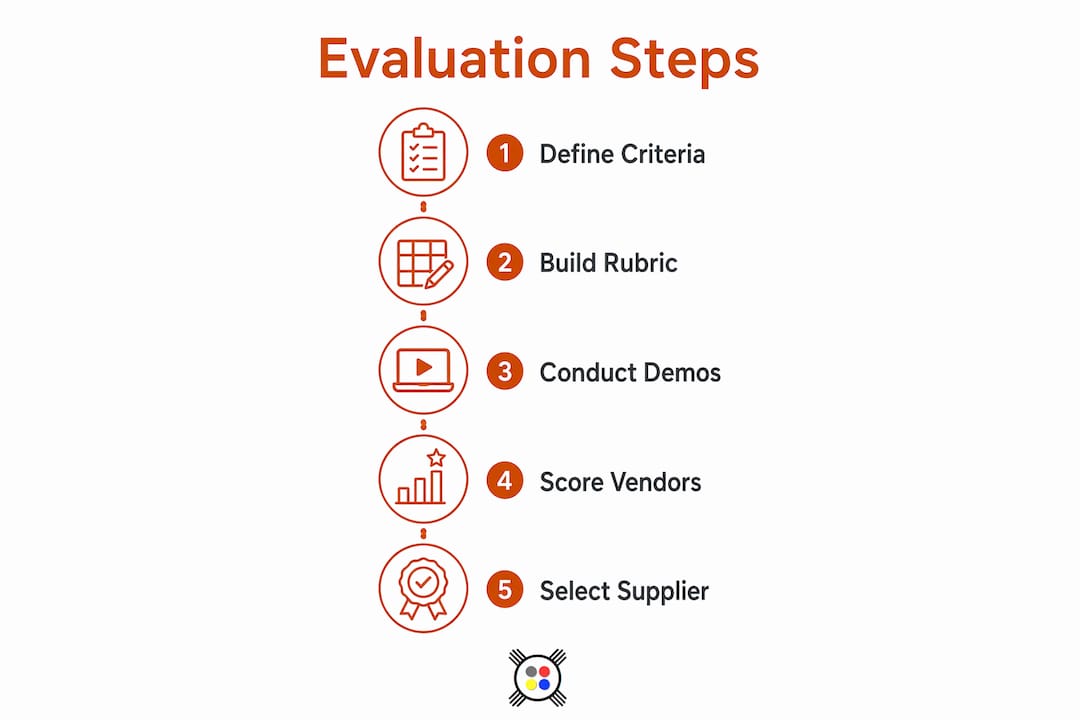
A structured optical security vendor assessment follows a defined sequence that prevents subjective drift and produces defensible decisions. Pre-agreed scoring weights are the single most effective mechanism for keeping evaluations objective, particularly when internal stakeholders have pre-existing vendor preferences.
The process runs in five stages:
-
Requirements definition and weight assignment: Document must-have capabilities (NIST-validated PQC, multi-layer threat coverage, IAM integration) and nice-to-have features (biometric gaze authentication, on-chain identity anchoring). Assign percentage weights before any vendor contact.
-
Desk review and RFI screening: Issue a Request for Information covering certification numbers, independent test reports, reference customer contacts, and integration architecture. Eliminate vendors who cannot provide CAVP or CMVP certificates at this stage.
-
Shortlist and scenario-based demos: Limit demos to three to five vendors. Require each vendor to demonstrate their solution against your specific workflows, including edge cases such as high-latency network conditions, multi-inspector authentication scenarios, and environmental variation for optical PUF systems.
-
Structured scoring: Score each vendor against your pre-agreed rubric immediately after each demo. Do not aggregate scores across the evaluation team until all individual scores are submitted independently.
-
Reference validation and technical deep-dive: Contact at least two reference customers in comparable deployment environments. Request architecture review sessions with the vendor’s engineering team, not just sales.
| Criterion | Weight | Must-Have Threshold |
|---|---|---|
| NIST CAVP/CMVP certification | 25% | Certificate number required |
| Multi-layer threat coverage | 20% | Physical + control + cross-layer |
| IAM and infrastructure integration | 20% | API documentation + tested compatibility |
| Optical PUF entropy and stability | 15% | Inter-device Hamming distance near 50% |
| Vendor financial health and roadmap | 10% | Audited financials or public filings |
| Total cost of ownership | 10% | 3-year TCO model provided |
Pro Tip: Run at least one demo scenario that simulates a real failure condition, such as a degraded optical channel or a revoked key event. Vendors who have only prepared for success scenarios will reveal integration and recovery gaps that polished presentations conceal.
Lab demos for optical security frequently fail in the field because inspection conditions vary in ways that controlled environments do not replicate. Require field-style testing with multiple inspectors and define repeatability thresholds as formal acceptance criteria before signing any contract.
Operational alignment, references, and contract considerations
Technical superiority does not guarantee deployment success. Total cost of ownership, reliability, and operational fit must be weighted alongside optical-specific criteria to prevent scenarios where a technically excellent product fails because it cannot integrate with your existing infrastructure or support model.
Stakeholder alignment is the operational factor most frequently underestimated. Security, IT operations, compliance, and procurement teams each apply different success criteria to the same vendor. Resolving these differences before demos begin, not after a preferred vendor is selected, prevents the political stalemates that derail otherwise sound evaluations.
Key operational factors to assess during the vendor solution evaluation process include:
-
Reference customer due diligence: Speak directly with security architects at reference sites, not just project managers. Ask specifically about integration complexity, time to first authenticated session, and any cryptographic module failures encountered post-deployment.
-
Contract structure: Require implementation support milestones, price lock provisions for at least 24 months, SLA commitments with financial penalties for downtime, and exit clauses that include data portability and key escrow provisions.
-
Vendor financial health: Request audited financials or verify public filings. A vendor with validated quantum-safe technology but insufficient runway to support a 3-year deployment is a procurement risk regardless of technical merit.
-
Product roadmap alignment: Confirm that the vendor’s development priorities align with your organization’s trajectory. If your roadmap includes decentralized identity, Web3 integration, or spatial computing environments, a vendor whose roadmap ends at traditional PKI is not a long-term fit.
-
Scalability validation: Require documented evidence of deployments at your target scale, not just theoretical capacity claims. Optical security assessments that ignore scalability under production load routinely produce costly re-procurement cycles within 18 months.
Authentication method compatibility also matters for organizations deploying multi-factor authentication alongside optical security layers. Verify that the vendor’s optical authentication integrates with your existing MFA infrastructure without requiring parallel credential stores.
Key takeaways
Effective optical security vendor evaluation requires validated cryptographic certifications, multi-layer threat coverage assessment, structured scenario-based demos, and pre-agreed scoring weights to produce defensible, operationally sound procurement decisions.
| Point | Details |
|---|---|
| Certifications are non-negotiable | Require NIST CAVP and CMVP certificate numbers before advancing any vendor past the RFI stage. |
| Multi-layer assessment is mandatory | Evaluate protections across physical, control plane, and cross-layer dimensions, not encryption alone. |
| Score before you demo | Assign and lock percentage weights to evaluation criteria before any vendor presentation begins. |
| Field-test optical PUF claims | Demand inter-device Hamming distance data and stability metrics across environmental conditions. |
| Operational fit determines success | Contract structure, vendor financial health, and scalability evidence matter as much as technical features. |
What most evaluations get wrong about optical security vendors
From my experience working through optical security assessments with security teams across government and enterprise environments, the single most common failure is treating the vendor demo as the evaluation rather than as one data point within a structured process. Teams spend weeks preparing RFPs and then abandon their scoring rubrics the moment a vendor delivers a compelling live demonstration. The demo becomes the decision.
The second failure is accepting “quantum-safe” claims at face value. I have reviewed vendor documentation from organizations that deployed what they believed were post-quantum encrypted optical networks, only to discover during a security audit that the PQC implementation had never been submitted for CAVP validation. The algorithm was correct on paper. The implementation was not verified. That distinction is the difference between actual security and documented liability.
The third failure is underweighting integration complexity. Optical security technologies, particularly those involving spatial encryption, gaze-based authentication, or optical PUF device fingerprinting, introduce dependencies that standard IT procurement frameworks do not anticipate. Key management integration, management-plane security, and IAM compatibility each require dedicated technical review sessions with the vendor’s engineering team, not their sales organization.
The vendors worth serious consideration are those who provide certification numbers unprompted, offer reference contacts without negotiation, and can articulate their key rotation and revocation architecture in a 30-minute technical session. Those who cannot are not ready for production deployment, regardless of how advanced their optical technology appears.
— Joshua
How Jett Optics approaches optical security evaluation and deployment
Jett Optics builds spatial encryption and post-quantum gaze security technologies designed specifically for the evaluation criteria outlined in this article. The platform’s spatial encryption architecture integrates AGT gaze tensors, quantum-resistant key exchange, and blockchain-compatible identity anchoring through DePIN networks, addressing the multi-layer threat coverage, key management integration, and scalability requirements that structured vendor evaluations demand. Deployments operate without hardware replacement, reducing integration complexity and total cost of ownership. Security professionals conducting an optical encryption assessment will find that Jett Optics’ architecture is documented, independently verifiable, and built for next-generation secure environments where human biometric inputs serve as cryptographic keys.
FAQ
What certifications should optical security vendors hold?
Vendors implementing post-quantum cryptography must hold NIST CAVP and CMVP certifications, which confirm algorithm correctness and module security at the implementation level. FIPS 140-3 compliance is required for federal procurement and strongly recommended for enterprise deployments.
How is optical PUF security verified during vendor evaluation?
Optical PUF evaluation requires inter-device Hamming distance data near 50%, intra-device bit stability metrics across temperature and humidity ranges, and documented error correction overhead. Vendors who cannot provide these figures have not validated their unclonability claims with engineering evidence.
What QBER threshold indicates a secure QKD system?
A quantum bit error rate below 4% is the validated benchmark for secure QKD operation, confirmed through independent lab testing on platforms including QNU Labs’ Armos QKD system with VIAVI. Systems operating above this threshold are considered compromised or insufficiently characterized.
Why do optical security demos often fail in production?
Lab demos use controlled inspection conditions that do not replicate field variation in lighting, temperature, or operator technique. Requiring field-style testing with multiple inspectors and defined repeatability thresholds as formal acceptance criteria prevents this gap from becoming a post-deployment failure.
What contract terms are critical for optical security vendor agreements?
Contracts must include implementation support milestones, 24-month price lock provisions, SLA commitments with financial penalties, exit clauses with data portability and key escrow provisions, and documented scalability evidence at your target deployment scale.