

TL;DR:
- Selecting deep tech encryption ventures in 2026 requires assessing their maturity, integration complexity, and regulatory environment to ensure practical deployment. Ventures like PQC offer near-term relevance with active customer pipelines, while FHE, QKD, and hybrid platforms vary in readiness and cost. Building hardware-software convergence and considering regulatory risks are crucial for successful adoption and market competitiveness.
Selecting among the major types of deep tech encryption ventures in 2026 is genuinely difficult. The field spans fully homomorphic computation, post-quantum algorithm libraries, quantum key distribution hardware, and optical biometric systems, each with distinct capital requirements, production timelines, and integration profiles. For entrepreneurs and technology innovators building the next generation of secure digital infrastructure, the wrong choice costs months of development time and millions in capital. This guide cuts through the noise by mapping the dominant venture categories, comparing their trade-offs, and offering a structured evaluation framework to match venture type to strategic objective.
Table of Contents
-
1. Key criteria for evaluating types of deep tech encryption ventures
-
5. Emerging hybrid and developer-friendly encryption ventures
-
6. Comparative analysis of deep tech encryption venture types
Key takeaways
| Point | Details |
|---|---|
| Production readiness varies sharply | Only about one-third of FHE ventures have production-grade products; verify maturity before committing resources. |
| Quantum readiness is not optional | PQC and QKD ventures are accelerating toward Q-Day preparedness; crypto-agility must be built in from day one. |
| Hardware-software convergence wins | Ventures combining proprietary silicon with software IP consistently outperform single-domain approaches. |
| Regulatory risk shapes market geography | Legislation like Canada’s Bill C-22 is actively redirecting encryption startup capital to pro-encryption jurisdictions. |
| Integration complexity determines adoption | Encryption-as-a-service models with zero code changes are emerging as the dominant enterprise adoption path. |
1. Key criteria for evaluating types of deep tech encryption ventures
Before analyzing individual venture categories, you need a structured lens to assess them. The types of deep tech encryption ventures active in 2026 differ enormously in maturity, capital intensity, and real-world applicability. Without a clear evaluation framework, you risk selecting a technically impressive venture that cannot ship.
The criteria that matter most to entrepreneurs:
-
Technology Readiness Level (TRL). Where is the product on the spectrum from lab prototype to production deployment? TRL 7 and above means the technology has been demonstrated in a relevant operational environment. Anything below TRL 6 signals that significant engineering work remains before commercial delivery.
-
Hardware versus software focus. Pure software encryption ventures iterate faster but face commoditization. Pure hardware ventures build deeper moats but carry longer development cycles and steeper capital requirements. Hardware-software convergence ventures that combine proprietary silicon with classical software consistently outperform single-domain models.
-
Quantum resistance and post-quantum preparedness. NIST finalized its first PQC algorithm standards in 2024. Any encryption venture that cannot demonstrate a post-quantum migration path or native quantum resistance is carrying existential technical debt.
-
Integration complexity and developer experience. How much does adopting this venture’s technology cost in developer hours? Encryption-as-a-service platforms that require zero application code changes are setting a new bar for enterprise adoption velocity.
-
Venture capital traction and regulatory exposure. VC signals tell you where the market is moving. Regulatory signals tell you where it might stall. Legislation such as Canada’s Bill C-22, which debates encryption backdoors versus digital sovereignty, is already triggering startup relocations to more favorable jurisdictions. Always map the regulatory environment of the venture’s primary markets before investing or integrating.
Pro Tip: When reviewing a deep tech encryption venture’s due diligence materials, explicitly ask for a production deployment reference. A compelling whitepaper is not a substitute for a live customer running the system at scale.
2. Fully homomorphic encryption ventures
Fully Homomorphic Encryption, or FHE, is one of the most technically ambitious categories within deep tech encryption solutions. FHE allows computation to be performed directly on encrypted data without ever decrypting it, which eliminates the most common attack surface in traditional data pipelines: the moment data must be exposed for processing.
The venture capital community has taken note. FHE sector funding exceeded $2.1 billion in early 2026, reflecting serious institutional belief in the technology’s long-term value. Companies like Zama, Duality Technologies, and Enveil have attracted significant rounds based on enterprise demand for privacy-preserving analytics, secure multi-party computation, and confidential AI inference.
The production reality, however, is more nuanced. Only about 33% of major FHE companies have reached production-grade security products capable of handling large datasets with acceptable latency. The core challenge is computational overhead. FHE operations can require orders of magnitude more processing power than standard encryption, creating what some engineers call a “transit tax” when data must cross hardware boundaries. Only a handful of ventures have solved microsecond-level latency on commodity hardware.
Key attributes of FHE ventures worth tracking:
-
Use case fit: Confidential cloud computing, privacy-preserving machine learning, healthcare data analytics, and financial modeling on sensitive datasets.
-
Funding leaders: Zama (open-source FHE toolchain), Duality Technologies (enterprise privacy-preserving analytics), and Enveil (secure data collaboration).
-
Primary risk: Computational overhead still limits applicability to high-value, low-frequency operations in most deployments.
-
Production maturity signal: Ask whether the product runs on standard server hardware or requires specialized accelerators. Accelerator dependency indicates the venture is still resolving the latency problem.
FHE remains one of the most defensible categories in the encryption startup universe because the underlying mathematical complexity creates genuine barriers to commoditization. The question is not whether FHE will be production-ready at scale. It is which ventures will survive long enough to get there.
3. Post-quantum cryptography startups and solutions

Post-quantum cryptography ventures build algorithm libraries, chips, and firmware designed to resist attacks from quantum computers running Shor’s algorithm and related quantum-enabled attacks against RSA, ECC, and Diffie-Hellman key exchange. With cryptographically relevant quantum computers projected within the decade, this is the most immediately actionable category among all types of encryption technologies in deployment today.
PQShield secured over $63 million to develop chip-level and firmware-level quantum-resistant IP, demonstrating that hardware-integrated PQC has attracted serious institutional capital. Quantum Bridge Technologies raised $16 million total to advance its DSKE protocol for Q-Day-ready secure communications. Meanwhile, ISARA and Keyfactor have built their market positions specifically around crypto-agility: the ability to swap out encryption algorithms without overhauling the underlying infrastructure.
Core attributes of PQC ventures:
-
Algorithm coverage: Leading ventures implement CRYSTALS-Kyber for key encapsulation and CRYSTALS-Dilithium for digital signatures, both NIST-standardized.
-
Hardware integration path: The strongest PQC ventures offer both software libraries and silicon IP so customers can deploy at the application layer first and migrate to hardware acceleration as volumes grow.
-
Crypto-agility as a differentiator: Building crypto-agile systems early is critical given the difficulty of patching hardware-deployed encryption algorithms after deployment. Ventures that bake algorithm-switching capability into the architecture from day one are far better positioned for enterprise procurement.
-
Adoption timeline: Financial services, defense, and critical infrastructure are the earliest adopters, driven by regulatory mandates and long asset lifetimes.
PQC ventures offer the clearest path to near-term production deployment among all deep tech encryption categories, which makes them attractive for entrepreneurs looking for ventures with defined customer pipelines rather than purely research-driven narratives. Review the deep tech security commercialization path for how PQC ventures are moving from lab to procurement cycles in 2026.
4. Quantum key distribution ventures
QKD ventures operate at the most hardware-intensive end of the quantum-safe communications spectrum. Rather than replacing classical algorithms with quantum-resistant mathematics, QKD physically transmits cryptographic keys using individual photons. The laws of quantum mechanics guarantee that any eavesdropping attempt disturbs the photon state and becomes detectable.
The major players in this space reflect the geographic concentration of government investment. ID Quantique in Switzerland, QuantumCTek in China, QNu Labs in India, and Toshiba’s quantum research division have all deployed production QKD links, primarily across metropolitan fiber networks and in satellite-based trials. These are not startup experiments. They are active government and financial sector deployments.
The trade-offs are significant:
-
Cost and infrastructure: QKD requires dedicated fiber runs or line-of-sight optical links, specialized photon detectors, and cryogenic components in some implementations. The per-link cost remains prohibitive for most commercial applications.
-
Distance constraints: Standard fiber QKD degrades beyond roughly 100 kilometers without trusted relay nodes, which introduce security assumptions that undermine the theoretical guarantees.
-
Hybrid QKD plus PQC: The most sophisticated deployments combine QKD for key distribution with PQC for algorithm-level quantum resistance. This layered approach is what enterprise IT security architectures are beginning to specify for critical infrastructure.
Pro Tip: Unless your venture targets government procurement, satellite communication, or Tier 1 financial infrastructure, QKD is likely too capital-intensive and operationally complex for your deployment window. PQC gives you 95% of the quantum-safe benefit at 5% of the infrastructure cost for most enterprise contexts.
QKD ventures are best evaluated as strategic infrastructure plays rather than broadly applicable encryption startup bets. The addressable market is real but narrow, and the capital requirements demand patient, government-aligned investors.
5. Emerging hybrid and developer-friendly encryption ventures
The fastest-growing category in 2026 is the one least often discussed in academic papers: encryption ventures that prioritize developer experience and operational velocity as primary product attributes. These are companies building encryption-as-a-service platforms, gateway-based solutions, and drop-in SDK integrations that bring serious cryptographic protection without requiring the customer to hire a cryptography PhD.
Encryption-as-a-service platforms that offer native encrypted operations from day one, with zero application code changes, are solving a real and expensive problem. Early-stage startups that add encryption as an afterthought after launch routinely face costly full rewrites of their data layer. The ventures in this category prevent that outcome by making encryption a first-class architectural citizen from initial deployment.
A comparison of integration approaches across this category:
| Approach | Integration Effort | Security Level | Best For |
|---|---|---|---|
| Gateway-based encryption | Minimal: no code changes | Strong classical + PQC-ready | Enterprise SaaS, APIs |
| SDK / library drop-in | Low: language-specific packages | Configurable | Web3 apps, mobile |
| Optical spatial encryption | Specialized: hardware-adjacent | Quantum-resistant biometric | AR/VR, spatial computing |
| Custom FHE integration | High: deep data layer rewrite | Maximum privacy-preserving | Healthcare, confidential AI |
Optical spatial encryption, as developed by Jett Optics and described in detail in spatial computing security, represents a distinct hybrid approach where biometric inputs such as gaze vectors become cryptographic keys. This eliminates password surfaces entirely and operates in ambient, hands-free environments where traditional input modalities fail.
The encryption business models in this category tend toward SaaS licensing, per-API-call pricing, and hardware-plus-subscription bundles. These models align recurring revenue with actual usage, which is a significant advantage over one-time hardware sales when courting institutional investors.
6. Comparative analysis of deep tech encryption venture types
Not every venture type suits every entrepreneur’s strategic position. The following comparison maps the four major categories across the criteria most relevant to build-versus-buy and invest-versus-partner decisions.
| Venture Type | Production Maturity | Capital Requirement | Integration Complexity | Quantum Resistance | Primary Use Case |
|---|---|---|---|---|---|
| FHE | Low to moderate (33% production-ready) | High | Very High | Native | Confidential AI, healthcare analytics |
| PQC | Moderate to high | Medium | Medium | Native | Enterprise software, chips, firmware |
| QKD | High (niche deployments) | Very High | High | Physical | Government, financial infrastructure |
| Hybrid / EaaS | Moderate to high | Low to medium | Low | PQC-ready | Developer platforms, Web3, spatial auth |
The pattern is clear. FHE and QKD carry the highest technical sophistication but also the steepest operational demands. PQC offers the strongest combination of near-term deployability and genuine quantum resistance. Hybrid and developer-friendly encryption ventures optimize for adoption speed and market reach, making them particularly suited to entrepreneurs building platforms rather than point security solutions.
Entrepreneurs should also weigh the AR security investment considerations when the target deployment environment involves spatial computing, extended reality, or ambient authentication. In those contexts, optical spatial encryption ventures occupy a category of their own, combining quantum-resistant cryptography with biometric key generation in a way that neither classical PQC nor QKD can replicate.
My take on selecting deep tech encryption ventures
I have spent enough time analyzing deep technology ventures to recognize a consistent pattern. The ventures that attract the most impressive technical press rarely deliver the fastest enterprise traction. The ventures that win in the market solve integration problems as aggressively as they solve cryptographic ones.
In my view, the encryption startups most worth watching in 2026 are those building hardware-software convergence from the ground up. Not retrofitting one onto the other. Not licensing an algorithm stack while outsourcing the silicon. Building them together so that the system-level trade-offs get resolved at the architecture stage rather than the deployment stage.
I also think the regulatory dimension is systematically underweighted in most venture evaluations. Legislation like Bill C-22 is not theoretical. It is already prompting founders to reconsider where to incorporate and where to sell. Any encryption venture evaluation that does not include a regulatory risk column is incomplete.
The advice I find myself giving most often: do not let production maturity slide as a criterion. The gap between a technically credible FHE company and one with a production-grade product running on a customer’s infrastructure is enormous. Ask for the reference customer. Ask for the latency numbers on real hardware. The answer will tell you everything about whether you are looking at a research project or a company.
— Joshua
Jett Optics and the future of spatial encryption
For entrepreneurs looking at where deep tech encryption solutions are heading next, Jett Optics represents a category-defining position at the intersection of quantum-resistant cryptography and optical biometric authentication. The platform uses Agentive Gaze Tensors to transform human gaze patterns into cryptographic keys, enabling ambient, hands-free authentication that operates without passwords, tokens, or static biometric templates.
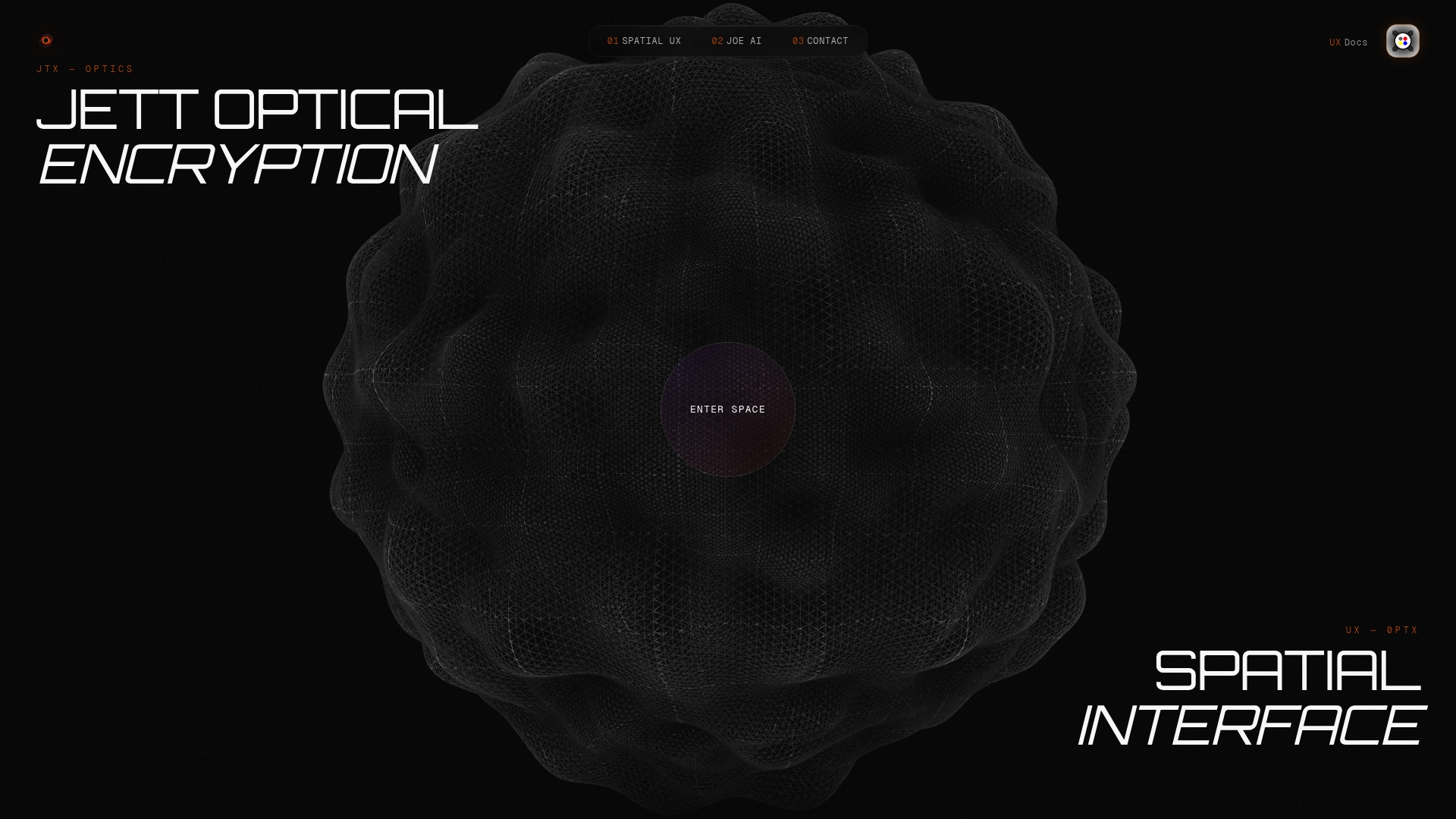
Jett Optics’ spatial encryption technology is built for Web3 and DePIN network compatibility, making it a natural fit for decentralized identity architectures where traditional authentication primitives break down. For secure digital communications, JettChat encrypted messaging integrates gaze-verified authentication with on-chain encrypted messaging in a single, developer-accessible platform. The encryption business model is built around hardware-adjacent SDK integration, which means you get quantum-resistant security with the operational simplicity this market demands.
FAQ
What are the main types of deep tech encryption ventures?
The four primary categories are fully homomorphic encryption ventures, post-quantum cryptography startups, quantum key distribution companies, and hybrid encryption-as-a-service platforms. Each differs in production maturity, capital intensity, and integration complexity.
How does FHE differ from post-quantum cryptography?
FHE enables computation on encrypted data without decrypting it, while PQC focuses on replacing classical algorithms with quantum-resistant alternatives. FHE addresses data-in-use privacy; PQC addresses the long-term threat from quantum computers to data-in-transit and data-at-rest protection.
How much venture capital is flowing into encryption startups?
The FHE sector alone exceeded $2.1 billion in funding by early 2026, and PQC ventures like PQShield have secured rounds above $63 million, signaling that venture capital in encryption is at a historically high level of concentration.
What is crypto-agility and why does it matter?
Crypto-agility is the ability to swap out cryptographic algorithms without rebuilding underlying infrastructure. It matters because hardware-deployed encryption is extremely difficult to patch after the fact, and building crypto-agile systems from day one is the only practical defense against algorithm obsolescence.
What should entrepreneurs prioritize when evaluating encryption ventures?
Prioritize production maturity, integration complexity, quantum resistance, and regulatory exposure in that order. A venture with impressive cryptographic claims but no live customer deployments and high integration friction will cost more to adopt than its security benefits justify.