

TL;DR:
- Deep tech exit strategy planning involves aligning technical milestones, business models, and capital structures early to optimize acquisition outcomes. Most founders mistakenly treat exit as a late-stage event, which limits leverage and undervalues the company. Effective planning begins 18 to 36 months before the exit, with staged evidence building and strategic relationship development.
Deep tech exit strategy planning is the process of aligning your startup’s commercialization trajectory, capital structure, and technical milestones with specific acquisition or liquidity outcomes from the earliest stages of company formation. Most founders treat exit planning as a late-stage event. That is the single most expensive mistake in deep tech M&A. The companies that command premium valuations begin scenario planning and backcasting from multiple plausible futures before their Series A closes. This article covers the four critical disciplines that determine whether your exit is a strategic win or a distressed sale: early decision architecture, technology legibility, negotiation leverage, and AI-era due diligence.
What key decisions define your deep tech exit strategy early on?
Exit readiness in deep tech requires aligning technical progress with manufacturability and commercialization, not treating exit as a late-stage event. The decisions you make in months six through eighteen of your company’s life determine which buyers will consider you, at what valuation multiple, and on what timeline. Founders who understand this build optionality into every structural choice. Those who don’t find themselves locked into a single exit path with no leverage.

The most consequential early decision is your business model. Licensing preserves capital but limits upside and attracts a narrower set of acquirers, typically those seeking IP portfolios rather than operational platforms. Owned manufacturing increases your acquisition profile and signals commercial seriousness, but demands significantly higher capital intensity. A platform model, where your technology becomes infrastructure others build on, creates the broadest buyer universe but requires network effects to justify the valuation premium. Each path closes certain doors while opening others.
Capital structure and governance decisions carry equal weight. Founders who accept terms with aggressive liquidation preferences, anti-dilution provisions, or board control provisions from early investors frequently discover these structures deter strategic acquirers or compress net proceeds at exit. Governance that gives founders meaningful control over sale timing and process is a negotiating asset, not just a comfort preference.
Key early decisions that preserve exit optionality include:
-
Scenario planning: Map at least three plausible exit outcomes (strategic acquisition, financial sponsor buyout, IPO) and trace backward to identify which present decisions keep all three viable.
-
Business model selection: Choose between licensing, manufacturing, and platform models with explicit awareness of how each affects buyer type, margin profile, and capital requirements.
-
Capital structure: Negotiate liquidation preferences and board composition with exit economics in mind, not just funding round mechanics.
-
IP ownership: Confirm clean title to all core IP before Series A, including contractor agreements, university licensing terms, and open-source compliance.
Pro Tip: Effective exit planning commonly starts 18 to 36 months before the exit event. If you are not building measurable performance trends that buyers can underwrite today, you are already behind.
How does technology legibility affect exit readiness?
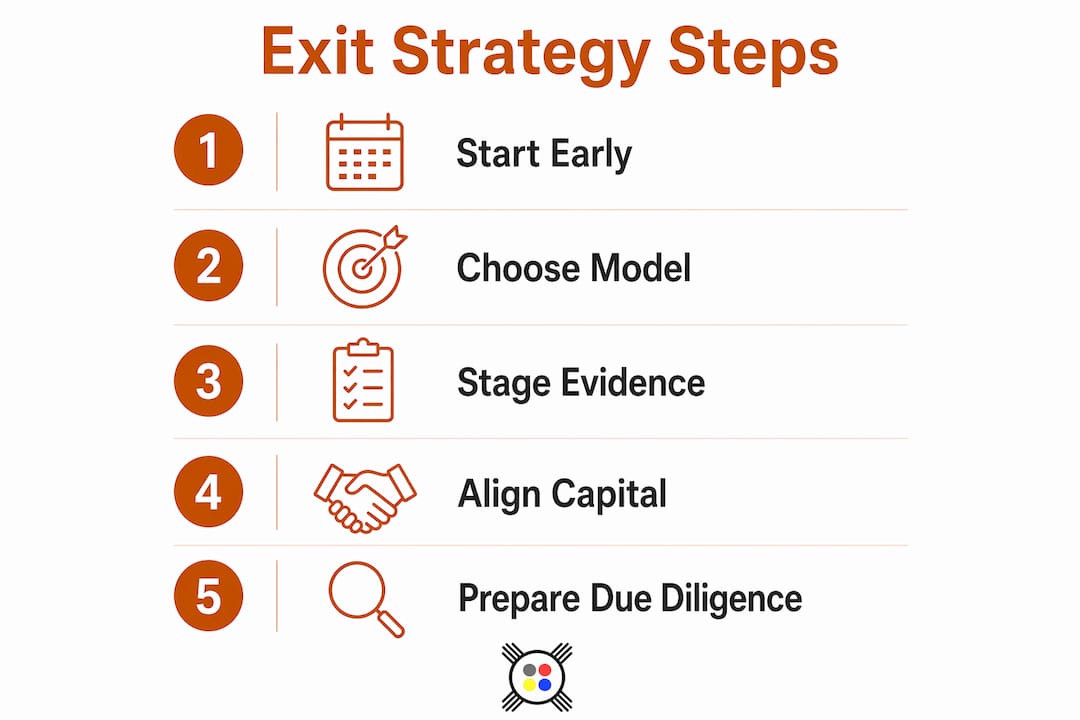
Technology legibility is the degree to which an acquirer can independently verify your technical claims, assess manufacturability, and model commercialization risk without relying solely on your team’s assertions. In deep tech, where the gap between laboratory proof-of-concept and scalable product is measured in years and tens of millions of dollars, legibility is the primary driver of buyer confidence and valuation underwriting.
Synchronized evidence of technical and market credibility reduces acquisition uncertainty and facilitates valuation underwriting. The practical implication: you cannot present a brilliant scientific result alongside zero commercial traction and expect a sophisticated acquirer to pay a strategic premium. The evidence packages must mature together.
The most effective approach is to sequence your proof packages across three dimensions rather than attempting to demonstrate all three simultaneously at exit:
-
Technical credibility: Peer-reviewed publications, patent filings with broad claims, third-party validation from recognized laboratories or standards bodies, and reproducible performance benchmarks.
-
Manufacturability: Demonstrated production at pilot scale, supplier qualification documentation, yield data, and cost-of-goods modeling that survives scrutiny from an acquirer’s operations team.
-
Market positioning: Signed letters of intent or early customer contracts, documented competitive displacement, and pricing data that supports the revenue model assumptions in your financial projections.
Each package should be ready to present independently before the next is fully developed. A buyer who sees technical credibility in year two, manufacturability evidence in year three, and commercial traction in year four experiences a coherent narrative of de-risking. A buyer who sees all three simultaneously in year four faces a single high-stakes judgment call with no prior reference points.
“The companies that achieve the highest acquisition multiples in deep tech are not the ones with the most advanced technology. They are the ones whose technology story is the easiest for a non-technical acquirer to verify and price.” — Anatomy of 4 M&A Paths, The Scenarionist
This sequencing discipline also protects your negotiating position. When a buyer has been tracking your progress across multiple proof stages, they arrive at the acquisition conversation already partially committed to your narrative. Their internal champions have already defended your technology to their own leadership. Reversing that position is costly for them, which shifts leverage to you.
What negotiation and timing tactics maximize valuation?
Negotiation leverage in deep tech M&A is not primarily a function of how good your technology is. It is a function of how many credible alternatives you have and how clearly buyers understand that those alternatives exist. The tactics below are not theoretical. They are the mechanics that separate founders who achieve strategic premiums from those who accept the first offer out of exhaustion or financial pressure.
The dual-track process is the most powerful structural lever available to a deep tech founder. Running simultaneous fundraising and M&A increases sale leverage by forcing buyer promptness and strengthening investor commitment. When a strategic acquirer knows you are actively closing a financing round, their cost of waiting rises materially. They cannot assume you will still be available or still need them in six months.
Specific tactics that create and maintain negotiation leverage:
-
Signed term sheets as urgency signals: A signed term sheet accelerates buyer urgency by signaling near-term financing support and valuation reset risk. Buyers adjust their internal timeline and cost of inaction once they know a financing event is imminent.
-
Multiple bidder management: Never allow a single buyer to believe they are the only party in the process. Even if you have a preferred acquirer, maintaining parallel conversations with two or three others creates the competitive tension that justifies your price.
-
Strict process timelines: Set explicit deadlines for term sheet submission and due diligence completion. Open-ended processes favor buyers, who can use time to uncover risks and reprice. Compressed timelines favor sellers, who control the information flow.
-
Relationship pre-investment: Build relationships with likely acquirers two to three years before you intend to sell. Corporate development teams at companies like Google, Qualcomm, or Lockheed Martin track potential targets for years. Being known is a prerequisite for being acquired at a premium.
Pro Tip: Use AI-powered call coaching tools to rehearse acquisition conversations and sharpen your responses to the valuation and diligence questions buyers will ask in early-stage M&A discussions. Founders who practice these conversations perform measurably better under pressure.
What are the unique due diligence challenges in deep tech exits?
Due diligence in deep tech M&A has evolved significantly in the past three years. The arrival of AI-powered analysis tools on the buyer side has transformed what was once a document review process into a real-time risk detection exercise. Founders who prepare their data rooms for human review alone are operating with an outdated model.
AI due diligence has become essential, focusing on data provenance, licensing, governance, and regulatory compliance, with direct effects on valuation and indemnity structures. For deep tech companies whose core assets include trained models, proprietary datasets, or AI-augmented hardware systems, this creates a new category of diligence risk that did not exist five years ago.
58% of M&A practitioners now use generative AI to analyze diligence materials from first data room access. This means inconsistencies in your documentation, gaps in data licensing records, or undisclosed model training sources are detected faster and flagged more systematically than any human review team could manage. The implication is direct: your data room must be internally consistent and auditable before you open it.
| Diligence Area | What Buyers Examine | Founder Preparation Required |
|---|---|---|
| AI and model governance | Training data provenance, licensing, bias documentation | Maintain an internal audit trail for all data and model rights |
| IP ownership | Patent assignments, contractor IP agreements, open-source compliance | Confirm clean title before diligence opens |
| Equity incentives | Option pool structure, vesting schedules, EMI eligibility | Coordinate with legal counsel on EMI option status well before exit |
| Tax structuring | Roll-over relief eligibility, timing of corporate restructuring | Engage tax advisors early to preserve roll-over relief options |
Additional diligence areas that frequently reprice deep tech deals include:
-
Regulatory compliance documentation: Particularly for companies operating in defense, healthcare, or critical infrastructure sectors where export controls or sector-specific regulations apply.
-
Customer contract assignability: Many enterprise contracts include change-of-control provisions that require customer consent to assignment. Undisclosed restrictions here can materially affect post-acquisition revenue assumptions.
-
Common deep tech diligence mistakes around data governance and model documentation are well-documented and avoidable with proper preparation. Review the most frequent diligence failures before opening your data room.
The founders who navigate AI-era diligence successfully treat their data room as a product. Every document is intentional. Every gap is explained. The narrative the buyer constructs from your data room should match the narrative you have been telling them in management presentations.
Key takeaways
Deep tech exit strategy planning succeeds when founders align early business model decisions, staged technical evidence, and negotiation leverage tactics into a single coherent process that begins years before the intended exit event.
| Point | Details |
|---|---|
| Start planning early | Effective exit planning begins 18 to 36 months before the exit event to build buyer-ready performance trends. |
| Business model shapes buyer universe | Licensing, manufacturing, and platform models each attract different acquirer types and valuation multiples. |
| Sequence your proof packages | Build technical credibility, manufacturability, and commercial traction evidence in stages to reduce buyer uncertainty. |
| Run dual-track processes | Simultaneous fundraising and M&A conversations create urgency and preserve negotiation optionality. |
| Prepare for AI-powered diligence | 58% of M&A practitioners use generative AI in data room review; documentation gaps reprice deals rapidly. |
Why most founders get exit planning backwards
From my perspective, the most persistent and costly mistake in deep tech exit planning is treating commercialization and exit readiness as sequential rather than parallel disciplines. Founders build the technology, then think about the market, then think about buyers. By the time they engage with potential acquirers, they have already made a dozen decisions that constrain their options and compress their valuation.
The founders I have seen execute the strongest exits share one habit: they maintain a live scenario map of their exit options and revisit it quarterly. Not as an abstract exercise, but as a practical filter for every major decision. Does this partnership agreement preserve our ability to sell to a strategic acquirer? Does this licensing deal signal the right things to a financial sponsor? These questions belong in board meetings, not just in pre-exit advisory sessions.
The relationship-building dimension is equally underestimated. Corporate development teams at major acquirers track targets for two to three years before approaching them. Founders who engage with these teams early, share progress updates, and build genuine relationships are not just networking. They are pre-selling the acquisition thesis. By the time formal conversations begin, the buyer’s internal champion has already done significant work to justify the deal. That is leverage you cannot manufacture in a compressed sale process.
The deep tech security commercialization path is long and technically demanding. The founders who reach the exit with maximum value intact are those who treat every commercialization milestone as a dual-purpose event: proof of technical progress and evidence for the acquisition narrative they are building in parallel.
— Joshua
How Jett Optics supports deep tech exit readiness
For deep tech founders building in optical encryption, spatial authentication, or biometric security, exit readiness and technology governance are inseparable. Acquirers in these sectors conduct the most rigorous AI and IP diligence of any vertical, and the documentation standards are unforgiving.

Jett Optics builds at the intersection of quantum-resistant encryption, AGT gaze tensors, and DePIN-compatible authentication systems. The platform’s architecture is designed with auditability and IP clarity as foundational properties, not afterthoughts. For founders preparing for acquisition conversations in the optical security or spatial cryptography space, Jett Optics’ encrypted communication infrastructure demonstrates the governance and documentation standards that sophisticated acquirers expect. Explore the full spatial encryption platform to understand how technology readiness and security architecture support both valuation and diligence outcomes.
FAQ
What is deep tech exit strategy planning?
Deep tech exit strategy planning is the process of aligning a startup’s business model, technical milestones, and capital structure with specific acquisition or liquidity outcomes, beginning years before the intended exit event. It treats exit readiness as a continuous discipline rather than a late-stage transaction.
How early should a deep tech founder start planning for an exit?
Effective exit planning starts 18 to 36 months before the exit event. Founders who begin earlier build the measurable performance trends and buyer relationships that support premium valuations.
What is a dual-track exit process?
A dual-track process runs fundraising and M&A conversations simultaneously. It creates urgency for buyers by signaling that the company has credible financing alternatives, which strengthens the seller’s negotiating position and preserves optionality.
How does AI change due diligence in deep tech M&A?
Buyers now use generative AI to analyze data rooms from the moment they receive access, detecting documentation gaps and inconsistencies faster than human review teams. Founders must treat their data rooms as auditable products before opening them.
Why does business model choice affect exit valuation in deep tech?
Business model selection directly determines buyer type, margin profile, and capital intensity. Licensing attracts IP-focused acquirers at lower multiples, while platform models with demonstrated network effects command the broadest buyer interest and highest valuation premiums.