

TL;DR:
- Deep tech encryption diversification involves systematically replacing cryptographic assets across an organization to mitigate quantum vulnerability, using frameworks like CBOM for transparency and governance. Prioritizing migration of long-lived systems and trust anchors reduces harvest-now-decrypt-later risks, with continuous governance critical for maintaining security. Vendor and algorithm diversity, along with performance testing, are essential for effective, sustainable encryption resilience.
Deep tech encryption portfolio diversification is the strategic practice of combining varied cryptographic technologies, algorithms, and vendors to reduce quantum vulnerability and performance risk across corporate security infrastructure. Security teams that treat encryption as a monolithic stack face compounding exposure as quantum computing advances and legacy algorithms approach mandated deprecation. The cryptographic bill of materials (CBOM), NIST PQC standards, and platforms like Naoris Protocol and Pantherun represent the practical toolkit for executing this strategy. This guide walks technical decision-makers through every phase: inventory, migration sequencing, vendor diversification, and governance.
What is deep tech encryption portfolio diversification?
Deep tech encryption portfolio diversification is the discipline of mapping, segmenting, and systematically replacing or augmenting cryptographic assets across an organization’s full security surface. The term borrows from financial portfolio theory but applies directly to cryptographic risk management. Where a financial portfolio concentrates risk in correlated assets, a monolithic encryption stack concentrates risk in a single algorithm family or vendor. The CBOM framework formalizes this by documenting every quantum-vulnerable cryptographic dependency, from TLS certificates to HSM firmware, creating an auditable artifact that drives both migration planning and vendor due diligence.

The standard industry term for the technical execution layer is crypto agility: the architectural property that allows an organization to swap cryptographic primitives without redesigning dependent systems. Diversification is the strategic goal; crypto agility is the mechanism that makes it sustainable. Security strategists should use both terms precisely, since conflating them leads to underinvestment in the governance infrastructure that keeps a diversified portfolio coherent over time.
How to conduct a cryptographic inventory for diversification
A cryptographic inventory is the prerequisite for every diversification decision. Without it, you are allocating migration resources based on assumption rather than measurement, and the resulting risk assessment will be structurally flawed.
The scope of a complete inventory covers:
-
TLS and VPN endpoints: certificates, cipher suites, and key exchange mechanisms across all network perimeters
-
PKI infrastructure: root CAs, intermediate CAs, certificate issuance policies, and revocation mechanisms
-
Code-signing pipelines: build system certificates, signing keys, and associated key storage
-
Hardware Security Modules (HSMs): firmware versions, supported algorithm sets, and key lifecycle configurations
-
IoT and embedded firmware: devices with hardcoded or long-lived cryptographic parameters that cannot be patched remotely
-
Storage and database encryption: at-rest encryption keys, rotation schedules, and key management service dependencies
NIST NCCoE guidance recommends starting with five to ten highest-risk systems to produce an initial CBOM artifact. This artifact is reusable across audits, regulatory submissions, and vendor due diligence processes, making it one of the highest-leverage investments a security team can make in the first phase of diversification.
The most common challenge in inventory work is vendor opacity. Many SaaS and infrastructure vendors do not publish their cryptographic dependencies, and contractual language rarely requires disclosure. Organizations must require vendors to provide CBOM-aligned attestations as a procurement condition, not as an afterthought.
Pro Tip: Map vendor crypto exposures during contract renewal cycles. Inserting CBOM disclosure requirements into renewal terms costs nothing and creates contractual leverage that is nearly impossible to obtain after signature.
How should you sequence migration for post-quantum readiness?
Migration sequencing determines which cryptographic assets get replaced first and in what order. The logic is not arbitrary. Sequential migration prioritizing long-lived confidentiality and trust anchors is critical because delayed migration of these systems increases harvest-now-decrypt-later risk. An adversary capturing encrypted traffic today can store it and decrypt it once a cryptographically relevant quantum computer becomes available.
The recommended sequencing follows this order:
-
Long-lived confidentiality systems: TLS sessions protecting data with multi-year sensitivity windows, VPN tunnels, and encrypted storage for regulated data classes
-
Trust anchors: Root CAs and intermediate PKI infrastructure, since a compromised root invalidates every certificate in the chain
-
Code-signing infrastructure: Compromised signing keys allow adversaries to distribute malicious software with valid signatures
-
Key management services: HSMs and key management systems must support post-quantum key generation before dependent systems can migrate
-
IoT and embedded systems: Highest migration complexity, often requiring hardware replacement rather than software update
NIST IR 8547 sets deprecation at 2030 and disallowance at 2035 for quantum-vulnerable public-key algorithms. After 2030, continued use of legacy algorithms requires documented risk acceptance. After 2035, usage is prohibited in federal systems. This timeline is a compliance floor, not a security target.
“2030 is a risk-acceptance start, not a migration completion date. Organizations that treat it as a finish line will find themselves managing documented exceptions rather than a secure posture.”
Hybrid classical/post-quantum cipher suites serve as transitional architecture during migration. They run both algorithm families in parallel, so a failure in the post-quantum implementation falls back to classical protection rather than exposing plaintext. Key management lifecycle alignment per NIST SP 800-57 is non-negotiable here: exceeding a cryptoperiod without key rotation accumulates exposure that hybrid suites cannot compensate for.
What are the best strategies to diversify encryption across vendors and algorithms?
Diversification across vendors and algorithms requires a structured approach that goes beyond simply purchasing from multiple suppliers. Vendor multiplicity without cryptographic surface coverage is partial diversification, one of the most common failure modes. An organization can use three different TLS vendors and still share a single quantum-vulnerable root of trust in its PKI.
The comparison below illustrates how diversification dimensions differ in risk profile and implementation complexity:
| Diversification dimension | Risk addressed | Implementation complexity |
|---|---|---|
| Algorithm diversity (RSA + ML-KEM) | Single-algorithm cryptanalysis | Medium: requires crypto-agile architecture |
| Vendor diversity (HSM suppliers) | Vendor-specific vulnerability or supply chain compromise | Low to medium: procurement-driven |
| Cryptographic surface coverage (TLS + PKI + code-signing) | Partial migration leaving exposed trust anchors | High: requires full CBOM scope |
| Decentralized mesh (Naoris Protocol) | Single point of failure in centralized PKI | High: architectural redesign |
| Biometric/optical layer (Jett Optics AGT) | Credential theft and static key exposure | Medium: hardware and software integration |
The Naoris Protocol demonstrates what cryptographic mesh architecture looks like in practice. It integrates hybrid post-quantum cryptography, hardware security, and real-time device integrity validation across Web2 and Web3 environments. This model distributes trust rather than concentrating it, which is the architectural analog of portfolio diversification in financial terms.
Performance is a non-negotiable constraint in critical infrastructure. Pantherun’s work in 5G and rail security demonstrates that encryption for critical infrastructure must achieve wire-speed, low-latency processing. A post-quantum algorithm that introduces unacceptable latency in a rail signaling system is not a viable diversification option regardless of its cryptographic strength.
Pro Tip: Require vendors to provide benchmark data for post-quantum algorithm performance under your specific traffic profiles before signing contracts. Marketing claims about PQC support rarely include latency figures for high-throughput environments.
How to implement encryption diversification: steps and pitfalls
Execution separates strategy from outcome. The following sequence reflects practitioner-validated practice for organizations moving from inventory to a diversified, governed encryption portfolio.
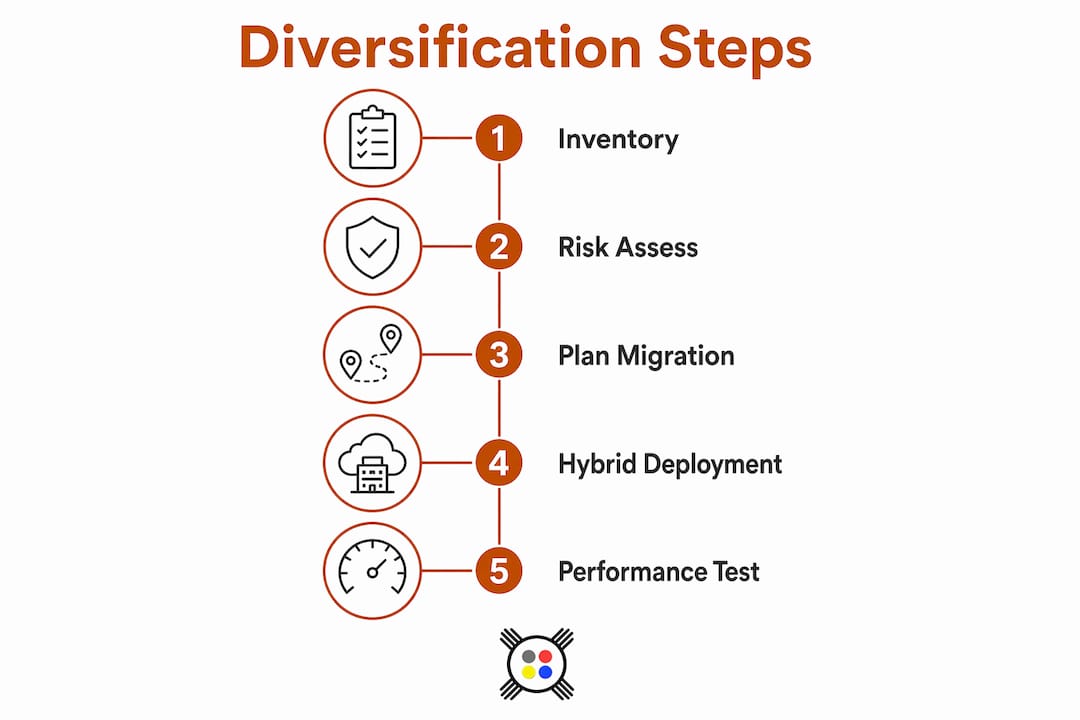
Step-by-step execution framework:
-
Complete CBOM across all cryptographic surfaces (TLS, PKI, code-signing, HSMs, IoT, storage)
-
Prioritize systems by data sensitivity, retention period, and migration complexity
-
Stage migration starting with long-lived confidentiality and trust anchors
-
Evaluate vendors against CBOM requirements and demand contractually backed PQC attestations
-
Deploy hybrid cipher suites as transitional architecture during migration windows
-
Integrate post-quantum key generation per NIST Draft SP 800-133r3 recommendations
-
Conduct integration testing under production-representative load conditions
-
Establish ongoing cryptographic governance with scheduled CBOM refresh cycles
The most damaging pitfalls are predictable and avoidable:
-
Partial diversification: Replacing TLS cipher suites while leaving PKI and code-signing on RSA-2048 creates a false sense of security. The CBOM prevents this by making the full surface visible.
-
Ignoring key management: Algorithm migration without corresponding key rotation and cryptoperiod alignment per NIST SP 800-57 leaves residual exposure in key material.
-
Neglecting latency requirements: Post-quantum algorithms like ML-KEM and ML-DSA have different performance profiles than RSA and ECDSA. Testing under realistic load is mandatory before production deployment.
-
Vendor attestation gaps: Standardized PQC certification is currently lacking, meaning vendor claims require independent validation against your CBOM and evidence-based integration plans.
-
Static governance: A CBOM completed once and never updated becomes a liability. Cryptographic governance must be a continuous operational function, not a one-time project.
Procurement alignment is an underrated success factor. Inserting crypto agility requirements and CBOM disclosure obligations into vendor contracts at the RFP stage is far more effective than attempting to retrofit these requirements after deployment.
How deep tech investment principles inform encryption diversification
The structural parallels between deep tech investment portfolio management and cryptographic portfolio diversification are precise enough to be operationally useful. Deep tech portfolio diversification employs staged funding, longer fund lifecycles, and domain spreading to reduce sector-specific concentration risk. Each of these tactics maps directly to cryptographic risk management.
-
Staged funding maps to phased migration: Committing full migration resources upfront before CBOM completion is the cryptographic equivalent of writing a large check into an unvalidated technology. Stage capital and effort based on validated inventory milestones.
-
Longer fund lifecycles map to multi-year migration planning: Building crypto agility upfront reduces total cost of ownership and governance overhead post-2035. Plan for a five to seven year horizon, not a single budget cycle.
-
Domain spreading maps to cryptographic surface coverage: Spreading investment across sectors reduces correlated failure risk. Spreading migration across TLS, PKI, code-signing, and HSMs reduces correlated cryptographic failure risk.
-
Syndication maps to vendor diversification: No single vendor should own your entire cryptographic stack, for the same reason no single LP should own an entire fund.
The table below maps investment portfolio tactics to their cryptographic equivalents for security strategists who need to communicate diversification rationale to executive stakeholders.
| Investment tactic | Cryptographic equivalent |
|---|---|
| Staged funding rounds | Phased migration tied to CBOM milestones |
| Longer fund lifecycle (10+ years) | Multi-year crypto agility roadmap through 2035 |
| Domain diversification | Coverage across TLS, PKI, HSM, IoT, code-signing |
| Syndication to reduce concentration | Multi-vendor HSM and CA infrastructure |
Explore the deep tech security commercialization path for a detailed breakdown of how these investment principles translate into security product selection and procurement cycles.
Key takeaways
Effective deep tech encryption portfolio diversification requires a CBOM-first approach, phased migration sequencing aligned with NIST IR 8547 deadlines, and continuous cryptographic governance across all cryptographic surfaces.
| Point | Details |
|---|---|
| CBOM is the foundation | Start with a cryptographic bill of materials covering TLS, PKI, HSMs, IoT, and code-signing before any migration decision. |
| Sequence by risk, not convenience | Migrate long-lived confidentiality systems and trust anchors first to reduce harvest-now-decrypt-later exposure. |
| Vendor diversity is not enough | Diversifying vendors without covering all cryptographic surfaces leaves quantum-vulnerable trust anchors intact. |
| Performance must be tested | Post-quantum algorithms require latency validation under production load, especially in 5G and critical infrastructure contexts. |
| Governance is continuous | A CBOM completed once and not refreshed becomes a false assurance artifact within months of completion. |
Why measurement-first thinking changes everything in encryption diversification
Most security teams I work with arrive at diversification discussions with a vendor shortlist already in hand. They have evaluated post-quantum products, attended briefings, and drafted a migration timeline. What they rarely have is a complete CBOM. This is the single most consistent gap I see, and it produces the same failure mode repeatedly: organizations diversify their TLS cipher suites, declare PQC readiness, and leave RSA-2048 root CAs and decade-old HSM firmware completely untouched.
The measurement-first principle is not a procedural nicety. It is the difference between a diversification strategy and a diversification theater. Vendor attestation gaps make this worse. Because standardized PQC certification does not yet exist, vendors can make technically accurate but strategically incomplete claims about post-quantum support. A vendor that supports ML-KEM for key encapsulation but has not updated its key generation practices per NIST Draft SP 800-133r3 is offering partial protection at full price.
The performance dimension deserves more attention than it typically receives in PQC discussions. Pantherun’s pivot to 5G and rail security is instructive precisely because it demonstrates that encryption technology must be evaluated against operational constraints, not just cryptographic strength. A post-quantum algorithm that cannot operate at wire speed in a 5G core is not a viable option regardless of its security margin. Security strategists should treat latency benchmarks as a first-class evaluation criterion alongside algorithm standardization status.
My practical recommendation: treat your CBOM as a living operational document, not a project deliverable. Assign ownership, schedule quarterly refresh cycles, and tie vendor contract renewals to CBOM disclosure requirements. Diversification is not a project with a completion date. It is a capability that compounds in value over time when governed consistently.
For security teams looking to understand how encryption venture categories map to diversification priorities, that taxonomy provides a useful framework for structuring vendor evaluation.
— Joshua
How Jett Optics supports your encryption diversification strategy
Jett Optics builds at the intersection of optical cryptography, spatial authentication, and post-quantum security, precisely the layer of the cryptographic stack that most diversification frameworks leave unaddressed.
The Optical Spatial Encryption platform integrates AGT gaze tensors, quantum-resistant encryption, and DePIN-compatible architecture into a vendor-independent cryptographic layer. This means your diversification strategy gains a biometric trust anchor that operates independently of your existing PKI and HSM infrastructure. For organizations seeking zero-trust authentication that does not inherit legacy algorithm dependencies, Gaze Verify provides encrypted session authentication grounded in human gaze as a cryptographic key. Jett Optics solutions are designed to extend your cryptographic surface coverage without requiring a redesign of existing systems.
FAQ
What is a cryptographic bill of materials (CBOM)?
A CBOM is a structured inventory of all cryptographic assets in an organization’s systems, including algorithms, key lengths, certificates, and dependencies. NIST NCCoE guidance recommends starting with five to ten highest-risk systems to produce an initial CBOM artifact reusable for audits and vendor due diligence.
When does NIST require migration away from legacy public-key algorithms?
NIST IR 8547 sets 2030 as the deprecation deadline and 2035 as the disallowance deadline for quantum-vulnerable public-key algorithms in federal systems. After 2030, continued use requires documented risk acceptance; after 2035, usage is prohibited.
What is the difference between crypto agility and encryption diversification?
Crypto agility is the architectural property that allows cryptographic primitives to be swapped without redesigning dependent systems. Encryption diversification is the strategic goal of distributing cryptographic risk across multiple algorithms, vendors, and surface areas. Agility enables diversification to be maintained over time.
How do you validate vendor PQC claims?
Require vendors to provide contractually backed attestations aligned with your CBOM and evidence-based integration plans. Because standardized PQC certification is currently lacking, marketing claims must be validated against your specific cryptographic inventory and tested under production-representative load conditions.
What is harvest-now-decrypt-later risk?
Harvest-now-decrypt-later is the threat model in which adversaries capture encrypted traffic today and store it for decryption once a cryptographically relevant quantum computer becomes available. Long-lived confidentiality systems and trust anchors are the highest-priority migration targets because they carry the greatest exposure to this attack vector.