
TL;DR:
- AR/VR security technology investment is driven by enterprise demand for spatial authentication, biometric verification, and threat detection systems. Funding has matured, focusing on growth-stage companies with validated ROI and advanced security benchmarks, especially in healthcare and manufacturing. The most promising companies lead with technical performance data, addressing real-time spatial reasoning and compliance requirements crucial for enterprise adoption.
AR/VR security technology investment is defined as capital allocation toward extended reality platforms, spatial computing infrastructure, and the protective systems that defend them from an expanding class of hardware, software, and biometric attack vectors. The sector crossed a critical threshold in 2025 when XR venture funding reached $3.53 billion, a 117% year-over-year increase that signals institutional conviction, not speculative enthusiasm. Meta, XREAL, and Qualcomm are shaping the hardware layer while AI-native XR platforms and spatial encryption technologies like those developed by Jett Optics define the security frontier. For technology investors and industry analysts, understanding where capital flows, what threats drive demand, and which technologies deliver validated performance is the difference between a high-conviction position and an expensive lesson.
What market trends and investment patterns define the AR/VR security technology space in 2026?
The funding story for AR/VR security technology investment in 2026 is one of maturation, not hype. Q1 2026 maintained $650 to $750 million in XR-sector venture funding, with a notable structural shift: fewer seed rounds and a concentration of capital in growth-stage companies that can demonstrate enterprise ROI. This is the signature of a market that has moved past proof-of-concept and into deployment validation.
The composition of investor interest has also shifted. Corporate strategic investments from Meta, Google, and Qualcomm are no longer just signaling confidence; they are actively shaping the ecosystem by setting hardware standards, API frameworks, and security compliance baselines that downstream software companies must meet. This creates a two-tier dynamic where companies aligned with these ecosystems attract follow-on institutional capital, while those building proprietary stacks face higher diligence scrutiny.
AR glasses hardware and AI-augmented XR platforms are the two categories drawing the most concentrated attention. XR funding is now more disciplined than during the metaverse bubble, with investors concentrating on proven enterprise ROI and AI-XR integration rather than speculative virtual worlds. That discipline is reflected in deal structures: longer diligence cycles, milestone-based tranches, and stronger preference for vertical SaaS models in healthcare, manufacturing, and defense.
| Metric | 2025 Full Year | Q1 2026 |
|---|---|---|
| Total XR venture funding | $3.53 billion | $650–$750 million |
| Year-over-year growth | 117% | Sustained momentum |
| Dominant round stage | Seed to Series A | Growth-stage, Series B+ |
| Primary investor focus | Platform breadth | Enterprise ROI, AI-XR security |
Pro Tip: When evaluating AR technology funding rounds in 2026, weight growth-stage deals in healthcare and manufacturing verticals more heavily. These sectors show the strongest product-market fit and the most predictable annual recurring revenue for XR security deployments.
What are the primary AR/VR security threats shaping investment priorities?
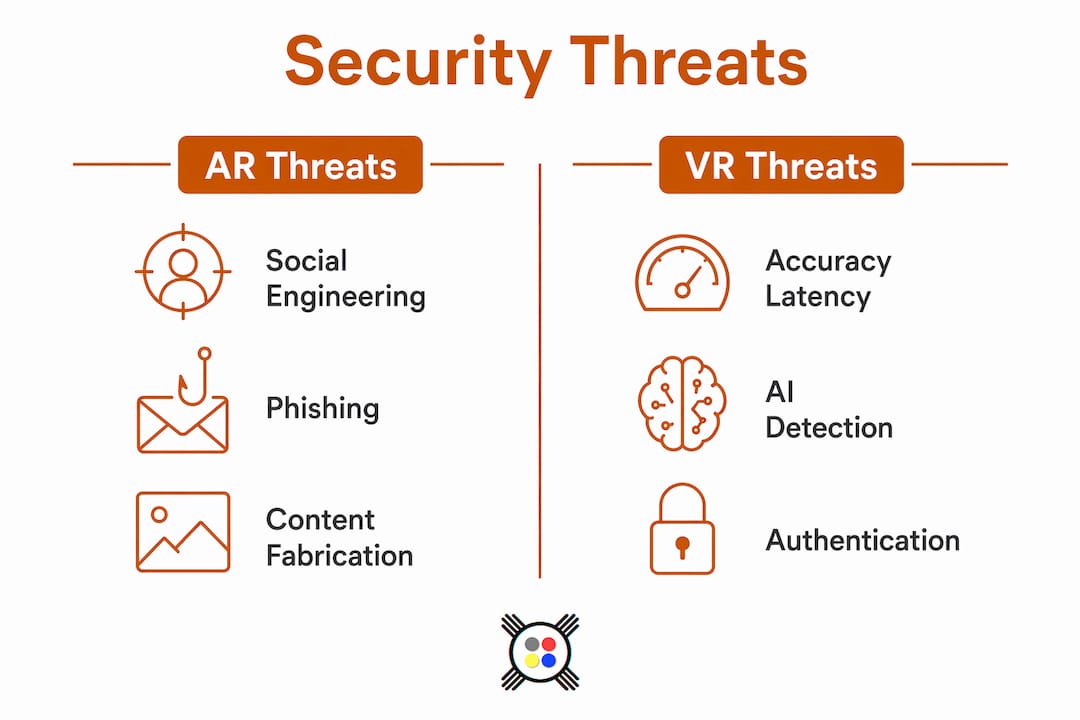
The threat surface in augmented reality security is not theoretical. A March 2026 study found that AR-LLM social engineering attacks achieve 93.3% phishing susceptibility and 85% trust acceptance after a single AR interaction. Those numbers reframe the entire investment thesis: security in augmented reality is not a compliance checkbox but a core product requirement that determines enterprise adoption velocity.

The mechanism behind these attacks is significant. Large language models integrated into AR overlays can fabricate contextually plausible instructions, impersonate trusted interfaces, and exploit the user’s natural tendency to trust spatially anchored information. Because AR content appears co-located with the physical world, users apply the same cognitive trust heuristics they use for physical signage or colleague communication. This is a fundamentally different attack surface than phishing emails or browser-based fraud.
Defensive innovation is advancing in parallel. Vision-language models are being benchmarked for their ability to detect semantic contradictions in AR content, where a virtual overlay conflicts with physical reality in ways that indicate manipulation. The key investment-relevant finding is that GPT-4o achieves 84.62% accuracy at a 7.26-second latency for real-time spatial contradiction detection, representing the current optimal balance between precision and deployment practicality. That benchmark matters because it defines the performance floor that any competing VR security solution must meet or exceed to attract enterprise contracts.
Investors evaluating security-focused XR companies should assess the following threat-response capabilities:
-
Multimodal AI detection: Does the platform deploy vision-language models capable of real-time semantic contradiction analysis across AR overlays?
-
Cross-stack security architecture: Does the solution implement cross-platform security layers like UNSEEN-style approaches that operate across hardware environments rather than within a single proprietary stack?
-
Hardware compliance and data sovereignty: Does the company address regional data residency requirements and hardware certification standards that enterprise procurement teams require?
-
Biometric authentication integration: Does the platform incorporate spatial authentication mechanisms, such as gaze-based verification, to prevent unauthorized access at the session level?
Pro Tip: Prioritize VR security solutions that publish accuracy-latency benchmarks for their AI detection layers. Companies that cannot produce these metrics are likely using AI as a marketing claim rather than a validated technical capability.
How does AI convergence enhance AR/VR security technology investment value?
AI’s relationship with XR investment has reversed direction. Through 2023 and into 2024, AI funding competed directly with XR for institutional capital, drawing attention and dollars toward large language model infrastructure and away from spatial computing. That dynamic has inverted. AI now drives XR growth by enhancing smart glasses capabilities, enabling spatial AI agents, and automating developer workflows that previously made enterprise XR deployments prohibitively expensive. The implication for investors is direct: AI-XR convergence is the fastest-growing segment within the broader extended reality market.
The distinction between genuine AI-native XR platforms and superficial AI buzzword plays is where sophisticated capital separates itself. A company that has integrated a general-purpose LLM into a marketing demo is not the same as one that has built real-time semantic reasoning into its spatial security stack and can produce validated performance benchmarks. Sophisticated investors demand validated AI metrics such as visual reasoning accuracy-latency tradeoffs to distinguish truly capable AI-native XR startups from mere buzzword users. This diligence criterion is now standard in term sheets from top-tier XR-focused funds.
The table below contrasts the two categories that define the current AI-XR investment divide:
| Attribute | AI-native XR security platform | AI-branded XR platform |
|---|---|---|
| AI integration depth | Embedded in spatial reasoning and authentication layers | Surface-level LLM API calls for UI features |
| Performance benchmarks | Published accuracy-latency metrics (e.g., 84.62% / 7.26s) | No published benchmarks |
| Enterprise security capability | Real-time contradiction detection, gaze authentication | Basic access controls |
| Funding trajectory | Growth-stage rounds with enterprise contracts | Seed-stage with limited traction |
| Investor diligence outcome | High conviction with validated metrics | High risk, low differentiation |
Jett Optics exemplifies the AI-native approach by building optical spatial encryption that uses AGT gaze tensors and quantum-resistant cryptography as the authentication substrate. This architecture addresses the real-time semantic reasoning requirement that enterprise XR security demands, while producing the kind of verifiable, hardware-anchored performance data that institutional investors require.
What practical strategies should investors use when evaluating AR/VR security opportunities?
Sound investment decisions in this sector require a structured evaluation framework that goes beyond market size projections. The following criteria reflect the operational realities of enterprise XR deployment in 2026.
-
Prioritize software infrastructure over hardware bets. Enterprise XR deployments succeed or fail on software architecture. Cross-platform abstraction layers using Unity and OpenXR, combined with real-time protocol-compatible security stacks, reduce costly rebuilds and protect against hardware obsolescence. Companies building proprietary hardware-locked solutions carry significantly higher technical debt risk.
-
Assess hardware tier alignment with security requirements. Dedicated enterprise-grade AR/VR hardware offers security features, warranty coverage, and IT-managed device capabilities that consumer devices cannot match. For deployments in healthcare, defense, or financial services, consumer-grade hardware is a disqualifying factor regardless of software quality.
-
Model deployment economics with vertical specificity. Enterprise XR deployment costs are well-documented: VR simulation modules run $18,000 to $35,000 per module, AR maintenance applications cost $8,000 to $18,000 per procedure, and annual mobile device management costs add $2,000 to $8,000. Large-scale deployments yield 250 to 300% ROI within three years, but only when the software stack is stable and the security layer does not introduce operational friction.
-
Evaluate vertical SaaS traction as a leading indicator. Healthcare, manufacturing, and training verticals show strong product-market fit and stable recurring revenue for XR security deployments. Companies with signed enterprise contracts in these sectors carry materially lower execution risk than those targeting horizontal consumer markets.
-
Scrutinize geographic and regulatory compliance posture. Corporations are undergoing a technological reassessment requiring hardware and data sovereignty compliance, favoring regional manufacturers and advanced security features to mitigate deployment risks. Companies without a clear compliance roadmap for GDPR, HIPAA, or sector-specific data residency requirements face procurement barriers that no amount of technical capability can overcome.
For analysts tracking the AI biometric convergence market, the intersection of gaze-based authentication and spatial computing security represents a particularly high-signal investment category. The companies that can demonstrate both technical depth and enterprise contract velocity in this space are the ones worth the deepest diligence.
Key takeaways
AR/VR security technology investment in 2026 is defined by the convergence of AI-native spatial platforms, enterprise ROI validation, and an urgent threat environment that makes security infrastructure a non-negotiable procurement requirement.
| Point | Details |
|---|---|
| Market funding is maturing | XR venture funding reached $3.53B in 2025 with Q1 2026 sustaining $650–$750M at growth-stage concentration. |
| Security threats are quantified | AR-LLM attacks achieve 93.3% phishing success, making augmented reality security a core enterprise requirement. |
| AI is now a tailwind | AI-native XR platforms attract superior funding; validated benchmarks like GPT-4o’s 84.62% accuracy are the diligence standard. |
| Enterprise ROI is proven | VR and AR deployments in manufacturing and healthcare deliver 250–300% ROI within three years at documented cost ranges. |
| Software stack choice is decisive | Cross-platform Unity/OpenXR architectures with RTP-compatible security layers outperform proprietary stacks in enterprise deployments. |
Why the security layer is the most underpriced asset in XR investing right now
I have watched three distinct cycles of XR investment enthusiasm, and the current moment is structurally different from anything that preceded it. The metaverse cycle was driven by narrative. The current cycle is driven by enterprise procurement contracts, and that changes everything about where the real value sits.
The mistake I see most often from analysts entering this space is treating security as a feature rather than a category. When a hospital system deploys AR surgical guidance, or a defense contractor runs VR mission rehearsal, the security layer is not an add-on. It is the product. The platform that cannot guarantee spatial data integrity, session authentication, and protection against AR-LLM manipulation will not clear procurement. Full stop.
What concerns me more is the number of AI-XR companies that have not published a single benchmark. The accuracy-latency tradeoff for real-time spatial reasoning is a solvable engineering problem, and any company that has actually solved it will show you the numbers. If they cannot, you are looking at a marketing story, not a technology company. The spatial computing security startups worth backing in 2026 are the ones that lead with performance data and follow with the vision, not the other way around.
The regulatory dimension is also moving faster than most investors have priced in. Data sovereignty requirements for XR hardware are tightening across the EU, and sector-specific mandates in healthcare and defense are creating compliance moats that will be very difficult for late entrants to cross. The companies building those moats today, through hardware certification, regional data residency architecture, and biometric authentication frameworks, are the ones that will own the enterprise contracts in 2028.
— Joshua
How Jett Optics addresses the AR/VR security investment thesis
Jett Optics builds directly at the intersection of the two most consequential trends in this analysis: AI-native spatial security and biometric authentication for enterprise XR environments. The platform’s AGT gaze tensor architecture uses human gaze patterns as cryptographic keys, producing quantum-resistant authentication that operates without friction in spatial computing workflows. For investors evaluating the optical encryption investment thesis, Jett Optics represents the category of company that leads with validated technical architecture rather than platform narrative. Explore gaze-based encrypted authentication and post-quantum spatial encryption to understand how Jett Optics is building the security infrastructure that enterprise XR deployments require.
FAQ
What is AR/VR security technology investment?
AR/VR security technology investment refers to capital directed toward extended reality platforms and the security infrastructure protecting them, including spatial authentication, biometric verification, and AI-powered threat detection systems designed for immersive computing environments.
How large is the AR/VR investment market in 2026?
XR venture funding reached $3.53 billion in 2025, a 117% year-over-year increase, with Q1 2026 sustaining $650 to $750 million concentrated in growth-stage enterprise-focused rounds.
What are the biggest security threats in augmented reality?
AR-LLM social engineering attacks represent the most quantified threat, achieving 93.3% phishing susceptibility and 85% trust acceptance after AR interaction, according to a March 2026 study published by AAAI.
How do investors evaluate AI-native XR security startups?
Sophisticated investors require validated performance benchmarks such as accuracy-latency tradeoffs. GPT-4o’s 84.62% accuracy at 7.26-second latency for spatial contradiction detection is the current reference standard for real-time AR security evaluation.
Which enterprise verticals offer the strongest AR/VR investment ROI?
Healthcare, manufacturing, and training verticals demonstrate the most predictable annual recurring revenue and product-market fit, with large-scale XR deployments delivering 250 to 300% ROI within three years at documented deployment cost ranges.