

Most technology investors assume that biometric authentication and AI-driven research platforms are separate concerns, addressed by separate vendors. That assumption is the exact gap that Jett Optics was built to close. Through its Augments platform, Jett Optics powers Cognitive BioLLMs UX and peptide research by fusing optical spatial encryption, Agentive Gaze Tensor (AGT) biometric verification, and on-chain trust protocols into a single, coherent infrastructure. The implications for biotech and cybersecurity decision-makers extend well beyond access control. They reach into the reliability of clinical AI, the tractability of peptide antibiotic discovery, and the defensibility of biological data at scale.
Table of Contents
-
Jett Optics’ augments framework: cognitive BioLLMs, UX, and peptide research convergence
-
Enhancing cognitive BioLLMs with Jett Optics’ infrastructure
-
AI-driven peptide research optimization powered by transformer-based workflows
-
Protocols for trust and identity: Jett Optics’ JTX-CSTB on-chain biometric verification
-
Scaling biological AI experimentation with co-designed wetlab and AI systems
-
Explore Jett Optics’ solutions empowering cognitive BioLLMs and peptide research
Key Takeaways
| Point | Details |
|---|---|
| Integrated spatial encryption | Jett Optics combines optical spatial encryption with biometric gaze authentication to secure cognitive BioLLMs and peptide research platforms. |
| Cognitive layer enhancement | Augmenting LLMs with a cognitive layer improves therapy outcomes beyond standalone AI or human clinicians. |
| AI-driven peptide optimization | Transformer-based optimization workflows enable experimentally validated improvements in peptide antibiotic potency. |
| Latency-aware attestation | JTX-CSTB protocol enforces strict session timing to ensure smooth UX and trustworthy biometric proofs on-chain. |
| Scalable biological AI design | Co-designed wetlab and AI systems dramatically increase experimental data density, supporting advanced BioLLM UX needs. |
Jett Optics’ augments framework: cognitive BioLLMs, UX, and peptide research convergence
The OPTX ecosystem sits at the foundation of Jett Optics’ platform. It is not a monolithic application layer. It is a modular, API-first environment where privacy-preserving spatial encryption enables real-time streaming chat, pluggable memory backends, and agentic web application support without exposing raw biometric data beyond the edge. This architecture matters because it resolves a core tension in biological AI research: researchers need dynamic, session-aware interfaces, but regulators and security architects require that sensitive data never traverse unencrypted channels. OPTX satisfies both constraints simultaneously.
Biometric identity within this ecosystem does not rely on a single hash. Instead, gaze decomposition into AGT tensors separates the gaze signal into three distinct verification regions:
-
COG (Cognitive): Captures intent-driven fixation patterns associated with active reasoning states.
-
EMO (Emotional): Encodes micro-saccadic deviations correlated with affective load and attention quality.
-
ENV (Environmental): Indexes spatial context, mapping where gaze lands relative to interface regions and ambient objects.
Verification strength derives from entropy measured across the AGT weight distribution, not from any single point match. This is a fundamentally more attack-resistant model than fingerprint or face-hash comparisons.
| Biometric method | Verification basis | Replay attack resistance | On-chain compatibility |
|---|---|---|---|
| Fingerprint hash | Single-point hash | Low | Partial |
| Facial recognition | Feature vector | Moderate | Partial |
| AGT gaze tensor (Jett Optics) | Entropy-weighted multi-region | High | Native |
Integration with Jetson edge nodes keeps processing local, while on-chain proofs allow downstream systems to verify identity without receiving raw biometric data. This is privacy-preserving identity verification that scales across DePIN (Decentralized Physical Infrastructure Networks) deployments.
Pro Tip: When evaluating biometric platforms for biotech environments, ask specifically whether the verification signal is entropy-weighted or hash-based. Hash-based systems are vulnerable to dataset leakage. Entropy-based AGT verification degrades gracefully even under partial data compromise.
For decision-makers evaluating optical spatial encryption as a platform investment, the OPTX modular approach means that new AI backends, including cognitive BioLLMs, can be integrated without rebuilding the authentication layer. That is a concrete infrastructure cost advantage.
Enhancing cognitive BioLLMs with Jett Optics’ infrastructure
The cognitive layer inside a BioLLM is not simply an additional fine-tuning pass. It is a specialized reasoning module that activates clinical and domain-specific inference pathways that general-purpose models cannot replicate. Research published in Nature Medicine demonstrates that an augmented cognitive layer outperforms both standalone LLMs and human clinicians across key clinical competencies in psychotherapy scenarios, with real-world deployment across nearly 9,000 users showing measurable symptom improvement correlated directly with cognitive layer activity.
What Jett Optics adds to this picture is the infrastructure that makes deployment trustworthy and scalable. The OPTX agent gateway exposes session, memory, skills, and streaming endpoints that enable dynamic, real-time cognitive interactions without frontend-only workarounds. This architecture supports:
-
Session continuity: Memory backends retain context across interactions, enabling the cognitive layer to track longitudinal patient or researcher state.
-
Streaming semantics: Real-time token streaming reduces perceived latency, a critical UX factor in clinical applications where interruption degrades therapeutic outcomes.
-
Skill modularity: Individual cognitive reasoning modules can be swapped or upgraded without disrupting the authentication or encryption layers below.
-
Gaze-authenticated sessions: Each session is tied to a verified biometric identity, ensuring that clinical data is attributed to the correct user throughout the interaction lifecycle.
“The best UX for agentic systems arises from gateway layers exposing session, memory, skills, and streaming endpoints rather than frontend-only solutions.” — Jett Optics OPTX architecture documentation
This is the architectural pattern that separates production-grade agentic web UX from prototypes. Frontend-only approaches cannot maintain session trust across context switches. The gateway pattern enforces trust at every layer.
The combination of cognitive BioLLM enhancement with biometric session management also addresses a compliance concern that many investors underestimate. In clinical AI deployments, auditability is not optional. The on-chain proof system embedded in OPTX provides an immutable record of which verified identity interacted with which session state, at which timestamp. That is an auditable chain of custody for clinical AI interactions, something no general-purpose LLM platform currently provides natively.
For investors, the value is in the spatial computing trust infrastructure that Jett Optics has built beneath the cognitive layer. The BioLLM is the differentiating application. The trust infrastructure is the defensible moat.
AI-driven peptide research optimization powered by transformer-based workflows
Peptide antibiotic research represents one of the most promising and technically demanding frontiers in drug discovery. The challenge is not generating new sequences. Generative models produce thousands of candidates easily. The challenge is generating sequences with experimentally validated antimicrobial activity against resistant strains, within a search space that wet labs can realistically evaluate.
ApexGO addresses this directly. Its architecture integrates a transformer VAE latent space with Bayesian optimization to navigate peptide design as a constrained continuous optimization problem rather than a combinatorial search. The VAE (Variational Autoencoder) maps template peptides into a continuous latent space where interpolation and perturbation correspond to meaningful chemical modifications. Bayesian optimization then queries this space using a surrogate model trained on minimum inhibitory concentration (MIC) assay results, directing the search toward candidates most likely to show activity in the next experimental round.
Key design principles that make ApexGO tractable for investor evaluation:
-
Constrained template search: Rather than exploring the entire peptide sequence space, ApexGO starts from validated template scaffolds, dramatically reducing the candidate volume that wet labs must evaluate.
-
MIC as the primary objective: Surrogate models prioritize MIC rather than generative plausibility or structural novelty, keeping the optimization aligned with clinical relevance.
-
Uncertainty-aware exploration: The Bayesian framework quantifies prediction uncertainty, allowing the system to flag candidates where the model is extrapolating rather than interpolating, a key UX signal for researchers deciding where to allocate experimental resources.
| Optimization approach | Search space | Primary objective | Experimental validation |
|---|---|---|---|
| Random screening | Unbounded | None | Expensive, low yield |
| Generative-only AI | Broad | Plausibility | Moderate yield |
| ApexGO (transformer VAE + Bayesian) | Template-constrained | MIC | In vitro and in vivo validated |
ApexGO’s results have been validated in preclinical mouse infection models, demonstrating improvement over controls at a level that supports progression to further development stages.
Jett Optics’ role in supporting these workflows centers on spatial encryption for peptide AI data pipelines. Proprietary peptide optimization data carries significant competitive and regulatory sensitivity. Securing that data within a post-quantum encryption envelope, while maintaining the streaming API access that AI optimization loops require, is a non-trivial infrastructure problem that OPTX is designed to solve.

Pro Tip: When evaluating AI-driven peptide discovery platforms, prioritize those that report MIC validation data from in vivo models rather than generative novelty scores alone. Generative novelty is easy to produce. Clinical relevance requires constrained, objective-aligned optimization.
Protocols for trust and identity: Jett Optics’ JTX-CSTB on-chain biometric verification
The JTX-CSTB protocol formalizes how Jett Optics converts biometric gaze evidence into on-chain verified identity. Understanding this protocol is essential for any investor or architect evaluating biometric gaze authentication as a platform capability rather than a feature.
The protocol lifecycle proceeds as follows:
-
Handshake initiation: The trust handshake begins with a timestamp-anchored session, valid for one hour, requiring user interaction within a defined latency budget to prevent timeout-based replay attacks.
-
AGT biometric proof generation: The user’s gaze pattern is decomposed into COG, EMO, and ENV tensor regions, producing an entropy-weighted proof that is hashed and submitted alongside a computational proof of work.
-
Multi-step attestation: Biometric gaze proofs combined with computational hashes are assembled into a multi-step attestation packet, ensuring that neither biometric evidence alone nor computational proof alone is sufficient for verification.
-
On-chain finalization: The attestation packet is finalized to Solana’s blockchain, creating an immutable record tied to the verified identity and enabling minting of OPTX tokens as proof of human-compute interaction.
-
Session and token management: The protocol explicitly handles session expiry with automatic reinitiation flows and clear user-facing messaging, preventing UX degradation at the point of attestation timeout.
Key security properties enforced by the protocol:
-
Replay resistance: Time-limited handshakes with entropy-weighted biometric proofs prevent recorded gaze sequences from being replayed against the system.
-
Double-mint prevention: On-chain finalization of each attestation packet ensures that a single verified interaction cannot generate multiple token minting events.
-
Privacy preservation: Biometric data is hashed and entropy-weighted before transmission; raw gaze data never appears in the on-chain record.
The AARON Router and audit trail system complements JTX-CSTB by providing full session traceability for enterprise and compliance use cases, giving institutional users a transparent record of every verified interaction.
Scaling biological AI experimentation with co-designed wetlab and AI systems
The bottleneck in biological AI is not model architecture. It is data density. Most biological assays are designed for human interpretability, which means they encode far less information per experiment than AI systems are capable of extracting. JURA Bio’s LIFT framework addresses this directly by co-designing experiments and AI inference to extract orders of magnitude more information from each assay without increasing physical resources.
LIFT’s core principles are directly applicable to the BioLLM and peptide research context:
-
Diverse libraries: Using libraries that span biological diversity rather than incremental variations maximizes the information content per experimental plate.
-
Composite readouts: Measuring multiple phenotypic outputs simultaneously, rather than single-endpoint assays, enables the AI to disentangle overlapping biological activity maps.
-
Sparsity-regularized training: Models trained with sparsity regularization extract interpretable activity patterns from high-dimensional composite data, avoiding the overfitting that plagues small biological datasets.
-
AI-optimized experiment planning: Designing experiments for AI interpretability rather than human readability extracts dramatically more signal per assay without additional cost.
Investor implications are significant:
-
Platforms that co-design wetlab and AI workflows will generate proprietary datasets that are structurally difficult to replicate, creating durable competitive advantages.
-
BioLLM UX requirements for high-throughput, data-rich workflows align precisely with the LIFT model, making LIFT-compatible platforms natural integration targets.
-
The efficiency gains from co-designed experiments reduce the capital required per discovery cycle, improving the unit economics of biological AI platforms.
Pro Tip: When assessing biological AI platforms for investment, ask whether experimental design is optimized for human readability or for AI signal extraction. The platforms that design for AI interpretability first will generate significantly more value per wet lab dollar spent.
Jett Optics’ scalable biological AI data security infrastructure provides the encryption and API framework necessary to deploy LIFT-style co-designed systems safely. The combination of spatial encryption, streaming API access, and on-chain identity verification addresses the three primary security concerns in high-throughput biological AI: data confidentiality, access auditability, and identity integrity.
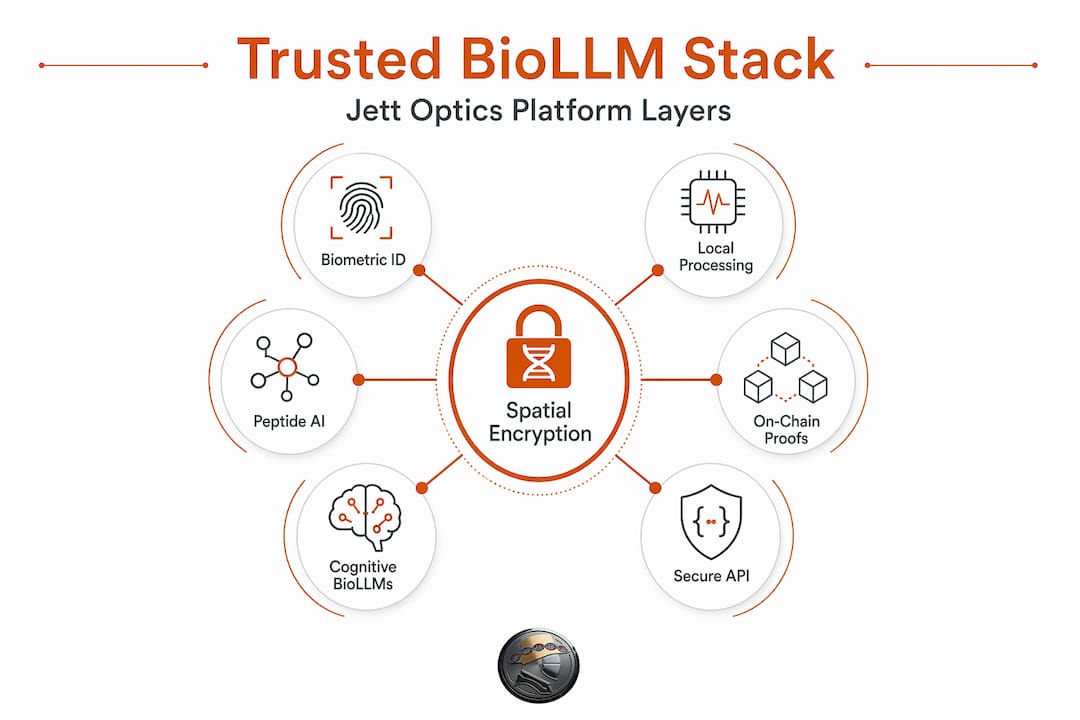
Why integrating optical encryption with cognitive BioLLMs matters for biotech and cybersecurity investors
Here is the observation most platform evaluations miss: front-end UX is not the differentiator in cognitive BioLLM deployments. The differentiator is what happens below the interface. Session trust, memory semantics, entropy-weighted biometric verification, and on-chain proof finalization are the mechanisms that determine whether a platform is defensible in regulated, high-stakes environments.
Most AI platforms treat authentication as a prerequisite, something to solve once and then set aside. Jett Optics treats it as a continuous, entropy-generating process that adds verifiable signal to every session. That distinction has compounding consequences. Each verified interaction enriches the on-chain identity record. Each enriched record increases the cost of impersonation. Each increase in impersonation cost improves the reliability of the clinical or research data attributed to that identity.
Cognitive BioLLMs operating without this infrastructure are generating clinically valuable outputs tied to unverified sessions. That is a liability, not an asset. The spatial computing trust infrastructure Jett Optics provides converts that liability into an auditable, on-chain verified asset.
For peptide research, the value proposition is different but equally concrete. Constrained, objective-aligned AI optimization is only as valuable as the security of the data informing the surrogate model. If MIC assay data is compromised or spoofed, the optimization loop converges on false objectives. The biometric tech competitive advantage that Jett Optics provides is not just authentication. It is data provenance, secured at the infrastructure level.
Investors who evaluate Jett Optics purely as a biometric authentication vendor are underestimating the platform. The actual value is in the full stack: optical encryption, cognitive augmentation, and on-chain trust protocols operating as an integrated system.
Explore Jett Optics’ solutions empowering cognitive BioLLMs and peptide research
Jett Optics has built a product suite that translates the technical architecture described throughout this article into deployable solutions for biotech and cybersecurity organizations.
JettChat encrypted messaging provides gaze-authenticated secure communication built on the same AGT verification framework that powers BioLLM session trust. The spatial encryption solutions platform delivers post-quantum encryption infrastructure tailored for biological AI data pipelines, supporting both streaming API access and secure data handling at scale. OPTX login and authentication enables DePIN-compatible biometric access with entropy-weighted gaze verification integrated directly into your existing authentication flows. The AARON network status dashboard provides real-time transparency into on-chain attestation activity and audit trail data for compliance-conscious institutional deployments. Developer documentation and protocol specifications are available directly through the Jett Optics platform for teams ready to build on this infrastructure.
Frequently asked questions
What is the OPTX ecosystem and how does it enhance cognitive BioLLMs?
The OPTX ecosystem is a privacy-preserving spatial encryption platform that provides advanced API bridges with streaming chat and pluggable memory backends, giving cognitive BioLLMs the session continuity and secure data handling they require for production clinical deployments. Its modular design allows new AI reasoning modules to be integrated without restructuring the authentication layer.
How does Jett Optics use biometric gaze authentication in identity verification?
Jett Optics decomposes gaze into AGT tensors across cognitive, emotional, and environmental regions, deriving verification strength from entropy measured across the full tensor weight distribution rather than single-point biometric hashes, producing on-chain identity proofs that are highly resistant to replay and spoofing attacks.
What improvements do cognitive layers bring to large language models in psychotherapy?
Cognitive layers enable LLMs to activate specialized clinical reasoning pathways, with research showing that augmented cognitive layer LLMs outperform both standalone models and human clinicians in clinical competencies, with measurable symptom improvement and long-term recovery benefits observed across real-world deployments.
How does ApexGO optimize peptide antibiotics using AI?
ApexGO maps template peptides into a continuous latent space using a transformer VAE with Bayesian optimization, targeting MIC improvement as the primary objective with uncertainty-quantified candidate ranking, producing results validated through in vitro assays and preclinical mouse infection models.
What role does the JTX-CSTB protocol play in secure biometric identity?
JTX-CSTB manages time-limited attestation handshakes that combine biometric gaze proofs with computational hashes and finalize verified identity on-chain via Solana, enabling OPTX token minting as proof of human-compute interaction while enforcing UX-aware latency constraints and replay attack resistance throughout the session lifecycle.